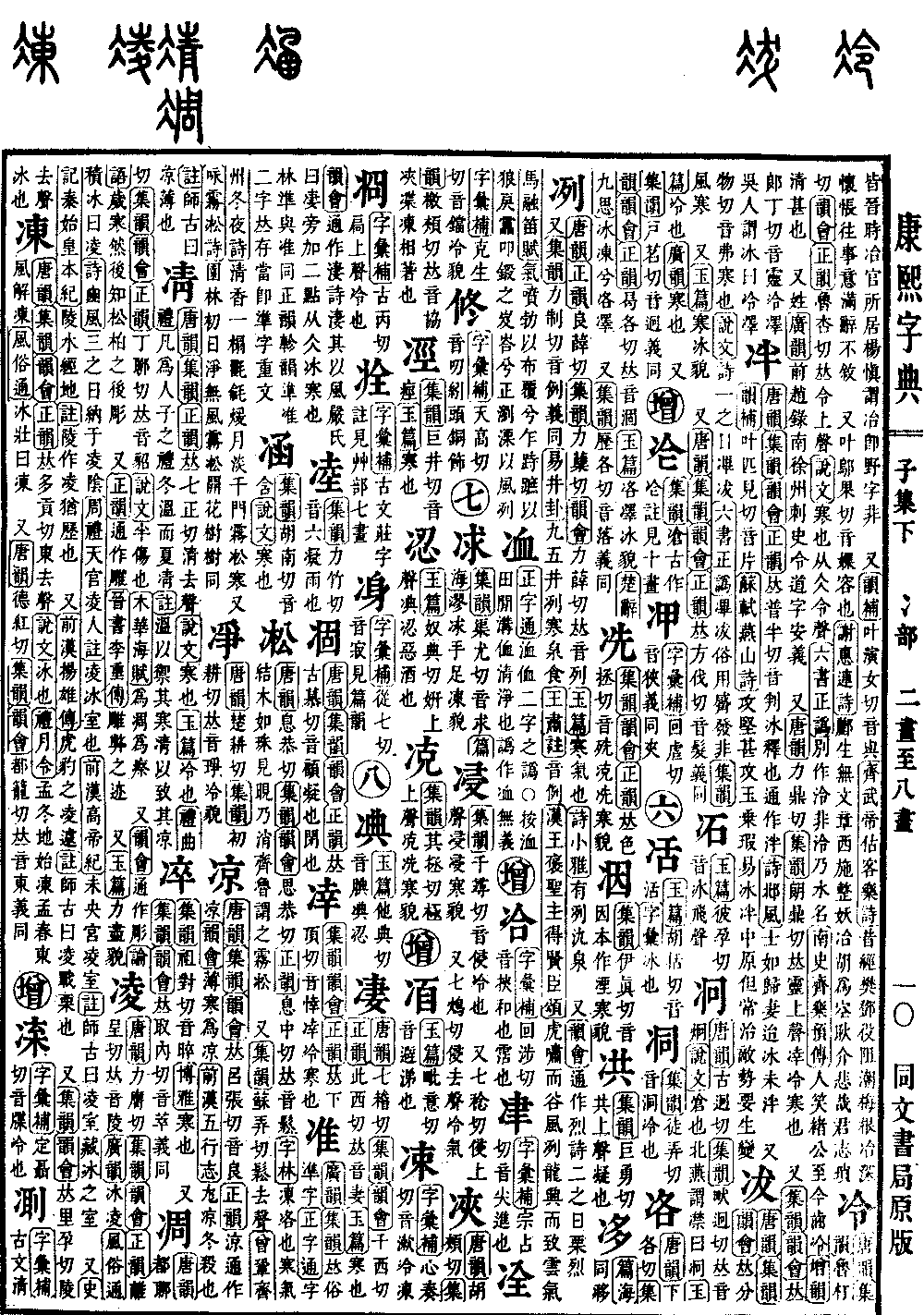
Zi Collection, Page Position: Lower
Radical: Ice (bīng)
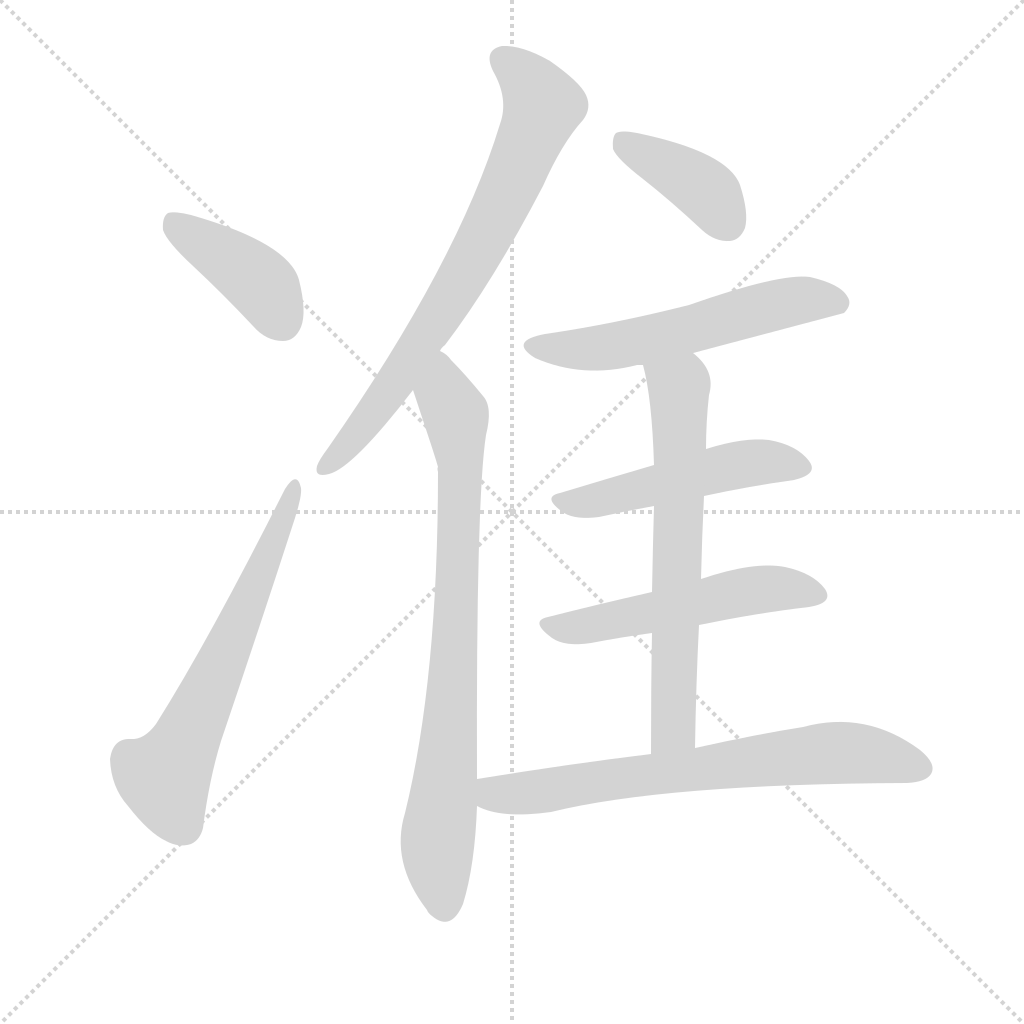
zhǔn
Strokes: 10
Page 132, Entry 37
According to the Broad Rhymes (Guangyun) and Collected Rhymes (Jiyun), this character is the common written form of the character zhǔn. The Correct Character Mastery (Zhengzitong) notes that the Grove of Characters (Zilin) records the standard form and this common form as identical. The Correct Rhymes (Zhengyun) lists both forms under the zhěn rhyme, indicating this should be considered a variant form of the standard character zhǔn.
For the standard form of the character: The Tang Rhymes (Tangyun) and Correct Rhymes give the pronunciation as the fanqie (rhyme spelling) zhī-yǔn. The Collected Rhymes and Rhyme Assembly (Yunhui) give the pronunciation as the fanqie zhǔ-yǐn, sounding like the word zhūn in the rising tone. The Explaining Graphs and Analyzing Characters (Shuowen Jiezi) defines it as level. The Treatise on Rhythm and the Calendar (Lulizhi) in the Book of the Former Han (Qianhan Shu) states that when a blackened string is pulled taut, it creates a standard. This term refers to a tool used to measure levelness and ensure uprightness. The Establishment of Government (Lizheng) chapter in the Book of Documents (Shujing) mentions the term zhǔnrén. The Correct Meanings (Zhengyi) explains that zhǔnrén refers to those who uphold the correct laws, meaning judicial officials. It also conveys the meaning of equalizing or averaging. The Monthly Ordinances (Yueling) chapter in the Book of Rites (Liji) mentions first determining levelness and straightness. The Correct Meanings defines this as balancing light and heavy weight. Furthermore, the Records of Trades (Kaogongji) in the Winter Officials section of the Rites of Zhou (Zhouli) says to weigh it first and then level it. The commentary notes this refers to striking and adjusting to make something level and straight. There is also píngzhǔn, which is a Han dynasty official title. Emperor Wu established the Equalization Officer to manage the empire's salt and iron affairs. It also means a standard or to emulate. The Appended Phrases (Xici) in the Classic of Changes (Yijing) states that the Changes align with the standards of heaven and earth. It also refers to a musical instrument created by Jing Fang of the Han dynasty used to determine musical scales; it is also written in the common form zhǔn. The Way of Heaven (Tiandao) chapter in the Master Zhuang (Zhuangzi) states that a level surface conforms to the standard, and craftsmen use it as a model. The Grove of Characters says the standard and common forms are identical. Additionally, the Tang Rhymes give the pronunciation as the fanqie zhí-yuè, and the Collected Rhymes, Rhyme Assembly, and Correct Rhymes give it as the fanqie zhū-liè, sounding like the word zhuō. The Annals of Emperor Gaozu (Gaozu Benji) in the Records of the Grand Historian (Shiji) describes the Han Emperor Gaozu as having a prominent zhǔn and a dragon-like countenance. The commentary by Fu Qian says zhǔn refers to the cheekbones, while Wen Ying says it refers to the nose. Also, the Collected Rhymes give a pronunciation of the fanqie shǔ-guǐ and the Correct Rhymes give the fanqie shì-guǐ, sounding like the word shuǐ, which also means level. Another interpretation refers to the ridge of a carriage shaft that does not retain water.
Research on the standard form: The original text of the Records of Trades in the Rites of Zhou reads: level it, then measure it. The commentary notes this refers to striking and adjusting to make it level and straight. Note: This commentary actually applies to the preceding sentence, weigh it first and then level it. Therefore, the sentence level it, then measure it is respectfully corrected to weigh it first and then level it.