Wu Collection, Middle Volume
Radical: Sickness (bìng)
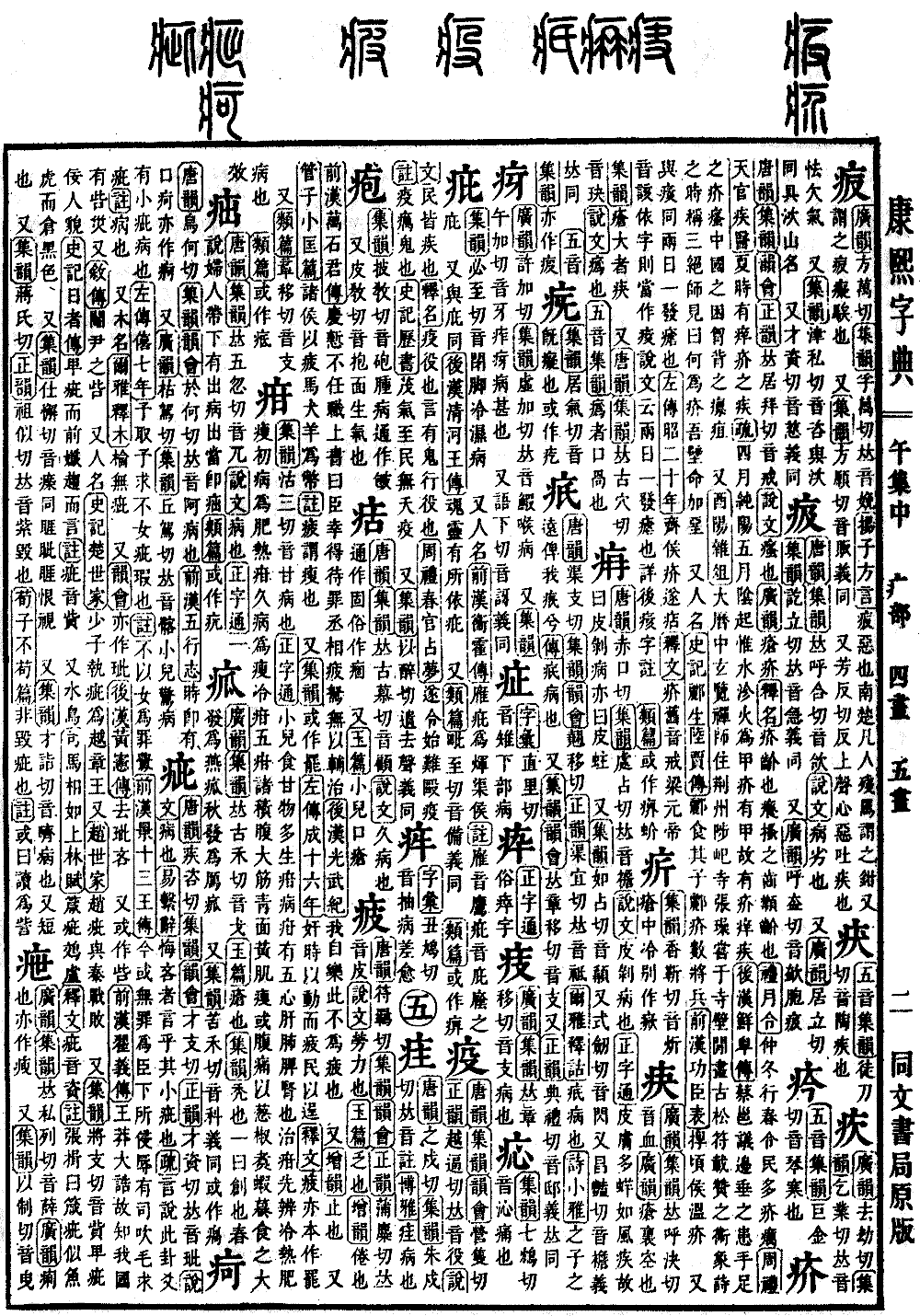
疵
Kangxi strokes: 10
Page 770, Entry 28
Pronounced ci (level tone).
Shuowen Jiezi (Dictionary of Explaining and Analyzing Characters): A sickness.
Book of Changes (Yijing): Regret and stinginess refer to its minor faults.
Commentary: This refers to the small faults and illnesses of the hexagrams and lines.
Zuo Commentary (Zuo Zhuan): What I take and what I seek, I do not find fault with you.
Commentary: Do not treat you as a source of guilt or crime.
History of the Former Han (Qianhan Shu): Now some are without guilt, yet are insulted by subordinates; officials blow apart hair to find faults.
Commentary: Sickness.
Also, a type of tree.
Erya (Approaching Elegance): The elm tree without faults.
Also written as a variant form (ci).
History of the Later Han (Houhan Shu): Remove faults and stinginess.
Also written as a variant form (zi).
History of the Former Han (Qianhan Shu): Wang Mang issued a great proclamation, thus knowing our country had faults and disasters.
Also: The faults of the palace eunuchs.
Used as a personal name.
Records of the Grand Historian (Shiji): The youngest son, Zhi-ci, became the King of Yuezhang.
Records of the Grand Historian (Shiji): Zhao Ci was defeated in battle with the Qin.
Pronounced zi (level tone).
Appearance of a flatterer.
Records of the Grand Historian (Shiji): Flattering and approaching, whispering and speaking.
Commentary: Pronounced zi.
Also, a water bird.
Sima Xiangru, Rhapsody on the Upper Forest (Shanglin Fu): The zhen-ci and the lu.
Exegesis: Pronounced zi.
Commentary: Zhang Yi said: The zhen-ci resembles a fish-tiger and is gray-black.
Pronounced ya (level tone).
Same as the character for glaring, meaning to glare in hatred.
Pronounced ji (level tone).
Sickness. Also, a shortcoming.
Pronounced zi (rising tone).
To slander or defame.
Xunzi: To criticize or slander.
Commentary: Some say it should be read as the character for slandering (zi).