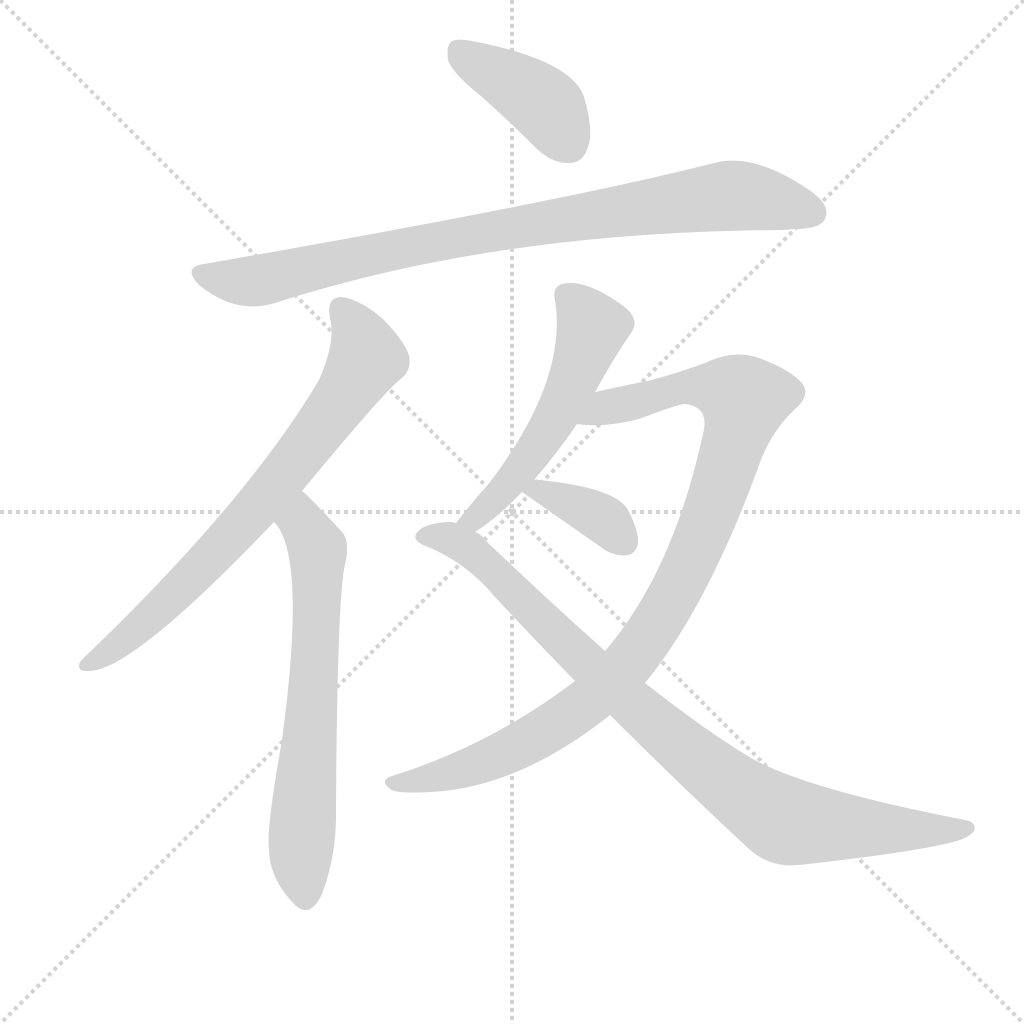
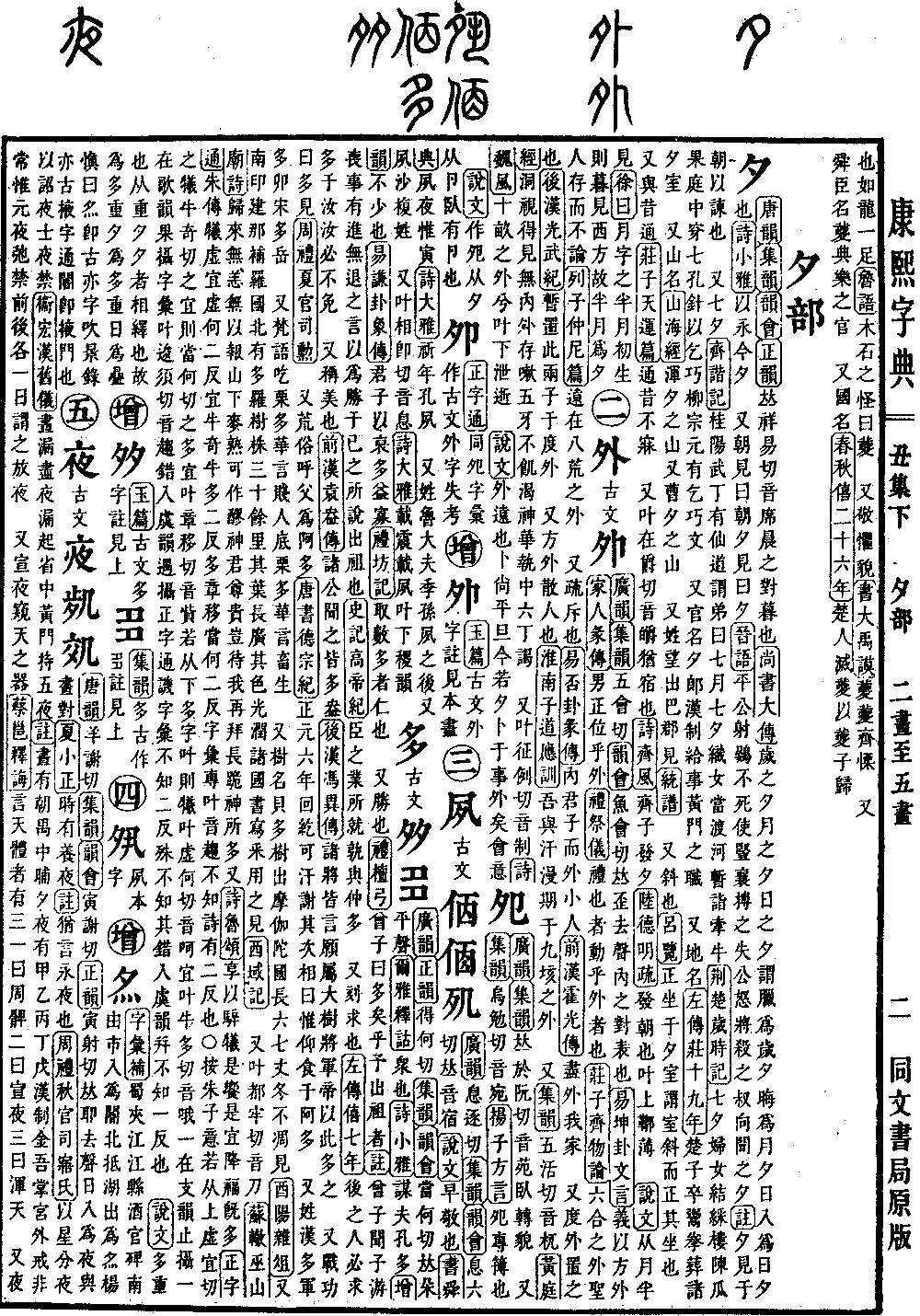
Chou Collection, Lower Volume
Radical: Evening (xī)
Kangxi Strokes: 8
Page 246, Entry 18
Ancient character form.
Pronounced ye (falling tone). The sun setting is night, the opposite of day.
Book of Small Rectifications of the Xia Dynasty (Xia Xiaozheng) mentions: There is the nourishing night.
Note: This means the long night.
Book of Rites: Office of Autumn (Zhou Li, Qiu Guan, Siwu Shi): Determine the night according to the stars and notify the officials in charge of the night to enforce the curfew.
Han Dynasty Old Ceremonies (Han Jiuyi) by Wei Hong: When the day water clock drips dry, the night water clock begins counting; palace eunuchs are on duty for the five night watches.
Note: The day is divided into dawn, morning, afternoon, and evening; the night is divided into the first, second, third, fourth, and fifth watches. Under the Han system, the official known as the Golden Guard (Zhijinwu) managed security outside the palace to guard against emergencies; only during the Lantern Festival, for one day before and after, was the curfew lifted, which was called releasing the night.
There is also the term Profound Night (xuanye), which is an instrument for observing celestial phenomena.
Explanation of Teachings (Shihui) by Cai Yong: There are three theories regarding the celestial bodies: first is the Zhou Shadow (Zhoubi), second is the Profound Night, and third is the Encompassing Sky (Huntian).
There is also Night Bright (yeming), which is an altar for the moon sacrifice.
Book of Rites: Record of Sacrifices (Liji, Jifa): Night Bright is the sacrifice to the moon.
There is also Martial Night Dwelling (wuxuye), the name of a martial dance melody.
Book of Rites: Record of Rituals (Liji, Jitong): In terms of dance, there is nothing more important than Martial Night Dwelling.
There is also Midnight (ziye), the name of a musical piece from the Jin dynasty.
Explanation of the Music Bureau (Yuefu Jieti): Formerly, a woman named Ziye composed this melody; the tune is very mournful.
It is also a country name. The country of Xiye, ten thousand three hundred and fifty li from Chang'an, is found in the History of the Former Han (Qian Hanshu), Records of the Western Regions.
There is also the country of Yelang, located in Bozhou. Found in the Records of Shu (Shuji).
Also, in the Records of the Grand Historian (Shiji), Xia Dynasty Annals: Xia Jie excavated a pond and built the Night Palace.
There is also Envoy Night (shiye), a name for female palace officials in the Han dynasty, found in the Biography of Imperial Relatives.
There is also Buye, a city name, located in the Western Xia region.
Poems by Du Fu state: Without wind, clouds cross the border; the sleepless city faces the pass.
Record of Things Heard and Seen (Shaoshi Wenjianlu): The windless pass and the sleepless city are places in Western Xia, where Wang Zhao managed the western frontier.
Records of Qi Lands (Qidi Ji): There is a sleepless city in the land of Qi. In ancient times, there was light shining day and night on the eastern border; the son of Lai built this city and used Sleepless (buye) as its name.
The tomb is called the night platform, also known as the long night.
Ancient Poems state: Build this long night chamber.
There is also Auspicious Night (jiaye), a name of a grass.
History of the Former Han (Qian Hanshu), Records of Rituals and Music: Songs for Suburban Sacrifices: Holding the auspicious night, the orchid is fragrant.
Note: Holding refers to grasping. Auspicious night is a fragrant grass.
Yang Shen, in his work Transferred Meanings (Zhuanzhu), writes it as liquid, which is incorrect.
It is also a surname, found in the Comprehensive Records (Tongzhi).
Also, as recorded in the Rhyme Collection (Jiyun), it is pronounced yi (even tone). It is the name of a county in the Donghai commandery.
Also pronounced ti (falling tone). In the Liezi, Tang Questions chapter, Shi Kuang was picking his ear in the night and listening closely, but could not hear the sound, found in the Ancient and Modern Transferred Meanings (Gujin Zhuanzhu).
It also functions as a rhyme in the Yu category.
Qu Yuan, in the Encountering Sorrow (Lisao): I ordered the phoenix to soar, following through day and night; the whirlwind gathered as they parted, leading the clouds and rainbows to arrive as a carriage.
It also formerly rhymed with the Ge category.
Lin, in the Repository of Arms (Wuku Fu): A thousand followers chanted together, a billion men sought to harmonize; the sound echoed to move the mountains, the light shone to illuminate the night. In the character dictionaries, it is written as ye (leaf), which is incorrect.
Also, as a rhyming character, it is pronounced yu (even tone).
Book of Odes (Shijing), Tang Odes: The days of summer, the nights of winter. It rhymes with the character residence in the following line, where residence is pronounced as a variant of occupy.
Also, as a rhyming character, it is pronounced yue (entering tone).
Book of Odes (Shijing), Lesser Odes: The three high-ranking officials are not willing to serve from early morning to night. It rhymes with the character evil in the following line.
Explanation of Graphs and Analysis of Characters (Shuowen Jiezi): Night is a place of stopping and resting, where the people of the world cease their activities and rest. The character structure is derived from evening, and it is a phonetic compound; it is also written in a variant form.
Correction: The original text of the Explanation of Graphs and Analysis of Characters incorrectly stated it meant to hold or shelter. I have corrected it according to the original text to reflect that it is night.