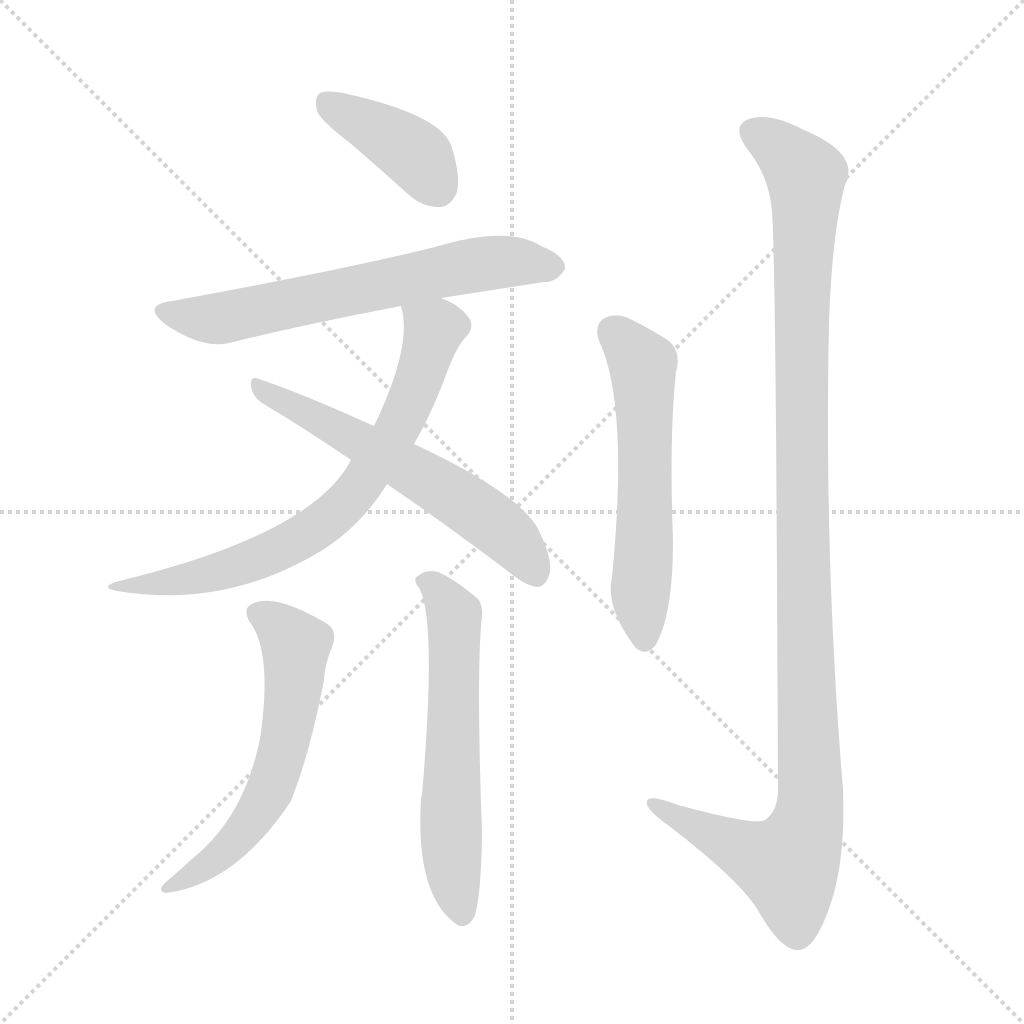
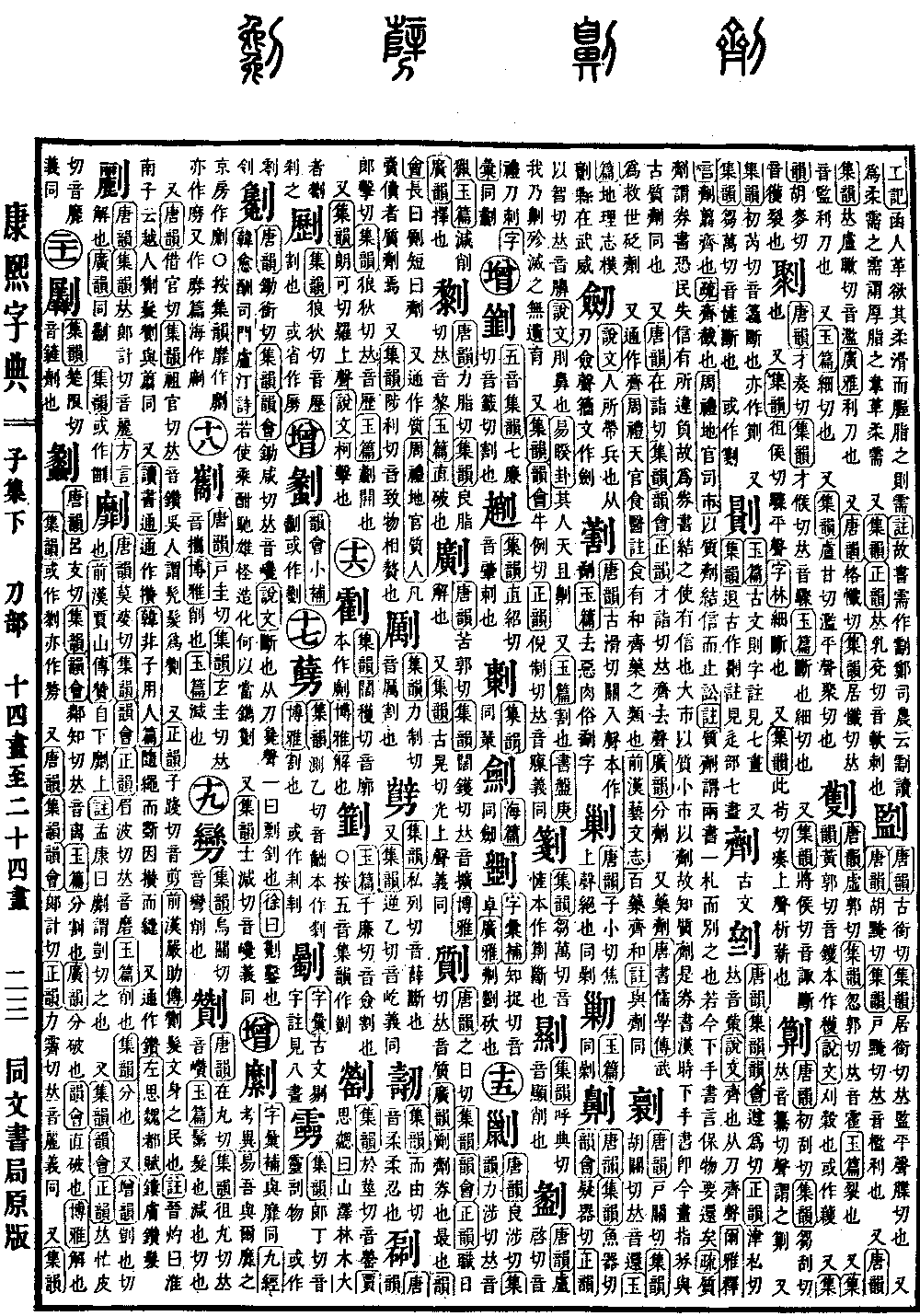
Zi Collection, Page Position: Lower
Radical: Knife (dāo)
jì
Kangxi Strokes: 16
Page Number: 145
Ancient form. According to Tang Rhymes (Tangyun), Collected Rhymes (Jiyun), and Rhyme Assembly (Yunhui), the pronunciation is based on the fanqie (a system of indicating pronunciation) zūn wéi. According to Correct Rhymes (Zhengyun), it is based on the fanqie jīn sī. The sound is that of evening or leveling.
Explanations of Characters (Shuowen Jiezi): To make even or level. It is derived from the radical Knife (dāo), and the element qí provides the sound.
Approaching the Correct (Erya), Explaining Words: The character jì means to trim and level.
Sub-commentary: To cut or level.
Rites of Zhou (Zhouli), Ministry of the Earth (Diguan), Market Superintendent: Using contracts (zhìjì) to establish trust and end litigation.
Note: The term zhìjì refers to writing two copies of an agreement on a single tablet and then splitting it. It is like the hand-written deeds of today, ensuring that goods are returned.
Sub-commentary: Zhìjì refers to written contracts. Fearing that the people might lose trust or fail to fulfill obligations, written contracts were used to bind them and ensure faith. Large markets used the zhì contract, and small markets used the jì contract; thus we know that zhìjì are types of written contracts. The hand-written deeds of the Han Dynasty, which are what we now call signed finger-contracts, are the same as the ancient zhìjì.
Also, according to Tang Rhymes, Collected Rhymes, Rhyme Assembly, and Correct Rhymes, the pronunciation is based on the fanqie zài yì or cái yì, which is the departing tone of the sound qí.
Broad Rhymes (Guangyun): To divide or apportion.
Also refers to medicinal preparations.
Book of Tang (Tangshu), Biographies of Confucian Scholars (Ruxue Zhuan): Wu acted as a corrective treatment and medicinal dose (biān jì) to save the world.
Also used interchangeably with the character qí.
Rites of Zhou, Ministry of Heaven (Tianguan), Note to the Dietary Physician: Food includes the blending of medicinal substances and the like.
History of the Former Han (Qian Hanshu), Treatise on Literature (Yiwen Zhi): The blending of a hundred medicines.
Note: This is the same as the character jì.