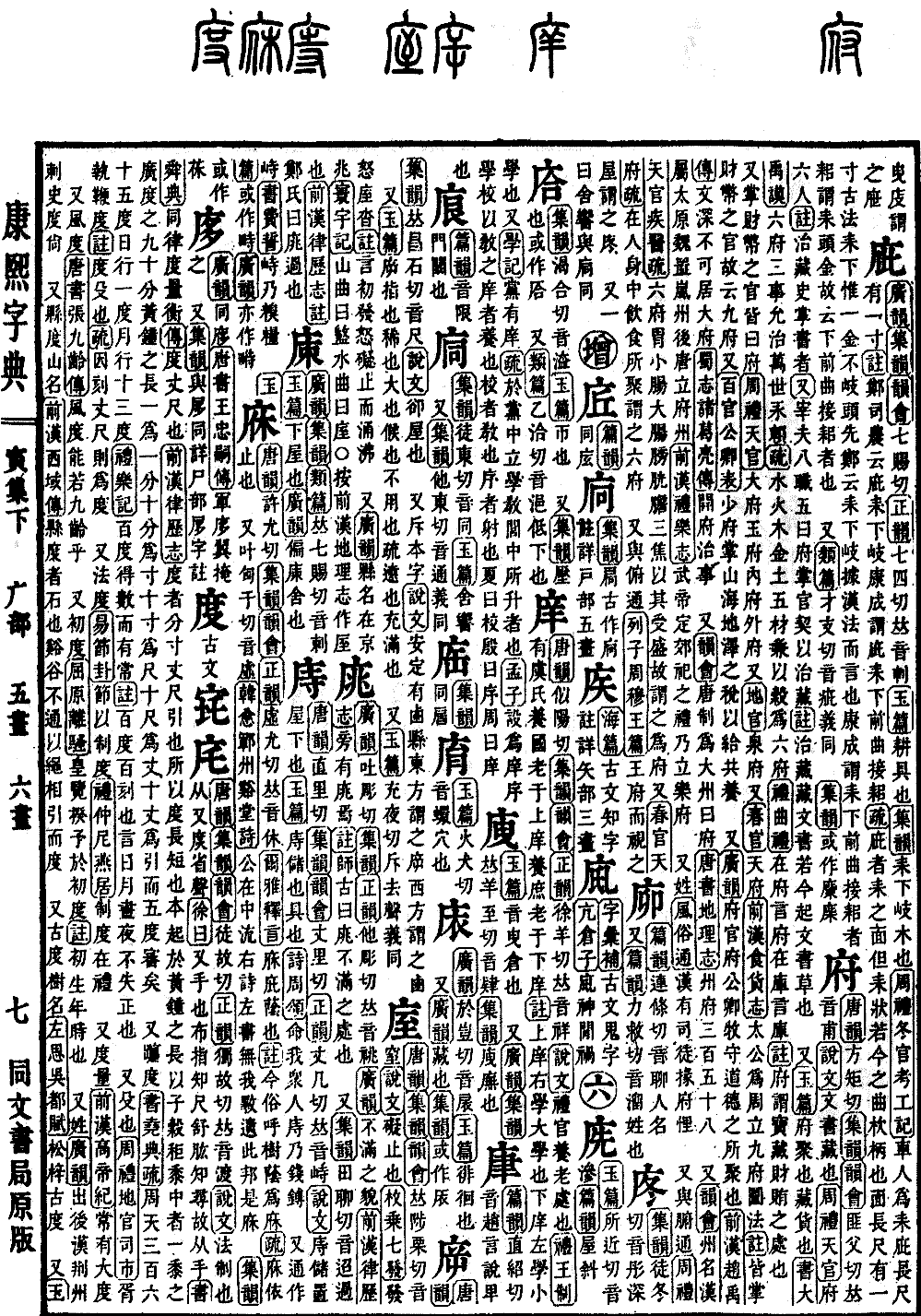
Yin Collection, Lower Volume
Radical: Broad (guǎng)
Kangxi Strokes: 8
Page 345, Entry 02
Pronounced fǔ.
Shuowen Jiezi (Explaining Graphs and Analyzing Characters): A place to store documents.
Rites of Zhou (Zhouli), Heaven's Officials: Six overseers of the treasury. Commentary: Those who manage the storehouse; historians who oversee documents.
Also: The eight duties of the chamberlain, the fifth being the overseer of the treasury, who manages official contracts to regulate the storehouse. Commentary: Managing the storehouse means storing documents, similar to drafting official documents today.
Also, Yupian (Jade Chapters): An overseer of the treasury is a place of accumulation. It is a storehouse for goods and wealth.
Book of Documents (Shangshu), Counsels of the Great Yu: When the six storehouses and three affairs are truly regulated, all generations will rely on them forever. Commentary: The six storehouses consist of the five elements of water, fire, wood, metal, and earth, combined with grain.
Book of Rites (Liji), Summary of Rites: When in the treasury, speak of the treasury; when in the armory, speak of the armory. Commentary: The treasury refers to the place where precious goods and wealth are stored.
Also, any official who manages wealth and currency is called an overseer of the treasury.
Rites of Zhou, Heaven's Officials: The Grand Treasury, the Jade Treasury, the Inner Treasury, and the Outer Treasury. Also, Earth's Officials: The Currency Treasury. Also, Spring's Officials: The Heavenly Treasury.
Book of Han (Hanshu), Treatise on Food and Money: Taigong established the nine-treasury circular currency system for the Zhou dynasty. Commentary: These were all officials in charge of wealth and currency, hence the name nine treasuries.
Also, Table of Officials and Ministers: The Lesser Treasury managed the taxes on mountains, seas, lands, and marshes to provide for imperial expenses.
Also, Guangyun (Broad Rhymes): An official residence is where officials, ministers, governors, and guardians gather, as do virtue and the Way.
Book of Han, Biography of Zhao Yu: One whose interpretations of the law are too severe should not reside in a major administrative office.
Records of the Three Kingdoms (Sanguozhi), Biography of Zhuge Liang: Established an administrative office to manage affairs.
Also, Yunhui (Collection of Rhymes): Under the Tang system, a major prefecture was called a prefecture.
Old Book of Tang (Tangshu), Treatise on Geography: There were 358 prefectures.
Also, Yunhui: A prefecture name. During the Han dynasty, it belonged to Taiyuan; during the Wei dynasty, Lanzhou was established; in the Later Tang dynasty, Prefecture (Fuzhou) was established.
Book of Han, Treatise on Rites and Music: Emperor Wu established the rites for suburban sacrifices and set up the Music Bureau (Yuefu).
Also, a surname. Custom and Tradition (Fengsu Tong): In the Han dynasty, there was a clerk of the Minister of Works named Fu Kui.
Also, interchangeable with the term for viscera (fǔ).
Rites of Zhou, Heaven's Officials, Commentary on Diseases: The six viscera are the stomach, small intestine, large intestine, bladder, gallbladder, and triple burner; because they receive and contain [food and drink], they are called viscera.
Also, Spring's Officials, Commentary on the Heavenly Treasury: Within the human body, the place where food and drink accumulate is called the six viscera.
Also, interchangeable with bend or bow down (fǔ).
Liezi, Chapter on King Mu of Zhou: The king bowed down and looked at it.