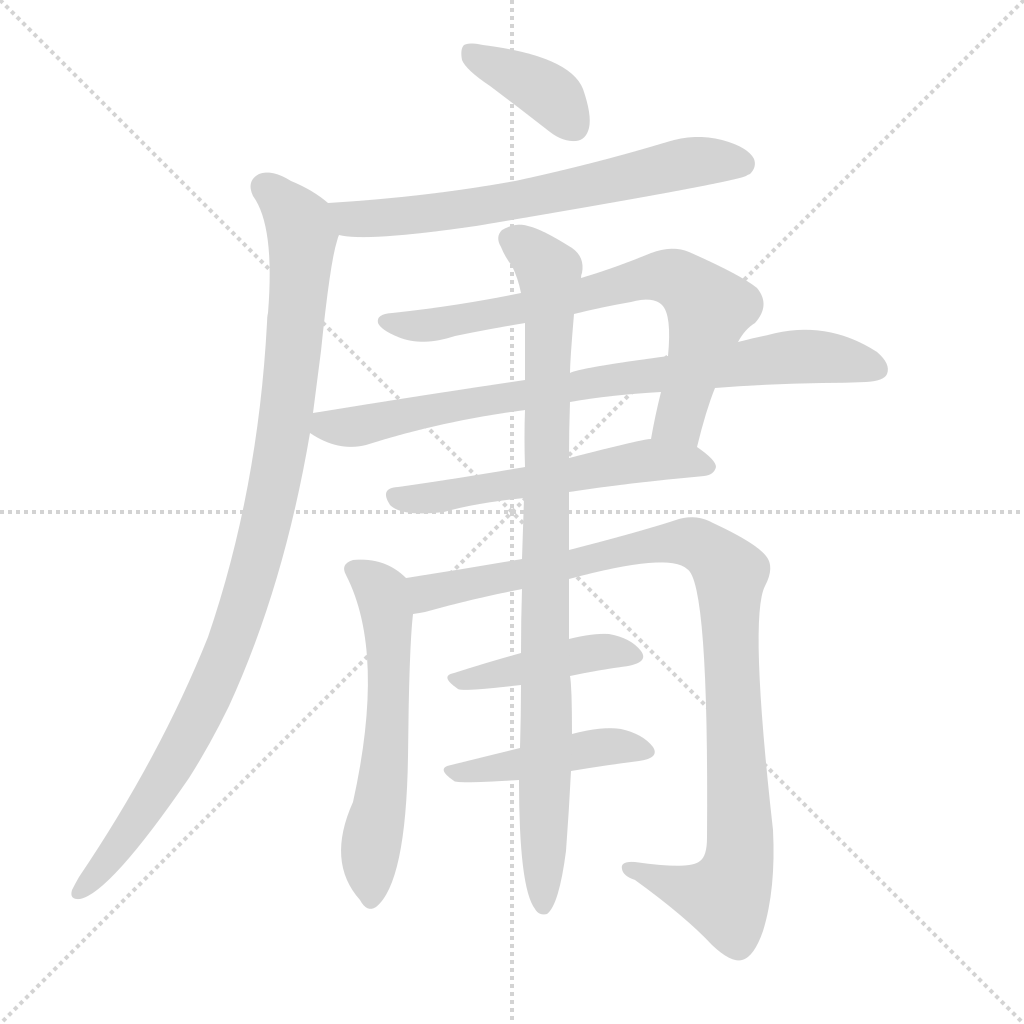
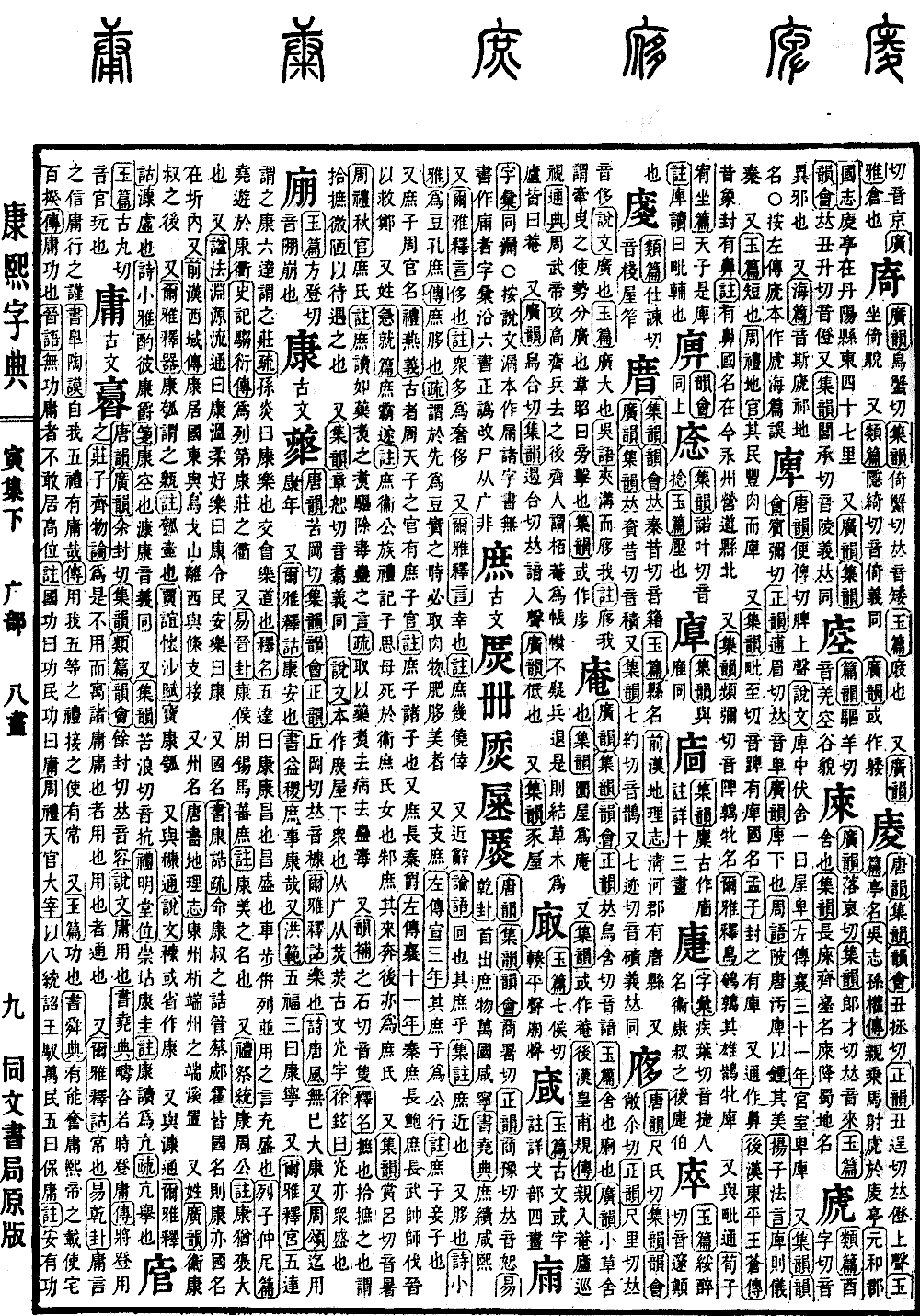
Yin Collection, Lower Volume. Radical: Broad (guǎng). Kangxi strokes: 11. Page 347, Entry 30.
Ancient character. Pronounced yong.
Shuowen Jiezi (Shuowen) states: yong means to use. Book of Documents (Shujing): Ask for someone who is like this to be elevated and used. Commentary: I will elevate and use them. Zhuangzi (Zhuangzi): By not using them, they are placed in yong. Yong is use. Use is to permeate.
Also, Erya (Erya): constant. Book of Changes (Yijing): Sincere in ordinary speech, cautious in ordinary conduct. Book of Documents (Shujing): Have they not been used in my five rituals? Commentary: Use my five ranks of rituals to receive them, so that they have a constant standard.
Also, Yu Pian (Yu Pian): achievement. Book of Documents (Shujing): Those who can exert their achievements and brighten the emperor's enterprises, let them reside in the hundred ministries. Commentary: yong means achievement. Discourses of Jin (Jinyu): Those without achievements and merits dare not occupy high positions. Note: State merits are called gong, while popular merits are called yong. Rites of Zhou (Zhouli): Use the eight unifications to assist the king in governing all people, the fifth is to secure those with achievements. Note: To settle those who have achievements.
Also, Earth Offices: By using achievements to regulate salaries, the people are encouraged to achieve.
Also, Erya (Erya): labor. Commentary: Referring to toil and hardship.
Also, Exegesis of Instructions: yong yong, to labor. Commentary: Those who have achievements and labor are all considered to have toiled. Book of Odes (Shijing): At the beginning of my life, there was still no labor. Commentary: yong means labor.
Also, Guangyun (Guangyun): harmony. Rites of Zhou (Zhouli) Commentary: Because it records that middle-harmony is its use.
Also, Jiyun (Jiyun): foolish. Records of the Grand Historian (Shiji): His talents did not exceed that of the ordinary.
Also, how. Zuo Commentary (Zuozhuan): How is this not being twofold? Book of Han (Hanshu): Even if you are a king of a state, how would it benefit you alone?
Also, the tax system of grain, labor, and cloth. Old Book of Tang (Tangshu): Using the labor of the people, twenty days per year, with two additional days in leap years; those who do not serve labor pay three feet of silk per day, which is called yong.
Also, water channel. Book of Rites (Liji): Sacrificing to the embankments and water channels. Note: Water channels are ditches. Commentary: Embankments are used to store water and also to block water. Channels are used to receive water and also to drain water.
Also, name of a state. Zuo Commentary (Zuozhuan): Chu destroyed the state of Yong. Note: Yong is the present-day Shangyong County, a small state belonging to Chu.
Also, Yongpu, a place name. Zuo Commentary (Zuozhuan): Battle at Yongpu.
Also, a surname. Surname Genealogy (Xingpu): Descendants of the state of Yong adopted the name as their surname. Book of Han (Hanshu): Yong Sheng of Jiaodong.
Also interchangeable with the character meaning a location (yong). Book of Han (Hanshu): Moved the people of Bei, Yong, and Wei to the capital; therefore the poems of the three states of Bei, Yong, and Wei share the same customs. Note: In the Mao commentary of the Book of Odes (Shijing), it is written as Yong.
Also interchangeable with the character meaning a wall (yong). Book of Odes (Shijing): Because of these Xie people, to build your wall. Note: yong means a city wall. Book of Rites (Liji): Being attached to the feudal lords is called being a dependent state. Note: A dependent state is a small city.
Also interchangeable with the character meaning to hire (yong). Book of Han (Hanshu): Poor and destitute, sold his labor in Qi. Note: Shigu states: this refers to being hired to work. Book of Han (Hanshu): Mixed with hired laborers. Note: Shigu states: yong refers to those hired to work, and bao refers to those who are trustworthy.
Also interchangeable with the character meaning a large bell (yong). Book of Odes (Shijing): The bells rang clearly. Commentary: A large bell is called yong.
Also, to rhyme with yang. Fu on the Giant Clam Bowl (Chequwan Fu): Modest without being sharp, gentle and forming a pattern. Virtue combines the holy and wise, conduct responds to the Golden Mean.