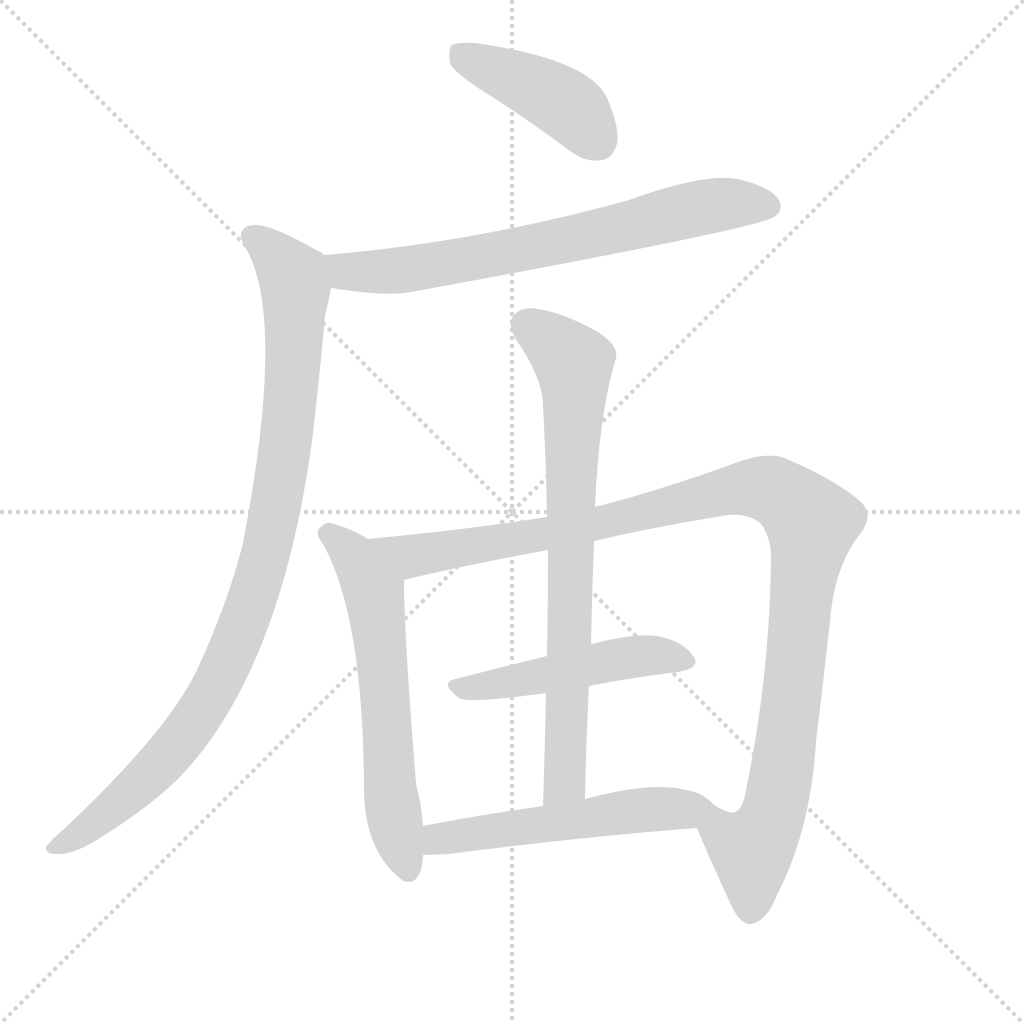
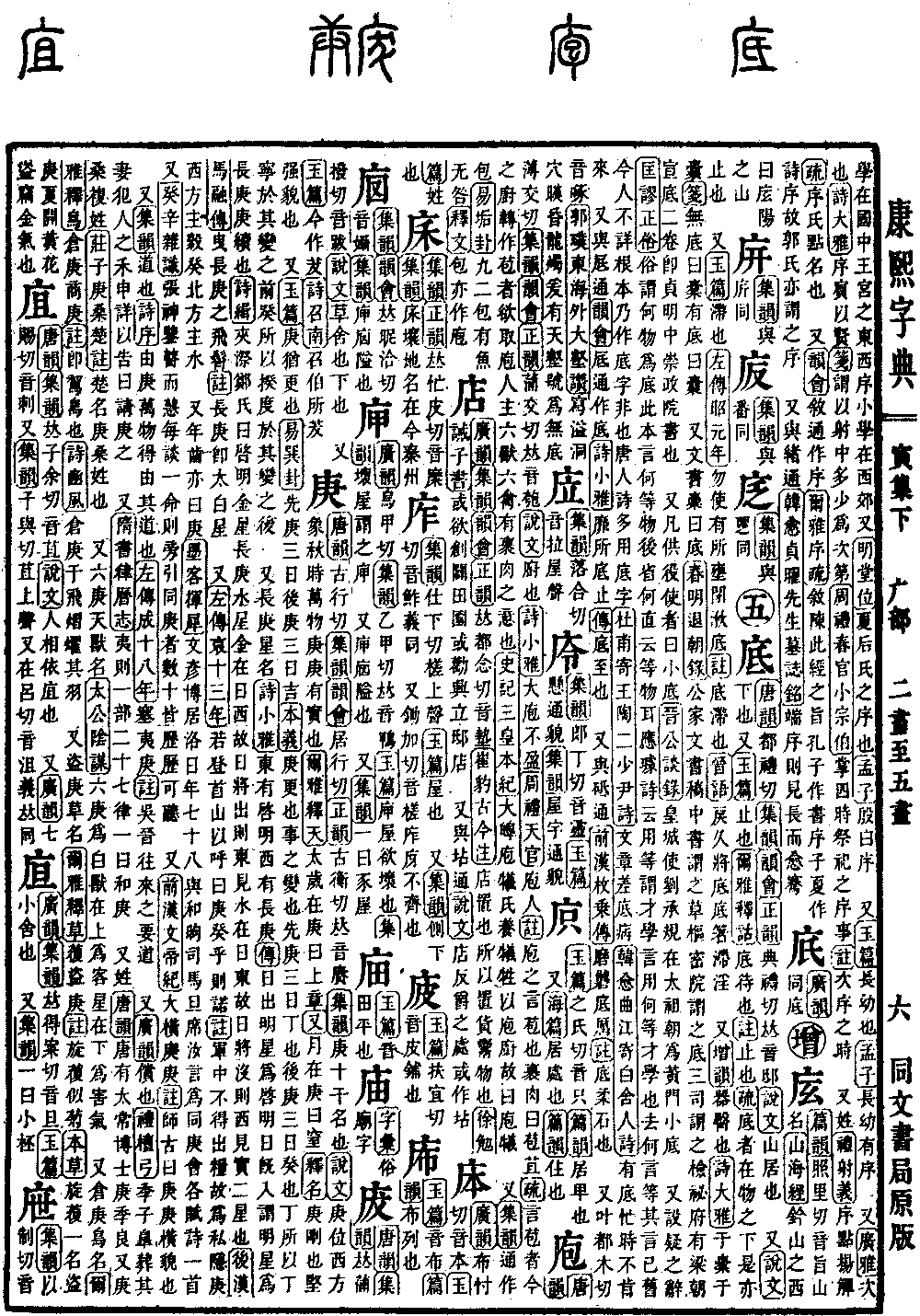
Yin Collection, Lower Volume
Radical: Wide (guǎng)
Kangxi Strokes: 15
Page 344, Entry 20
Dictionary of Characters (Zihui): This is the vulgar form of the character for ancestral temple. The ancient form of the character is written as a variant (miào).
Tang Rhymes (Tangyun), Broad Rhymes (Guangyun), Compendium of Rhymes (Yunhui), and Correct Rhymes (Zhengyun): Pronounced miao (falling tone).
Explanation of Graphs and Analysis of Characters (Shuowen Jiezi): A place to honor and serve the likeness of ancestors.
Commentary on Past and Present (Gujin Zhu): A temple (miao) carries the meaning of appearance (mao), acting as a place to simulate the appearance and physical form of ancestors.
Explanation of Names (Shiming): A place where the forms of ancestors reside.
Jade Book (Yupian): Refers to an ancestral temple.
Approaching the Elegance (Erya), Explanation of Palaces: A building with east and west side rooms is called a temple. Commentary: Refers to the main hall in front of the side chambers. Sub-commentary: Any large house containing east and west side rooms, side chambers, and walls separating the front hall in an orderly fashion is called a temple.
Six Writings (Liushu Gu): The front part of a palace is called a temple, while the back part is called the sleeping quarters (qin). This concept extends to what is now known as the front hall of a royal palace or the reception hall of an official. The ancient Admonition of Yu (Yu Zhen) states: The common people have their sleeping quarters and their temples. The commentary to the Zuo Tradition (Zuo Zhuan) states: Rats do not burrow in sleeping quarters or temples, because they fear humans. In this context, it also refers to the imperial court or the hall of government.
Masters of the Teaching (Wenzhongzi), Chapter on Rites: Even those living in seclusion in the mountains and forests hold ambitions of entering the court to serve. Additionally, any place used to sacrifice to external spirits is also called a temple.
Records of the Grand Historian (Shiji), Treatise on the Feng and Shan Sacrifices: Xinyuan Ping of the Zhao state, using his skill in observing cloud formations, presented himself to the Emperor and claimed there was a divine aura northeast of Chang'an appearing in five colors, upon which the Emperor constructed the Five Emperors Temple at Weiyang.