Wu Collection, Middle Volume
Radical: Sickness (bìng)
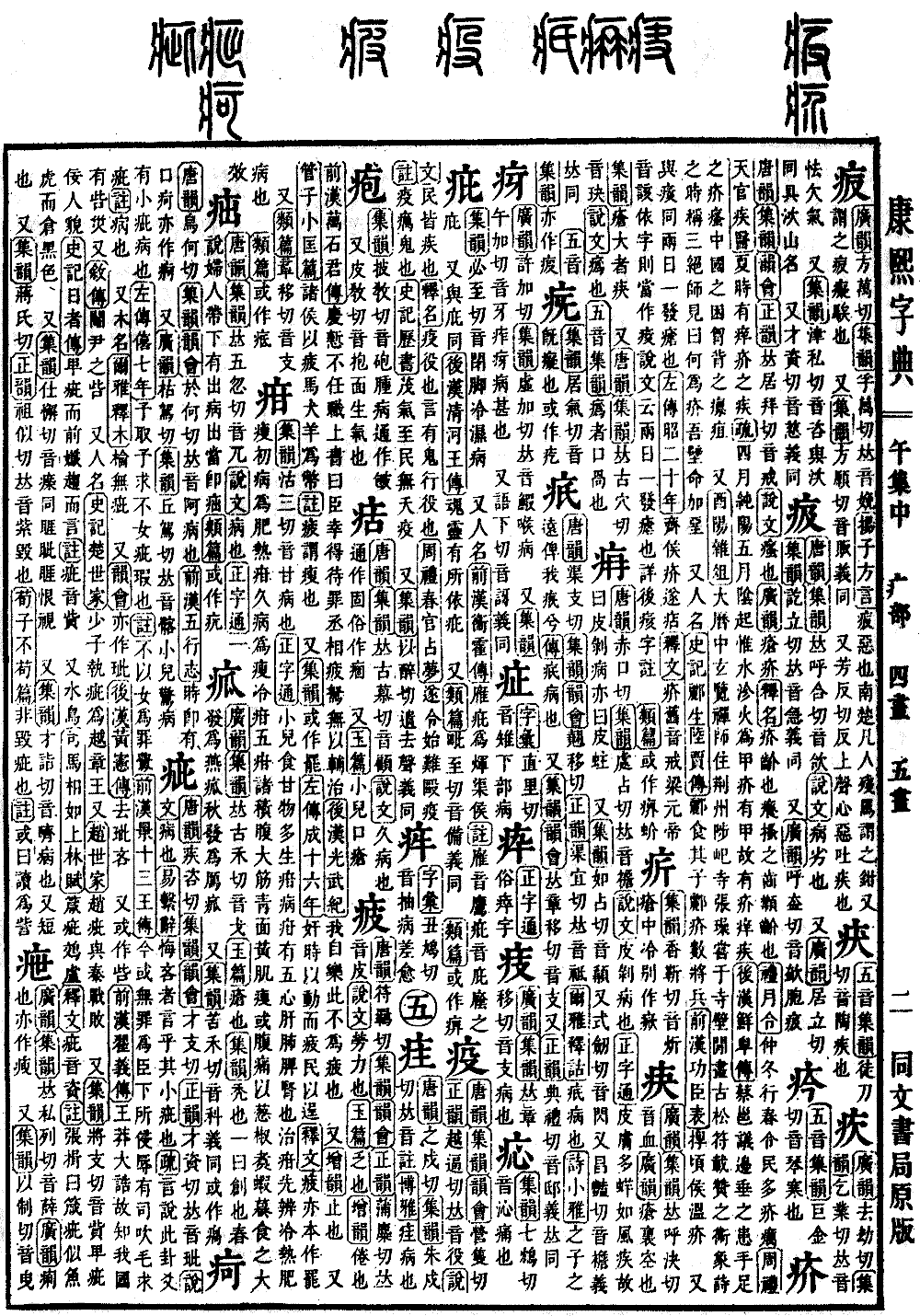
疱; Kangxi strokes: 10; Page 770, Entry 21
According to the Sound-Rhyme Compendium (Jiyun), pronounced pao (falling tone). A swelling affliction. Commonly written as the character pào. Also pronounced bao (falling tone). Refers to a growth or eruption on the face. The original character is formed with the skin radical, not the strike radical.
Pào. According to the Tang Rhyme (Tangyun), pronounced pao (falling tone). According to the Sound-Rhyme Compendium (Jiyun) and the Rhyme Gathering (Yunhui), pronounced pao (falling tone). Also pronounced pao (departing tone). According to the Explaining Graphs and Analyzing Characters (Shuowen), it is a growth or eruption on the face. Xu comments that it is a facial sore. According to the Broad Elegance (Boya), it is a form of illness. According to the Thorough Investigation of Characters (Zhengzitong), any sudden swelling on the hands, feet, arms, or elbows that resembles a water blister is called a pào. According to the Huainanzi (Huainanzi), Book of Forest Discourses (Shuolinxun), Lancing a small blister can lead to the development of a malignant carbuncle. According to Han Yu, Poem on Eating Toads, Although the two legs are long, what can be done about the rugged blisters on the back.
Also, according to the Broad Rhyme (Guangyun), pronounced pao (departing tone). According to the Sound-Rhyme Compendium (Jiyun), pronounced pao (falling tone). The meaning is the same. According to the Sound-Rhyme Compendium (Jiyun), it is also written as pào. It is sometimes also written in a variant form (bāo).