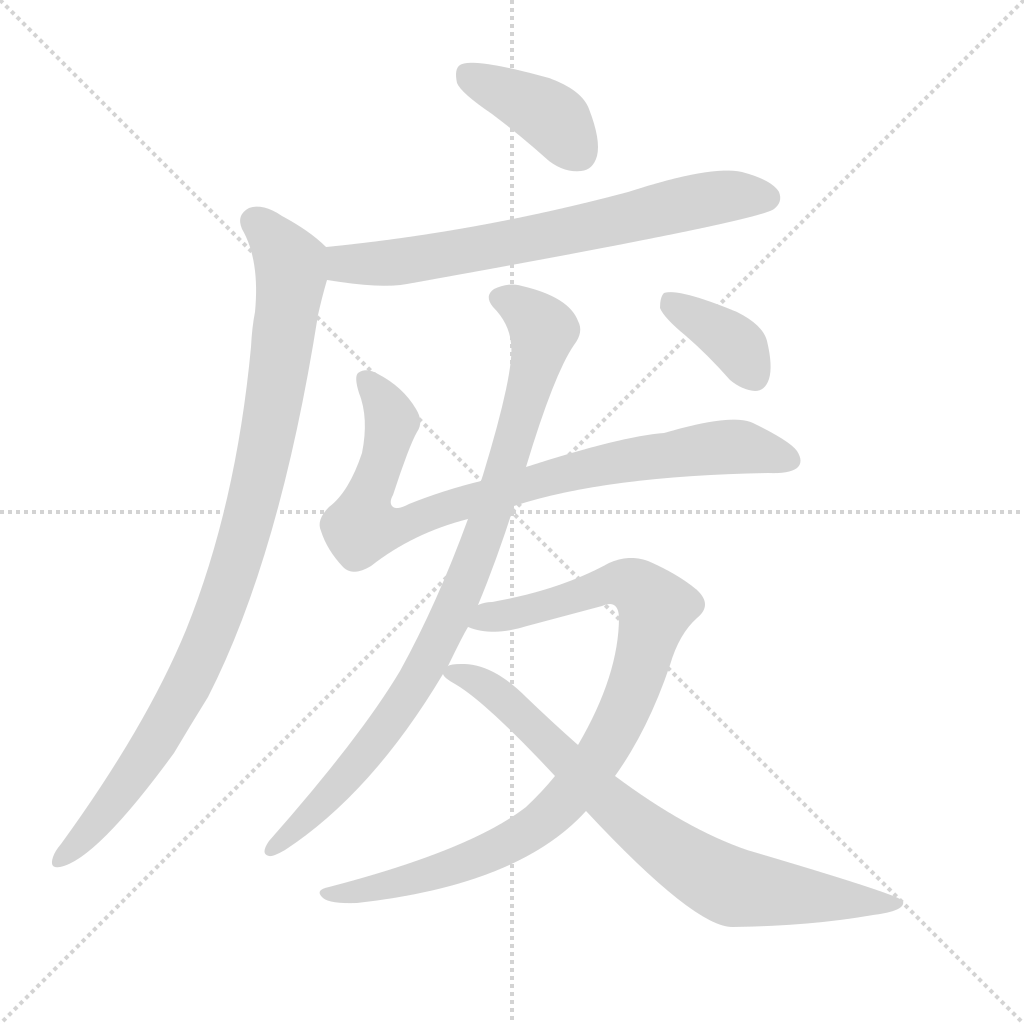
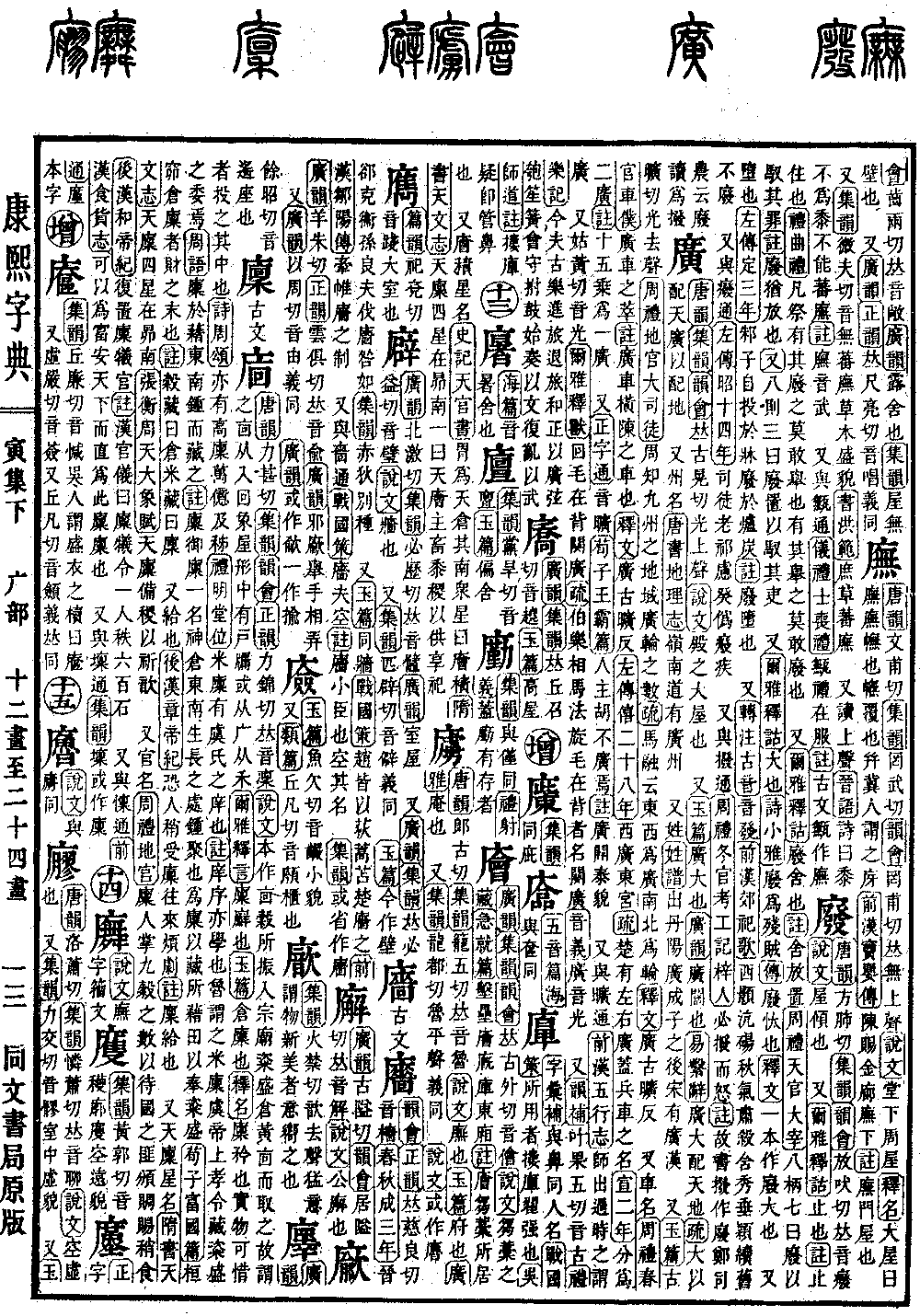
Yin Collection, Lower Volume
Radical: Broad (guǎng)
Kangxi stroke count: 15
Page 351, Entry 02
Pronounced fei (falling tone)
According to the Explaining Graphs and Analyzing Characters (Shuowen Jiezi), it refers to a house collapsing. In the Erya: Explaining Ancient Words (Erya Shigu), it means to stop. The commentary explains this as to cease or halt. In the Book of Rites (Liji): Summary of the Rituals (Quli), it states that if a sacrifice is cancelled, no one dares to initiate it, and if it is initiated, no one dares to cancel it. Also, in the Erya: Explaining Ancient Words (Erya Shigu), it means to set aside. The commentary explains this as to place or abandon. In the Rites of Zhou (Zhouli): Officials of Heaven (Tianguan), Grand Master (Dazai), the seven methods of wielding power include one called to dismiss, used to manage criminal behavior. The commentary states that to dismiss is equivalent to to set aside. Another passage mentions that the third of the eight regulations is to dismiss or appoint, used to manage officials. Furthermore, the Erya: Explaining Ancient Words (Erya Shigu) states it means great. In the Book of Odes (Shijing): Minor Odes (Xiaoya), it is used in the phrase to abandon for the sake of harsh taxes. The commentary states that to abandon here means to be excessive. The explanation of the text notes one version uses the character meaning great. It also means to fall. In the Zuo Tradition (Zuozhuan): Third Year of Duke Ding, it is written that the Viscount of Zhu threw himself from his bed and fell onto the charcoal stove. The commentary explains this as to fall. According to the study of ancient sound changes, it is also pronounced fa. In the Book of Han (Hanshu): Hymns for Sacrifices to Heaven and Earth (Jiaosi Ge), it is written that the autumn air is severe and killing, containing beauty and drooping ears of grain, continuing the old without being discarded. It is also used interchangeably with the character for physical ailment. In the Zuo Tradition (Zuozhuan): Fourteenth Year of Duke Zhao, it is written that the Minister of Instruction Lao Qi and Lu Gui feigned a physical ailment. It is also used interchangeably with the character meaning to strike or pull. In the Rites of Zhou (Zhouli): Winter Officials (Dongguan), Record of Trades (Kaogongji), Carpenter (Ziren), it is written that it strikes out in anger. The commentary notes that the original text used the character for discard. Zheng Sinong states that discard should be read as strike. Textual verification: The original text of the Explaining Graphs and Analyzing Characters (Shuowen Jiezi) reads house collapsing, which has been corrected to house in disrepair based on the original. In the Rites of Zhou (Zhouli): Winter Officials (Dongguan), Record of Trades (Kaogongji), Carpenter (Ziren), it is written that it must strike out in anger. Based on the meaning of the original text, the character must may be omitted, but the character for the particle er cannot be omitted. It has been corrected to strike out in anger.