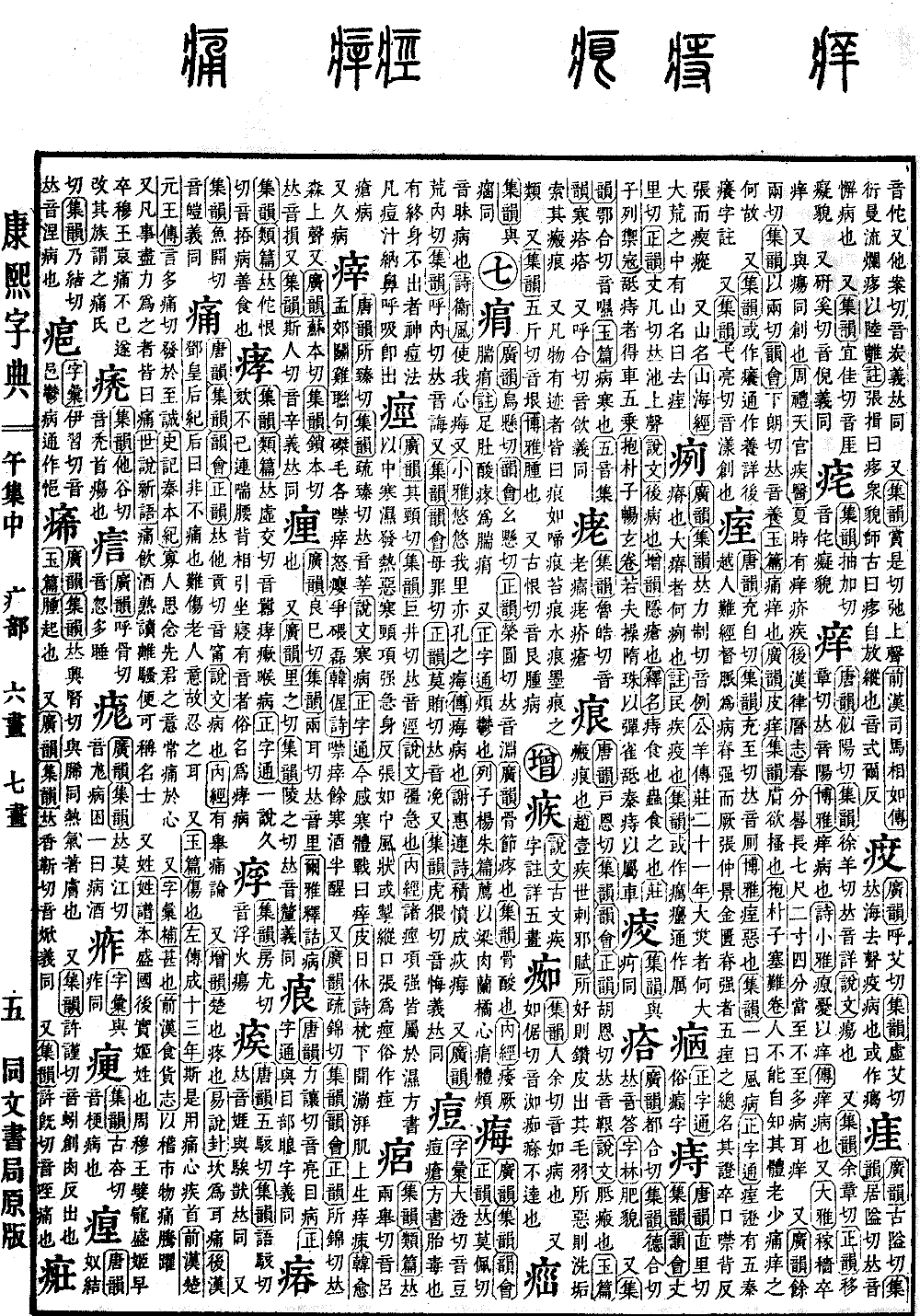
Wu Collection, Middle Volume
Radical: Sickness (bìng)
痛
Kangxi strokes: 12
Page 773, Entry 28
Tang Rhyme (Tangyun), Collected Rhymes (Jiyun), Rhyme Meetings (Yunhui), and Correct Rhymes (Zhengyun): Pronounced tong.
According to Explanation of Simple and Compound Characters (Shuowen), it means illness.
In the Classic of Internal Medicine (Neijing), there is the Discourse on Pain.
Also, in Supplementary Rhymes (Zengyun), it means to suffer, to ache.
In Book of Changes (Yijing), Explanation of the Trigrams: The Trigram of Water represents ear pain.
In History of the Later Han (Hou Hanshu), Biography of Empress Deng: The Empress said, It is not that I do not feel the pain, but I find it difficult to hurt the feelings of the elderly, so I endure it.
Also, in Jade Chapters (Yupian), it means to be injured.
In Zuo Tradition (Zuozhuan), Thirteenth Year of Duke Cheng: Because of this, my heart is pained and my head aches.
In History of the Former Han (Qian Hanshu), Biography of Prince Yuan of Chu: His words were very painful and earnest, emanating from the utmost sincerity.
In Records of the Grand Historian (Shiji), Annals of Qin: The thoughts of my predecessors weigh heavily on my heart.
Also, in Supplement to the Collection of Characters (Zihuibu), it means extreme.
In History of the Former Han (Qian Hanshu), Treatise on Food and Money: Market prices soared extremely high.
Furthermore, when one exerts all one's effort in doing something, it is also called tong.
In A New Account of Tales of the World (Shishuo Xinyu): Drink wine heartily and read the Encountering Sorrow (Lisao) thoroughly, then one may be called a refined scholar.
Also, a surname. In Genealogy of Surnames (Xingpu): Originally from the state of Sheng, the descendants are of the Ji surname. King Mu of Zhou had a beloved consort, Sheng Ji, who died early. King Mu grieved deeply and changed the clan name to the Tong clan.