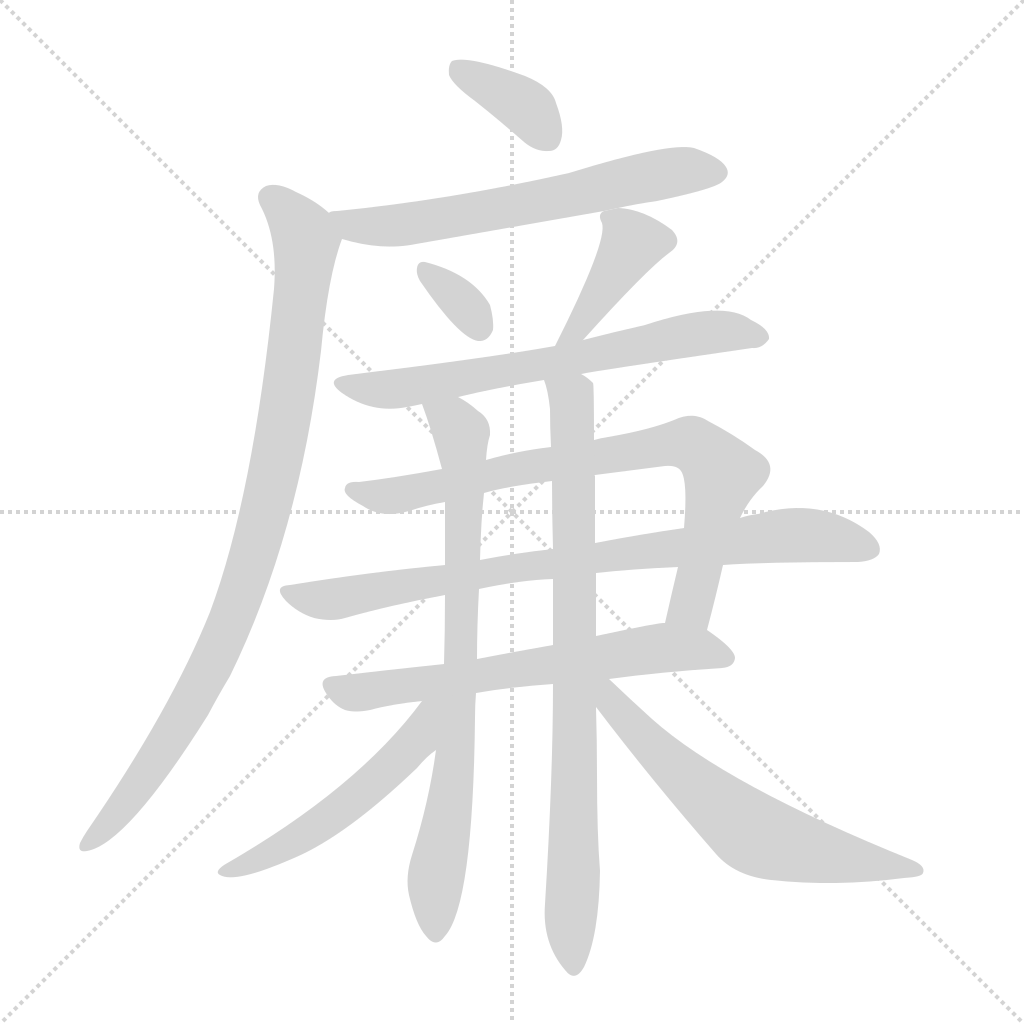
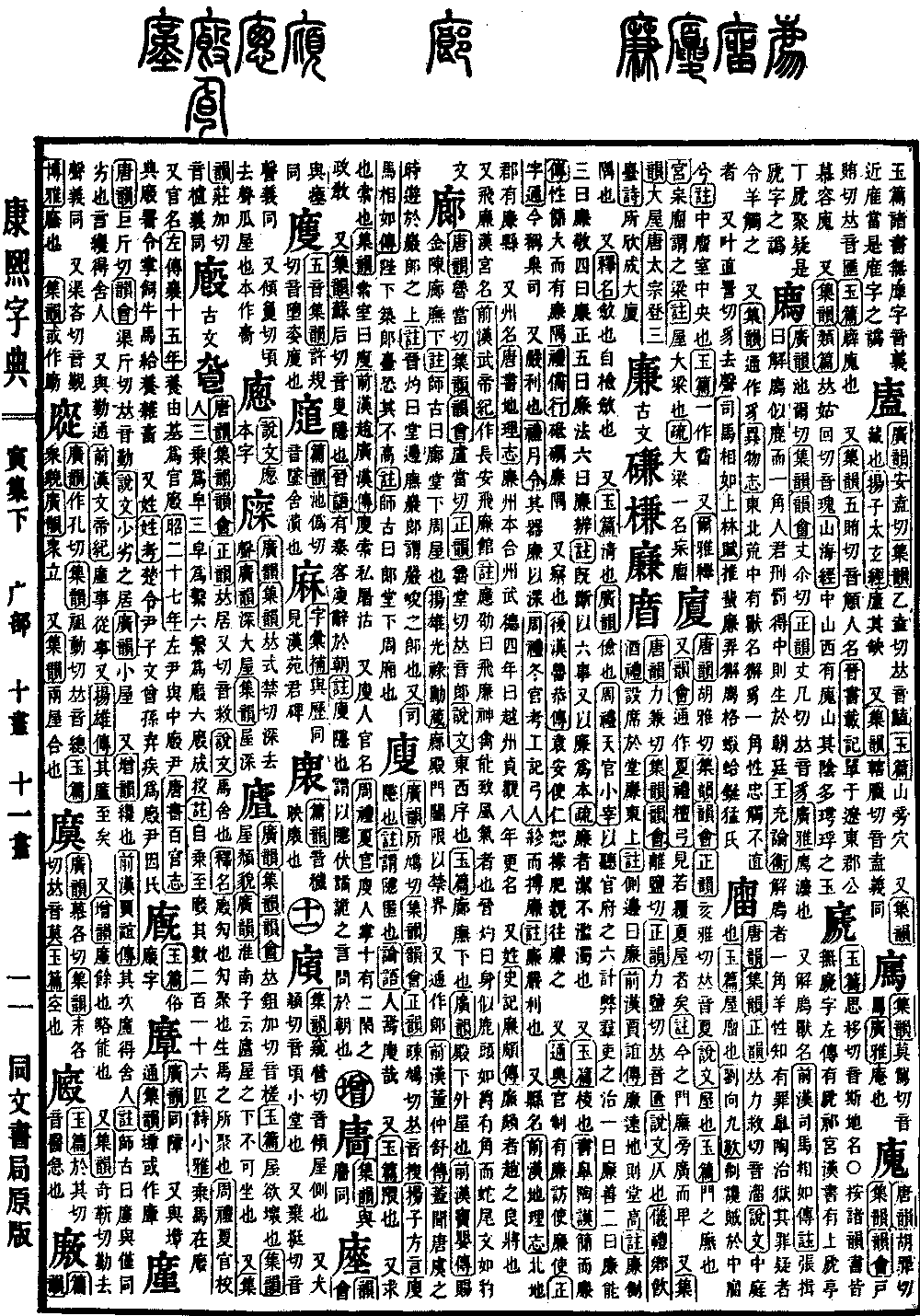
Yin Collection, Lower Volume
Radical: Broad (guǎng)
Kangxi Strokes: 13
Page 349, Entry 08
Archaic forms: 磏, 槏
Pronounced lian (level tone)
According to the Explanation of Characters (Shuowen Jiezi), it means side. In the Book of Etiquette and Ceremonial (Yili), it states: place the mat at the eastern edge of the hall. The commentary explains that the side edge is called lian. In the Biography of Jia Yi from the History of the Former Han (Qian Hanshu), it states: if the edges are far apart, the hall is high. The commentary notes that lian means a side corner.
It also means to restrain, to be self-disciplined.
According to the Jade Chapters (Yupian), it means pure. According to the Extended Rhymes (Guangyun), it means frugal.
In the Rites of Zhou (Zhouli), it mentions the six criteria for evaluating officials: first is pure in virtue, second is pure in ability, third is pure in respect, fourth is pure in rectitude, fifth is pure in adherence to law, and sixth is pure in discernment. The commentary notes that after evaluating these six matters, purity is taken as the foundation. The sub-commentary explains that lian means being clean and not excessive or corrupt.
According to the Jade Chapters, it means sharp-edged. In the Book of Documents (Shujing), it says: and be sharp-edged. The commentary says the nature is great and possesses sharp corners. In the Classic of Rites (Liji), it mentions sharpening the corners.
It also means to investigate. In the Biography of Lu Gong from the History of the Later Han (Hou Hanshu), Yuan An sent his assistant Fei Qin to investigate the matter.
According to the Comprehensive Institutions (Tongdian), the official system includes the titles of lianfangshi and lianshi. The Correct Meaning (Zhengzitong) notes these are now known as the provincial judicial commissioner.
It also means strict or sharp. In the Book of Rites, it states: their vessels are sharp and deep. In the Rites of Zhou, it mentions tightly bound and sharp. The commentary explains that lian means strict and sharp.
It is the name of a county. According to the Treatise on Geography from the History of the Former Han, there was a Lian County in Beidi Commandery.
It is the name of a prefecture. According to the Treatise on Geography from the Old Book of Tang (Tangshu), Lian Prefecture was originally He Prefecture; it was called Yue Prefecture in the fourth year of Wude and renamed in the eighth year of Zhenguan.
It is a surname. In the Biography of Lian Po from the Records of the Grand Historian (Shiji), it mentions Lian Po was a brilliant general of Zhao.
It also refers to Feilian, the name of a Han palace. In the Annals of Emperor Wu from the History of the Former Han, it mentions the Feilian Hall in Chang'an. The commentary of Ying Shao states: Feilian is a divine bird capable of summoning the wind. Jin Zhuo states: its body resembles a deer, its head like a sparrow, with horns and a snake's tail, and its markings like those of a leopard.