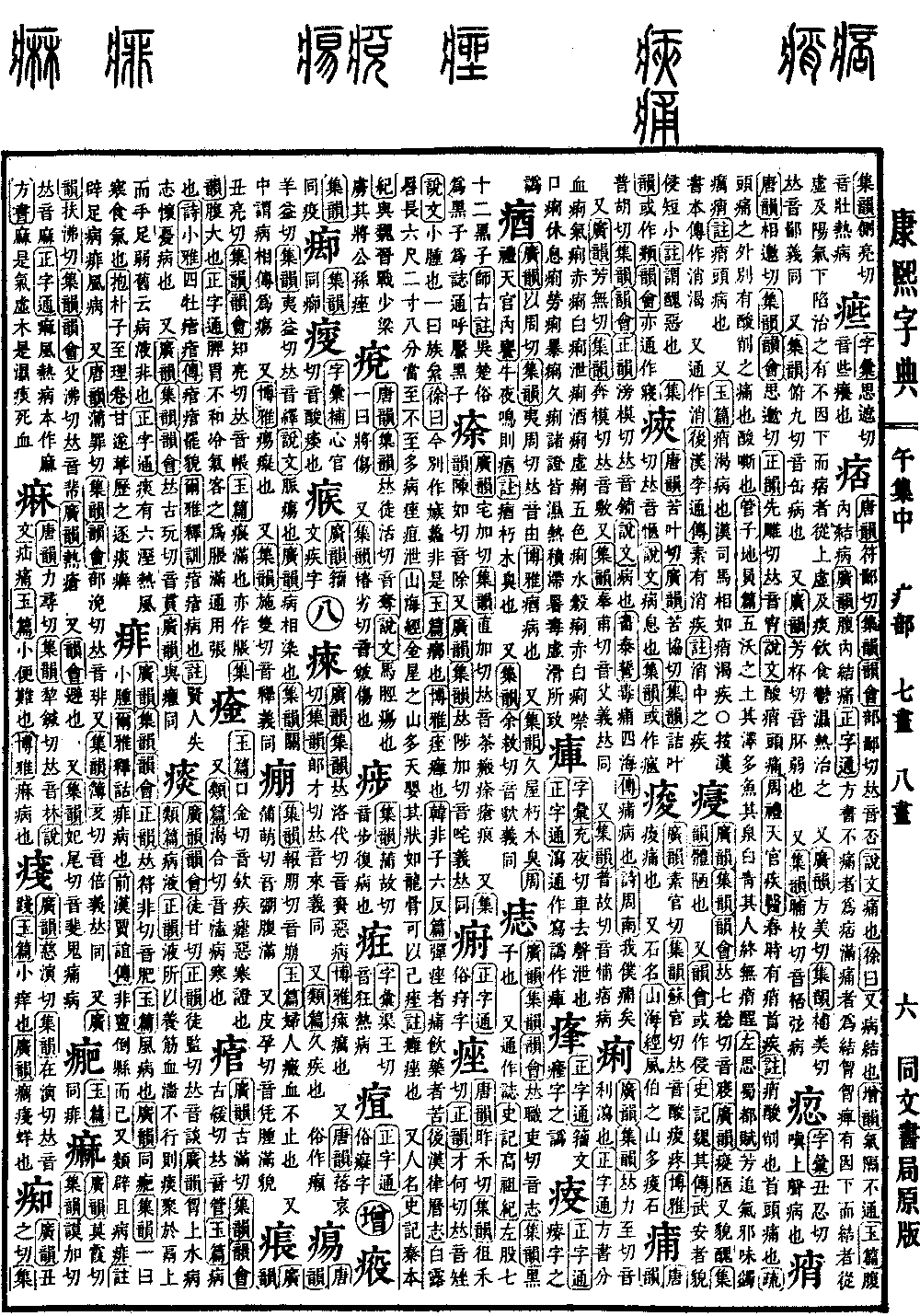
Wu Collection, Middle Volume
Radical: Sickness (bù)
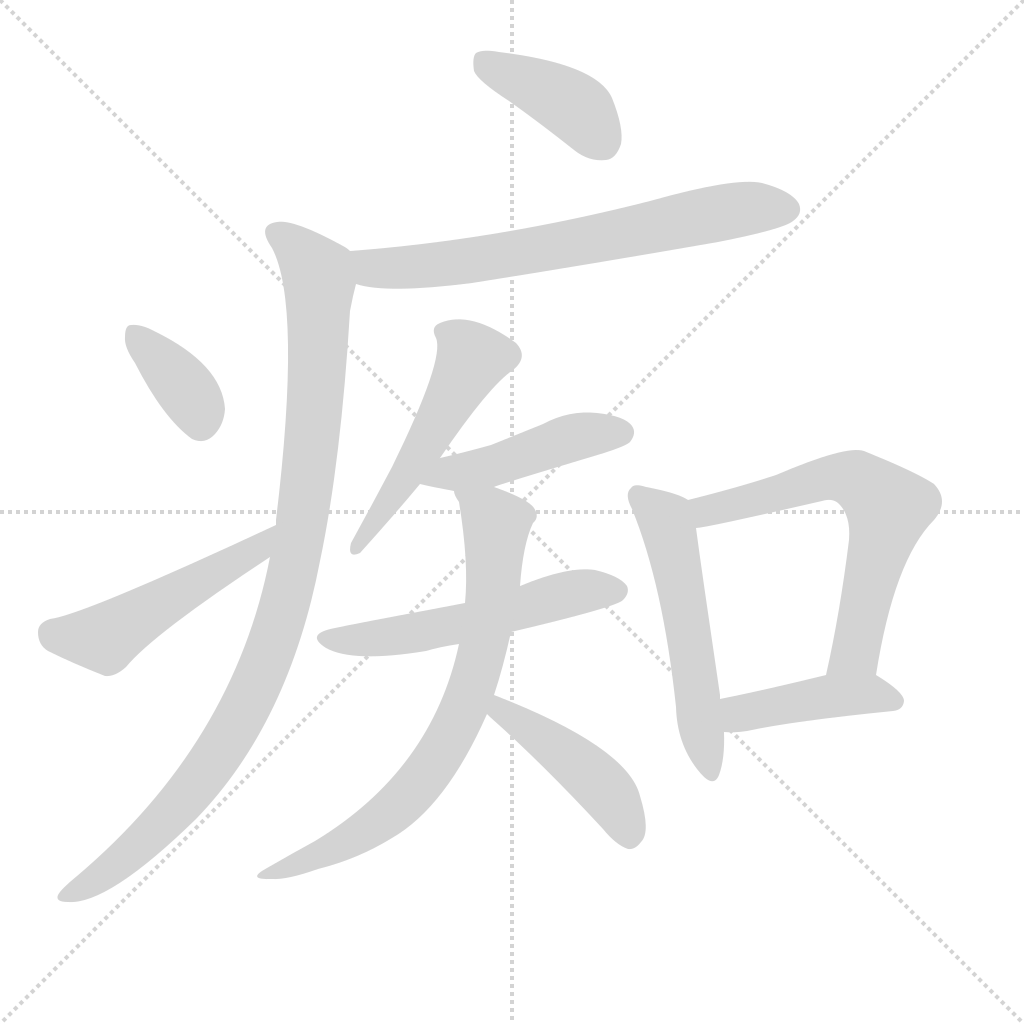
Character: chi
Kangxi strokes: 19
Page 774, Entry 38
Guangyun (Guangyun): Pronounced chi. Chichi, to be sick. Also means dishonest.
Jiyun (Jiyun): Pronounced chi. To be foolish.
Zhengzitong (Zhengzitong): A common variant of the character for foolish.
Jiyun (Jiyun): Pronounced chi. Foolish, lacking understanding.
Foolish.
Tangyun (Tangyun): Pronounced chi.
Jiyun (Jiyun), Yunhui (Yunhui), Zhengyun (Zhengyun): Pronounced chi.
Shuowen (Shuowen): Lacking wisdom.
Xu says: Foolishness is an insufficiency of mental clarity. It also means illness.
Book of Han (Hanshu): Now you alone have ruined your appearance, suffered disgrace, and acted like a madman, with your brilliance dimmed and not proclaimed.
Book of Later Han (Houhanshu): Hou Ba sent an envoy to summon Yan Guang, who said: Master Hou is normally foolish, but he has slightly recovered now.
Book of Jin (Jinshu): Wang Zhan possessed hidden virtues, yet people all considered him foolish.
Also, ancient people borrowed a book and would return it accompanied by a measure of wine as compensation. Sometimes this is also written as chi.
Yiyuan Cihuang (Yiyuan Cihuang): Li Jiweng said: To borrow a book is one instance of foolishness; to cherish a book is two; to demand a book back is three; to return a book is four.
Yanshi Jiaxun (Yanshi Jiaxun): People who lack talent yet consider themselves refined are called holders of the talisman of foolishness in the Jiangnan region.