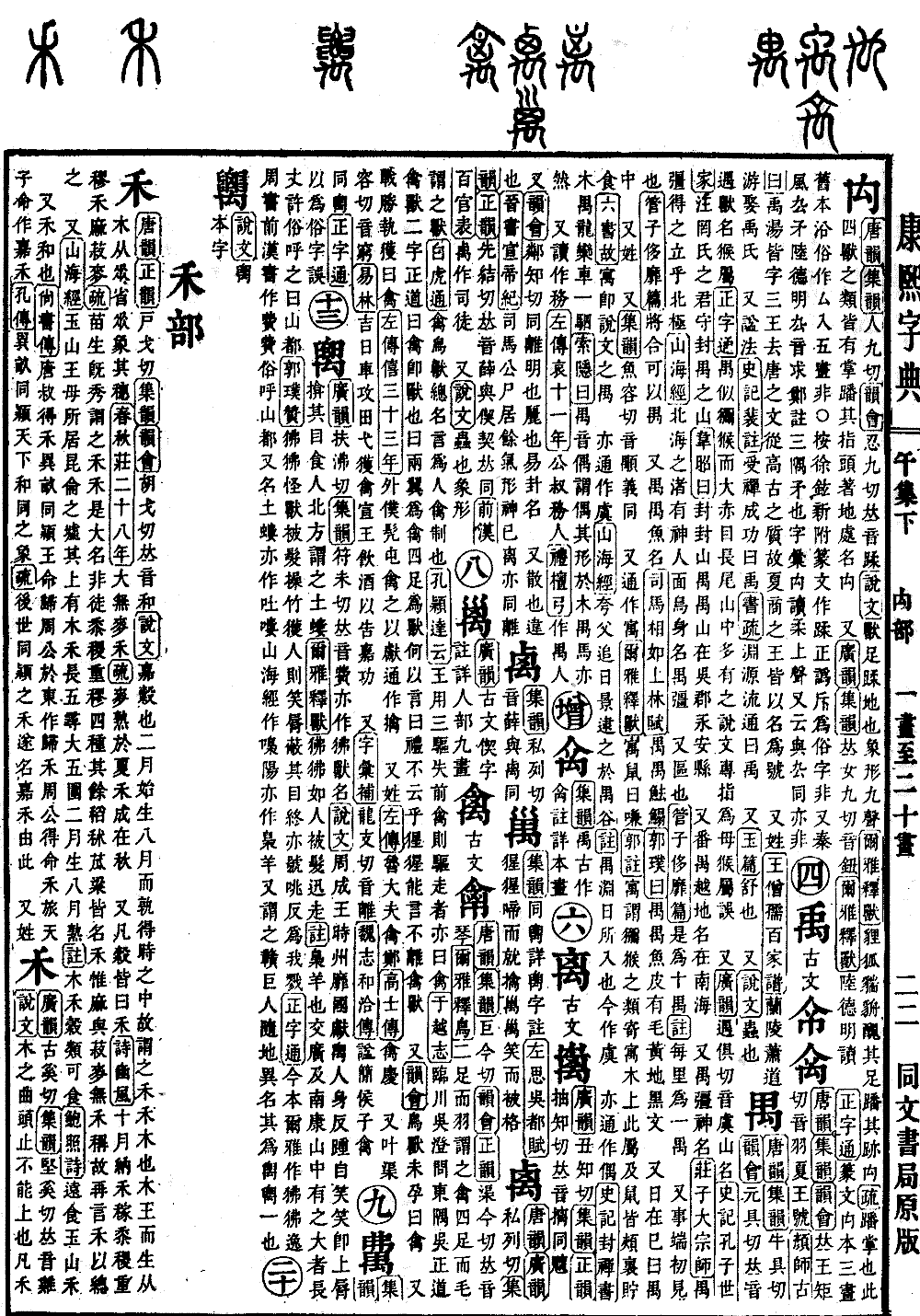
Wu Collection, Lower Volume
Radical: Nèi (nèi)
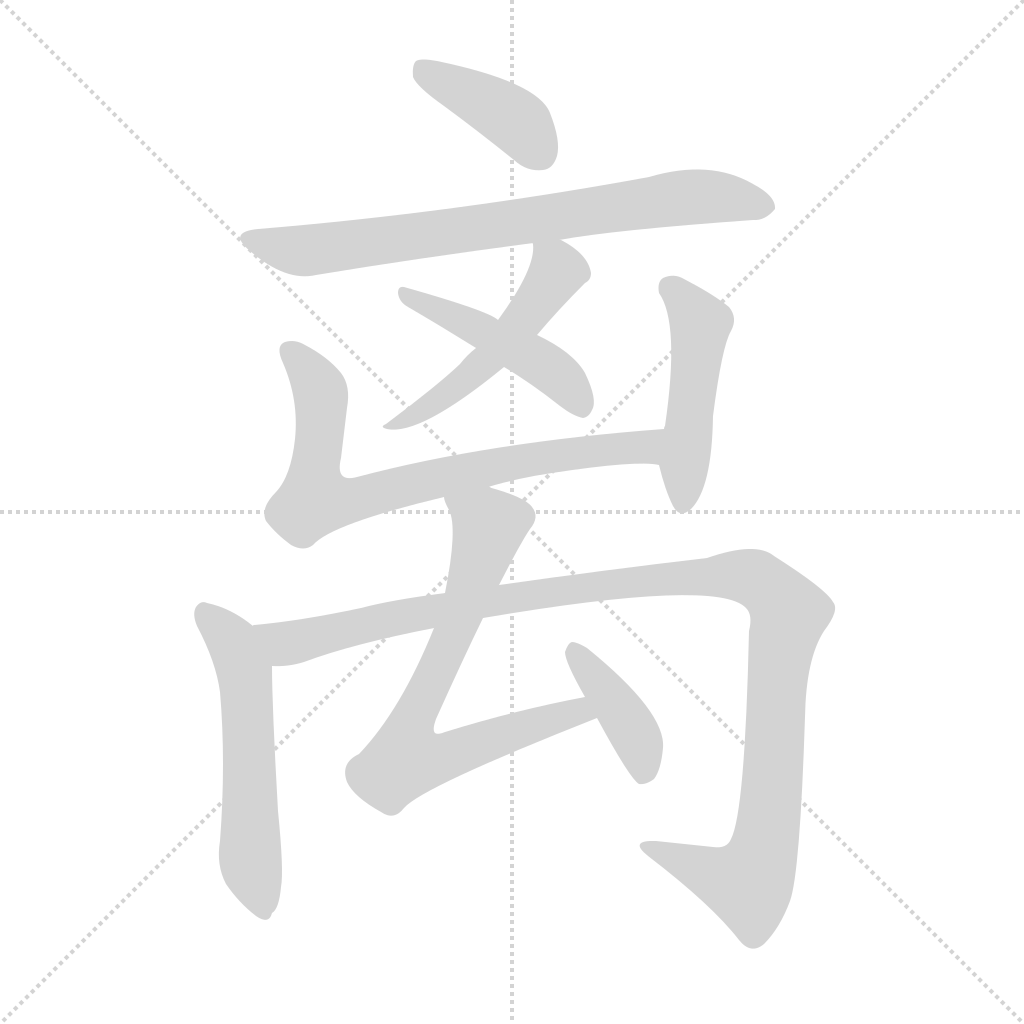
Li
Kangxi Stroke Count: 19
Page 848, Entry 07
In ancient texts, according to Guangyun, pronounced chi. According to Jiyun and Zhengyun, pronounced chi, with the same sound as li. Identical to chi (a mythological dragon-like creature).
Also, according to Yunhui, pronounced lin. Identical to li. Meaning brightness, or beauty. The name of a hexagram in the Book of Changes (Yijing).
Also meaning to scatter, or to violate. In the History of the Jin Dynasty (Jinshu), Biography of Emperor Xuan, it is written that Lord Sima was merely surviving, his form and spirit already departed. Also identical to li.
Li. According to Tangyun, pronounced li. According to Jiyun and Yunhui, pronounced li. According to the Explaining Graphs and Analysis of Characters (Shuowen), this refers to the yellow-breasted bunting (cang geng); when it sings, the silkworms hatch. Composed of the radical for bird (zhui) with li as the phonetic component. According to Yupian, also written as li. According to Guangyun, today li is used for the oriole (lihuang), and borrowed to mean departure. According to Jiyun, sometimes written as li.
Also, the name of a hexagram. In the Book of Changes (Yijing), Hexagram of Li, the commentary states: Li means to be beautiful. According to Yupian, li means brightness.
Also, according to Yupian, to scatter. According to Guangyun, being near is called li, being far is called bie (separation). According to the Regional Speech (Fangyan) by Yang Xiong, canli means to divide. In the states of Qin and Jin, it is called li. In the Book of Changes (Yijing), Qian Hexagram, it states: in advancing or retreating there is no constancy, one should not depart (li) from the group. In the Book of Odes (Shijing), it states: there are women who have departed (pili).
Also, according to Yupian, to encounter. According to the Regional Speech (Fangyan), a net is called li. In the Book of Changes (Yijing), Minor Excess Hexagram, it states: flying birds encounter (li) it. In the Former Han Dynasty, Biography of Yang Xiong, the commentary by Ying Shao states: li is like encountering (zao).
Also, in the Book of Odes (Shijing), Small Odes section, it states: do not depart (li) from the village. The commentary states: li means to pass through (li).
Also, according to Yupian, to be paired. In the Book of Rites (Liji), Section on Rules of Deportment (Quli), it mentions sitting in pairs and standing in pairs. The commentary states: li means pair (liang). When two things are attached to each other, it is called li.
Also, according to Yupian, to cut. In the Book of Rites (Liji), Section on Academic Records (Xueji), it states: in the first year, observe the cutting (li) of the classics and distinguish their intent. The commentary states: cutting the classics means breaking the sentences. In the Book of Zhou (Zhouli), Ministry of Summer, it mentions lands that are not fragmented (huali). The commentary states: hua is read as a variant, meaning to correct so it is not crooked or cut off.
Also, in the Book of Rites (Liji), Section on the Bright Hall (Mingtangwei), it mentions the uncle's set of hanging chimes. The commentary states: li refers to the ordering of the hanging musical stones. The commentary notes: the set of chimes made by the uncle.
Also, in the Ceremonial Rites (Yili), Section on the Great Archery Ritual, it mentions the center passing (li) through the tether of the net. The commentary states: li means to pass through (guo), or to hunt (lie).
Also, according to Yupian, it means to be shallow. In the Zuo Tradition (Zuozhuan), first year of Duke Zhao, it mentions establishing a defense and changing into simple clothing. The commentary states: li means simple.
Also, in the Erya, Section on Kinship, it states: a man refers to his sister's son as a nephew, and the son of a nephew is called a li grandson.
Also, in the Xunzi, Section on Refuting Physiognomy, it uses the term lili. The commentary states: lili refers to the appearance of not being close or involved in affairs.
Also, in the Erya, Section on Explaining Words, it mentions fu-li. The commentary states: this refers to the thick, tangled, and obscured appearance of plants and trees. Fu-li is the same as mili, which means tangled and overgrown.
Also, in Qu Yuan's Encountering Sorrow (Lisao), it mentions the length of the jade pendants that are lu-li. The commentary states: lu-li is similar to the word for jagged or mountainous, meaning a large, varied appearance. Xu Shen says: a beautiful appearance. Yan Shigu says: scattered.
Also, in the Former Han Dynasty, Songs for Suburban Sacrifices, it mentions avoiding liu-li. The commentary states: liu-li refers to those who are unable to find their proper place.
Also, in Sima Xiangru's Rhapsody on the Great Master (Daren Fu), it mentions an overflowing, majestic appearance, brilliant and forest-like (lin-li). The commentary states: lin-li means to be varied and intertwined. In Yang Xiong's Rhapsody on Hunting (Yulie Fu), it mentions lin-li.
Also, in Sima Xiangru's Rhapsody on the Great Forest (Dalin Fu), it mentions the long-li in front and the brilliant one behind. The commentary states: Fu Qian says: both are names of gods. Yan Shigu says: long-li is a spiritual bird. Note: in the Former Han Dynasty Records of Rites and Music, it is written as long-li. The commentary states: it is the name of a star. In Zhang Heng's Rhapsody on Thinking (Si Fu), it mentions the long-li in front spreading its wings. The commentary states: long-li is the Vermilion Bird god of the south.
Also, in the Erya, Section on Music, it states: a large zither is called li. The commentary states: the sound changes often, the notes are flowing and varied.
Also, in the Former Han Dynasty, Record of the Western Regions, it mentions that the Jibin state produces bi-liu-li. The commentary states: Yan Shigu cites the Weilue as saying: the Da Qin state produces ten types of liu-li: red, white, black, yellow, blue, green, light blue, dark blue, red, and purple.
Also, the name of a horse. In Li Si's Memorial on Urging the Expulsion of Guests, he mentions riding the xian-li horse.
Also, the name of a bird. In the Book of Odes (Shijing), Odes of Bei, it mentions the child of the liu-li. The commentary says: liu-li is a bird. Note: the Erya commentary on birds writes it as liu-li.
Also, the name of a plant. In Qu Yuan's Encountering Sorrow (Lisao), it mentions carrying the jiang-li and pi-zhi plants. The commentary states: li is the miwu plant.
Also, in Sima Xiangru's Rhapsody on Sir Fantasy (Zixu Fu), it mentions the nie-li and red willows. The commentary states: li is the wild mountain pear.
Also, according to Piya, the Han Poem (Hanshi) says: the peony is the li plant. When people are about to separate (li), they give each other peonies. Also called ke-li.
Also, the name of a tree. In the History of the Great Historian (Shiji), Biography of Confucius, the commentary records that the Huanglan says: in the burial grounds, there are trees such as the zha, fen, and luo-li.
Also, the name of a river. In the Former Han Dynasty, Annals of Emperor Wu, it mentions emerging from Lingling and the Xia-li River.
Also, a place name. In the Zuo Tradition (Zuozhuan), 15th year of Duke Cheng, it mentions meeting the state of Wu at Zhongli. The commentary states: Zhongli was a state of Chu, located in Huainan county.
Also, the name of a state. In the Former Han Dynasty, Record of the Western Regions, it mentions the Dong-li state, which is a large state. In the Records of Gleaned Matters (Shiyiji), it mentions the Nili state coming to pay tribute.
Also, according to Guangyun, a surname. Mencius had a disciple named Li Lou.
Also, according to Jiyun, pronounced chi. Originally written as chi. See the note on the character chi under the insect radical.
Also, according to Jiyun, pronounced li. Li-qi means the appearance of raising one's arms.
Also, in Sima Xiangru's Rhapsody on the Shanglin Park (Shanglin Fu), it mentions li-mi in the wide expanse. The commentary states: li-mi refers to being connected and not broken. Li is pronounced li.
Also, according to Guangyun, Jiyun, and Yunhui, pronounced li. According to Guangyun, to depart. In the Book of Documents (Shujing), Section on the Punitive Expedition of Yin, it mentions being an official but departing (li) from one's post. The commentary states: li is read as written, also pronounced li. In the Book of Rites (Liji), Section on Rules of Deportment (Quli), it states that parrots can speak but do not depart (li) from birds.
Also, the same as li (lychee). In Sima Xiangru's Rhapsody on the Shanglin Park (Shanglin Fu), it mentions the li-zhi fruit. The commentary states: Jin Zhuo says: li-zhi is as large as a chicken egg, the skin is rough; once the skin is peeled, the flesh is like a chicken egg, yellow inside, the taste is sweet, and it has more acidity than sweetness. Yan Shigu says: pronounced li.
Also, according to Guangyun, Jiyun, and Yunhui, pronounced li. In the Book of Rites (Liji), Monthly Ordinances (Yueling), it states: the department of heaven observes the movements of the sun, moon, and stars; their mansions (su) and conjunctions (li) must not be in error. The commentary states: li is read like the li in liao (to pair); it means the mansions coincide or pair, and the astronomers must carefully observe them so that there is no error. The commentary states: li is read as li. It means to pair.
Also, rhymes with li. In Zhuo Wenjun's Lament of the White Hair (Baitou Yin), it says: sorrowful and more sorrowful, when marrying off a daughter one does not need to weep; I hope to find a person of one heart, who will not depart (li) from me until our hair turns white.
Also, rhymes with luo. In Han Yu's Inscription for the Tomb of Vice-Prefect Pei, it says: branches divide and clans separate (li), each becoming a great family. Family rhymes with ge.
Textual verification: In the Book of Rites (Liji), it says "sitting in pairs, standing in pairs." The commentary says "li means pair. When two things are attached, it is called li." I note that the original commentary does not contain this text. I have amended this based on the commentary by Mr. Fang cited in the Chen Collection to "two things attached to each other is called li." In Yang Xiong's Rhapsody on Hunting (Jiaolie Fu), "lin-li" is mentioned. I have amended the text from "Rhapsody on Hunting" to "Rhapsody on Feathered Hunting" (Yulie Fu) to match the Literary Selections (Wenxuan). In Sima Xiangru's Rhapsody on the Shanglin Park (Shanglin Fu), "the long-li in front and the brilliant one behind" is mentioned. I have amended the text from "Rhapsody on the Great Forest" (Dalin Fu) to "Rhapsody on the Shanglin Park" (Shanglin Fu) to match the History of the Han Dynasty (Hanshu).