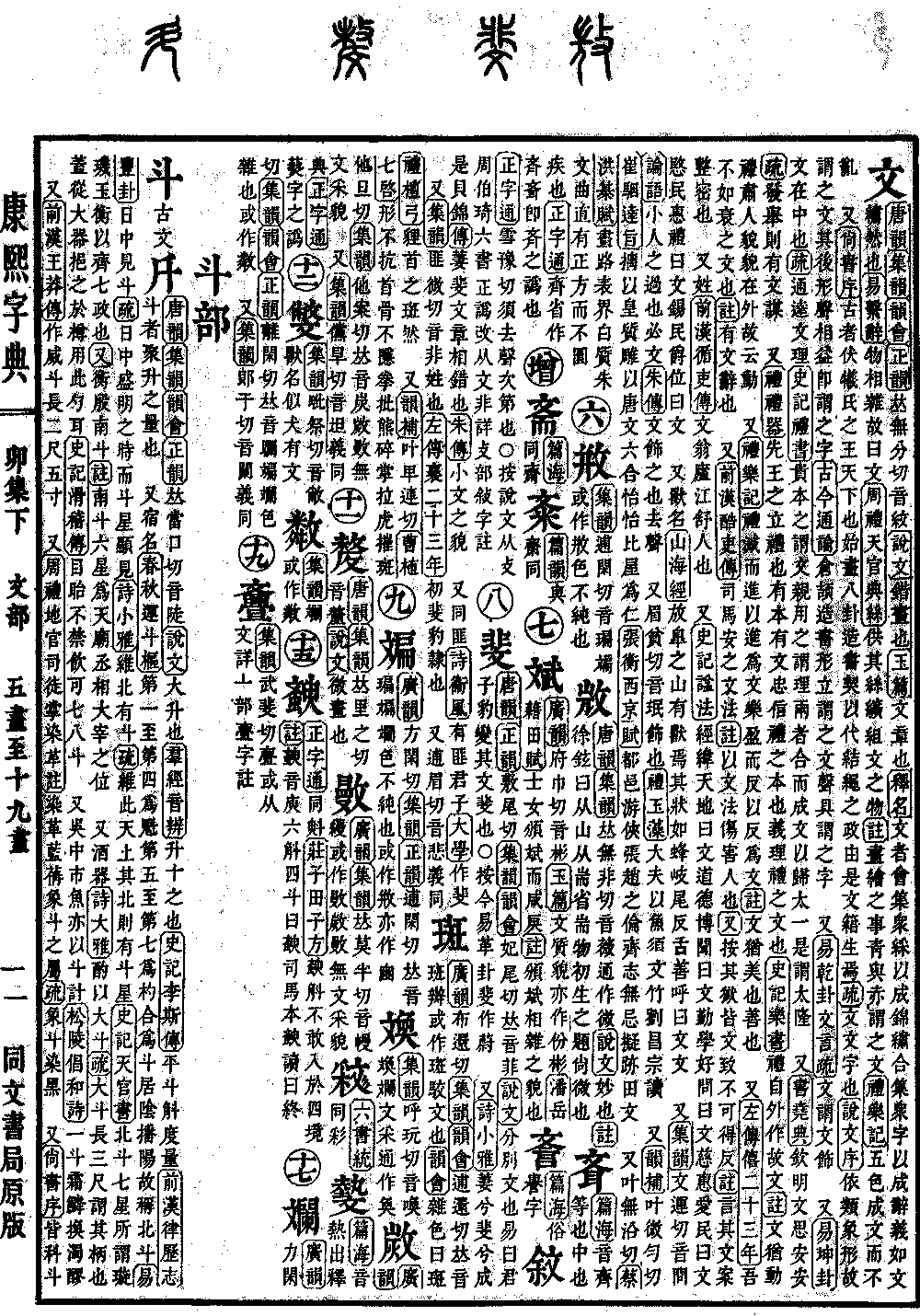
Mao Collection, Lower Volume
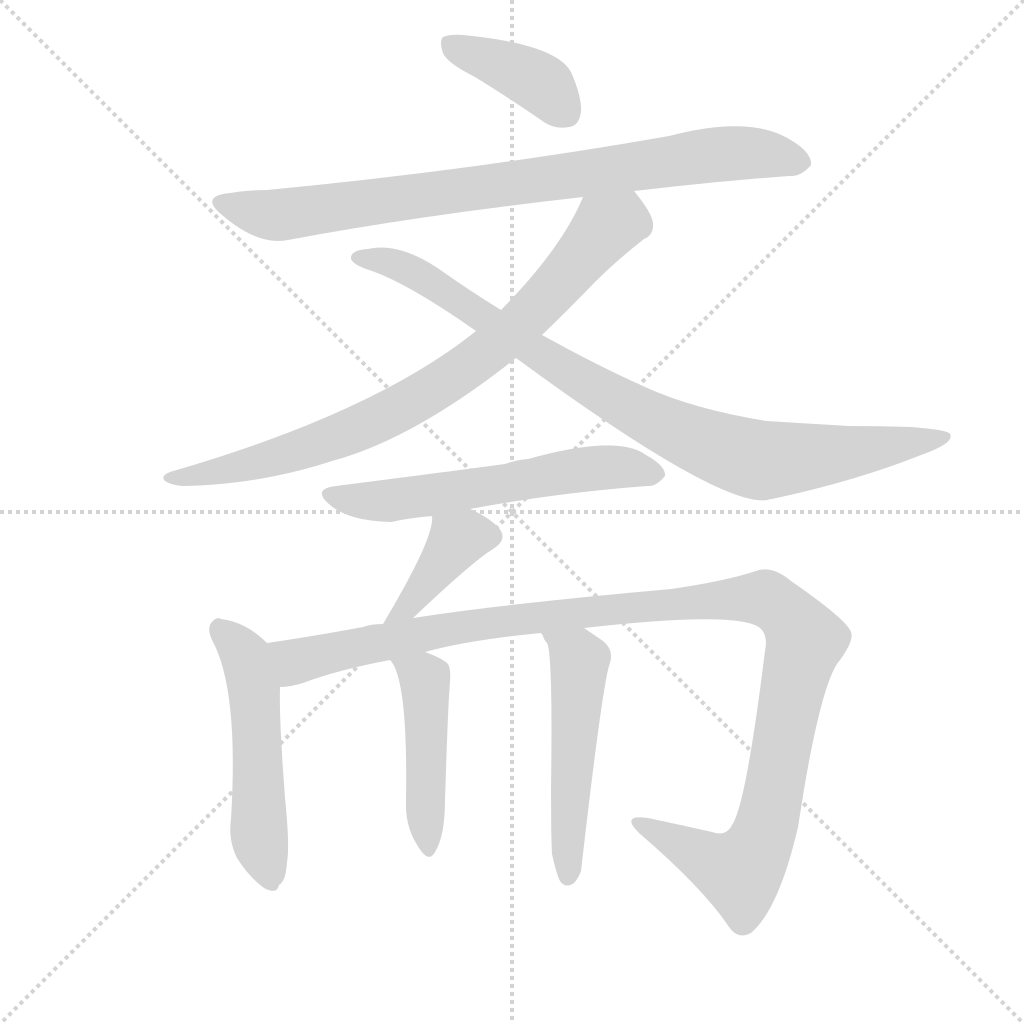
Radical: Script (wén)
17 strokes
Page 477, Entry 05
Pianhai: The same as the character for abstention (zhai).
Broad Rhymes (Guangyun): Pronounced zhai (level tone).
Collected Rhymes (Jiyun), Rhyme Meetings (Yunhui), and Orthodox Rhymes (Zhengyun): Pronounced zhai (level tone). Sounds the same as the level tone of the character for debt (zhai).
Orthodox Rhymes (Zhengyun): Means to be clean, solemn, and respectful.
Extended Glossary (Guangya): Zhai means respect.
Book of Rites (Liji), Record of Sacrifices: The meaning of this character is to be uniform, orderly, and solemn.
Book of Changes (Yijing), Appended Remarks: The sages use this for purification and fasting.
Commentary: To cleanse the heart is called zhai.
Also, in the Official Regalia section of the History of the Later Han (Hou Hanshu), there is a type of ceremonial cap called a long cap. It also refers to a quiet room for living or study.
Collected Rhymes (Jiyun) and Orthodox Rhymes (Zhengyun): Pronounced zi.
Mencius: Simple garments for mourning.
Zhao Qi Commentary: This refers to mourning attire. Pronounced zi.
Also, Book of Changes (Yijing), Treading Hexagram: Obtain his resources.
Zixia Commentary: Written as the character for equal (qi) plus axe (fu). Yu Xi, in his Forest of Records (Zhilin), states: It should be written as zhai. It means to fast and enter the ancestral temple to receive the axe.
Also, rhyming with zhen: Pronounced zhi.
History of the Later Han (Hou Hanshu), Biography of Zhou Ze: Living in the world with misfortune, he became the wife of the Grand Master of Ceremonies, and out of three hundred sixty days in a year, he spent three hundred fifty-nine days in purification and fasting.
Note: According to the Analytical Dictionary of Characters (Shuowen Jiezi), it is composed of the radical for divine manifestations and the character for equal (qi). The radical for divine manifestations indicates clear instruction and reverence. The character for equal indicates that all things are clean and orderly. The Hongwu Correct Rhymes (Zhengyun) states: In ancient times, the character for equal (qi) was used alone; later people added the heart radical beneath it to distinguish the meaning.