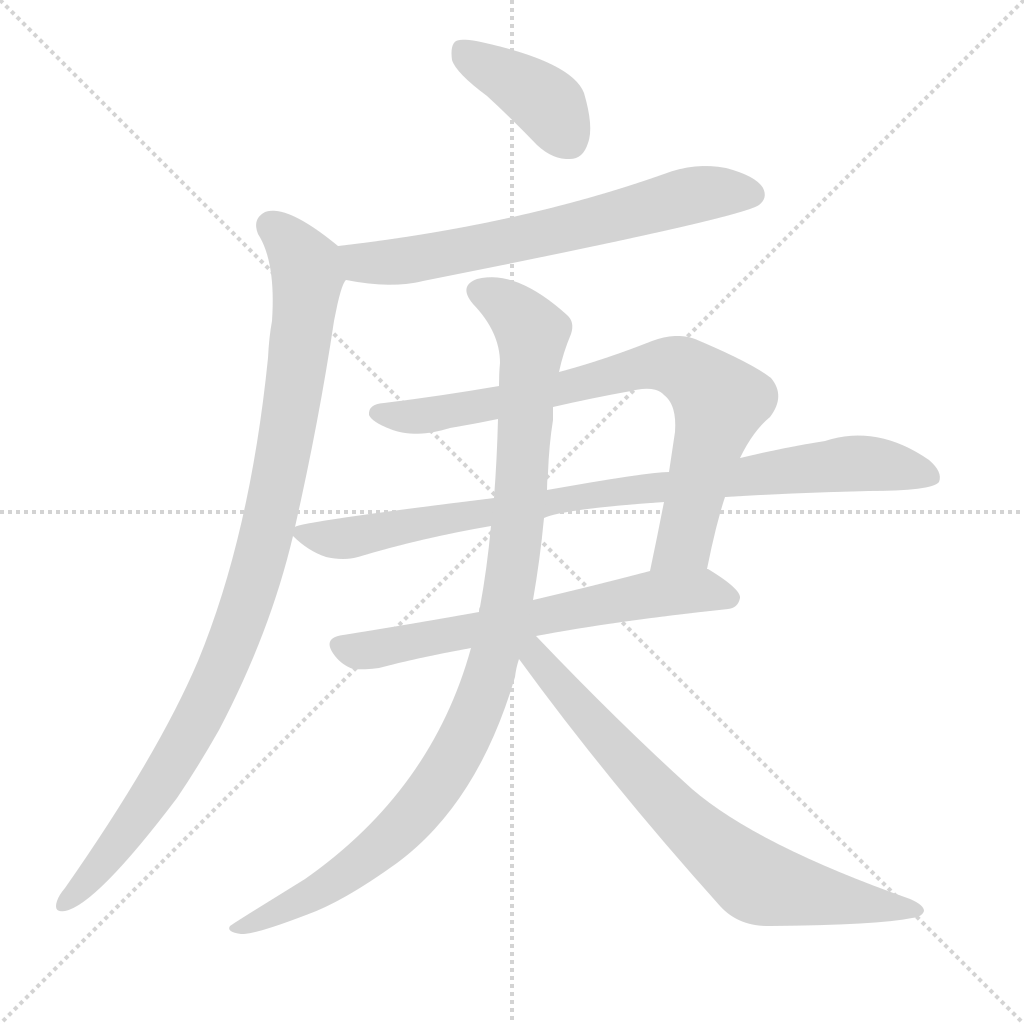
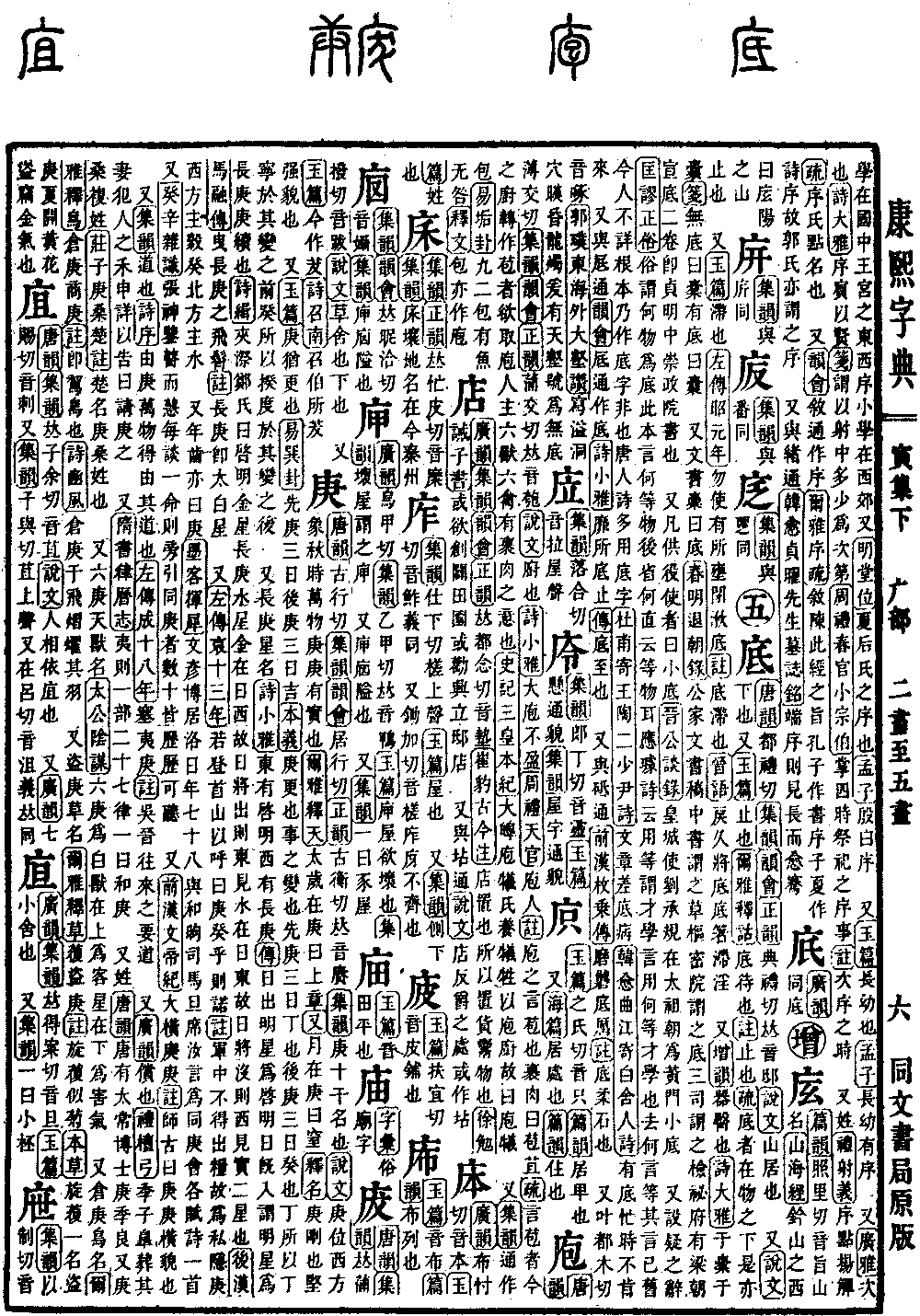
Yin Collection, Lower Volume
Radical: Broad (guǎng)
Kangxi Dictionary strokes: 8
Page 344, Entry 22
Pronounced gēng
Pronounced gēng
Pronounced gēng
Readings are the same as gēng (to continue/renew).
In Jiyun, geng is the name of the seventh celestial stem.
In Shuowen Jiezi, the position of geng is in the west, symbolizing the appearance of all things bearing fruit in autumn.
In Erya, Explaining Heaven (Erya Shitian), the movement of the Great Year (taisui) to the geng year is called shangzhang.
Also, the movement of the moon to the geng day is called zhi.
In Explaining Names (Shiming), geng carries the meaning of being strong and firm.
In Yupian, geng also carries the meaning of change.
In Book of Changes (Yijing), Hexagram Xun, taking action three days before the geng day (the ding day) and three days after the geng day (the gui day) is auspicious.
In the Original Meaning (Benyi), geng means change, referring to when things undergo a transformation. The three days before geng is the ding day, and the three days after geng is the gui day. The ding day is for careful instruction before things change, and the gui day is for assessment and consideration after things change.
Also refers to Changgeng, the name of a star constellation.
In Book of Odes (Shijing), Lesser Odes (Xiaoya): In the east there is the Qiming star, in the west there is the Changgeng star.
In the Commentary (Zhuan): When the sun rises, the bright star is called Qiming. When the sun sets, the bright star is called Changgeng. Geng carries the meaning of continuation.
In Shiji (a commentary on the Book of Odes), Zheng of Jiaji states: Qiming is the planet Venus, and Changgeng is the planet Mercury. Venus is to the west of the sun, so it is visible in the east when the sun is about to rise. Mercury is to the east of the sun, so it is visible in the west when the sun is about to set. They are actually two separate stars.
In Book of the Later Han (Hou Hanshu), Biography of Ma Rong: Dragging silk ribbons that shine like the rays of the Changgeng star.
In the Annotation: Changgeng is the planet Venus (Taibai).
Also in Zuo Tradition (Zuo Zhuan), 13th Year of Duke Ai: If one ascends the Shou Mountain and calls out for "geng and gui," one will receive a response.
In the Annotation: In the military, one cannot speak openly about grain, so secret language is used. Geng represents the west, which governs grain. Gui represents the north, which governs water.
Age is also referred to as geng.
In Moke Huixi, Wen Yanbo, while living in Luoyang at the age of seventy-eight, held a gathering for those of the same age (tonggeng) with He Xu, Sima Dan, and Xi Ruyan, and each composed a poem.
In Guixin Zashi, Zhang Shenjian, though blind, was wise; whenever he performed fortune-telling for people, he would cite dozens of examples of people of the same age, explaining them clearly and eloquently.
In Book of the Former Han (Qian Hanshu), Annals of Emperor Wen: The prophetic signs obtained from divination were clearly visible as horizontal and vertical lines (da heng geng geng).
In the Annotation, Shigu says: Geng geng is the appearance of horizontal and vertical lines.
In Jiyun, it also refers to a road.
In Shixu (Preface to the Book of Odes), the poem Yougeng refers to how all things can grow by following their natural laws (dao).
In Zuo Tradition (Zuo Zhuan), 18th Year of Duke Cheng: The important thoroughfare of Yigeng was blocked.
In the Annotation: An important channel of communication between the states of Wu and Jin.
In Guangyun, it also means to repay.
In Book of Rites (Liji), Tan Gong: When Zizi Gao was burying his wife, he damaged the crops of others. Shen Xiang told him: Please compensate them.
In Book of Sui (Suishu), Treatise on Rhythm and Calendar (Lüli Zhi): The Yize section has twenty-seven musical pitches. The first pitch is called he geng.
It is also a surname.
In Tangyun, there was a Taichang scholar named Geng Jiliang during the Tang Dynasty.
There is also Gengsang, a compound surname.
In Zhuangzi, Commentary on Gengsang Chu: Chu is a person's name. Gengsang is the surname.
There are also the Six Geng, the names of celestial divine beasts.
In Taigong Yinmou: The Six Geng are white beasts; in the heavens they appear as guest stars, and on earth they manifest as harmful vapors.
There is also Canggeng, the name of a bird.
In Erya, Explaining Birds (Erya Shniao): Canggeng is also called Shanggeng.
In the Annotation: This is the oriole.
In Book of Odes (Shijing), Odes of Bin (Binfeng): The orioles fly, their feathers shining brightly.
There is also Daogeng, the name of a plant.
In Erya, Explaining Plants (Erya Shicao): Fu is called Daogeng.
In the Annotation: Xuanfu resembles a chrysanthemum.
In Compendium of Materia Medica (Bencao Gangmu): Xuanfu is also called Daogeng. It blooms with yellow flowers in summer because it steals the metal energy (yellow corresponds to metal) of autumn.