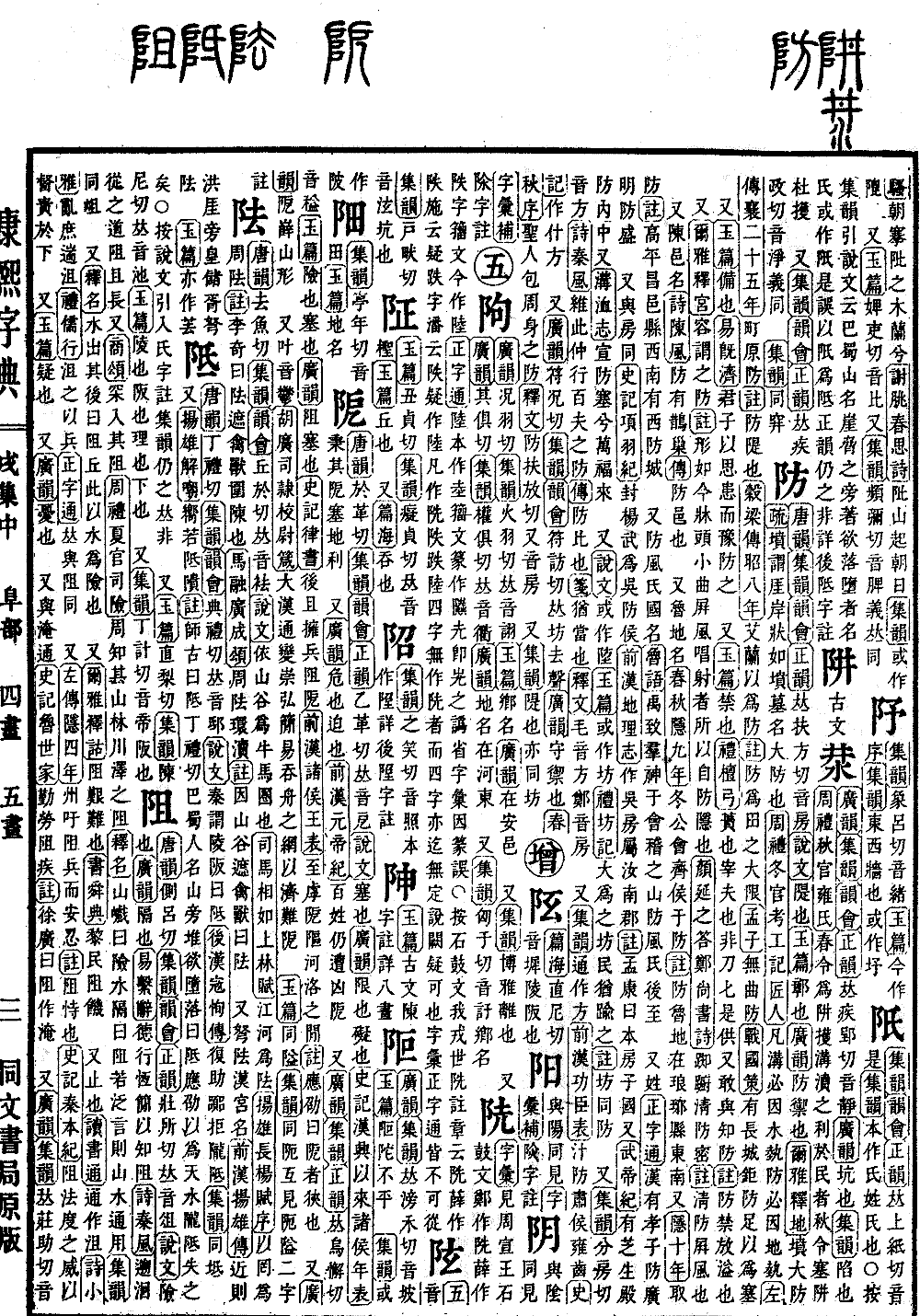
Xu Collection, Mound Radical, Upper Volume
Entry 08
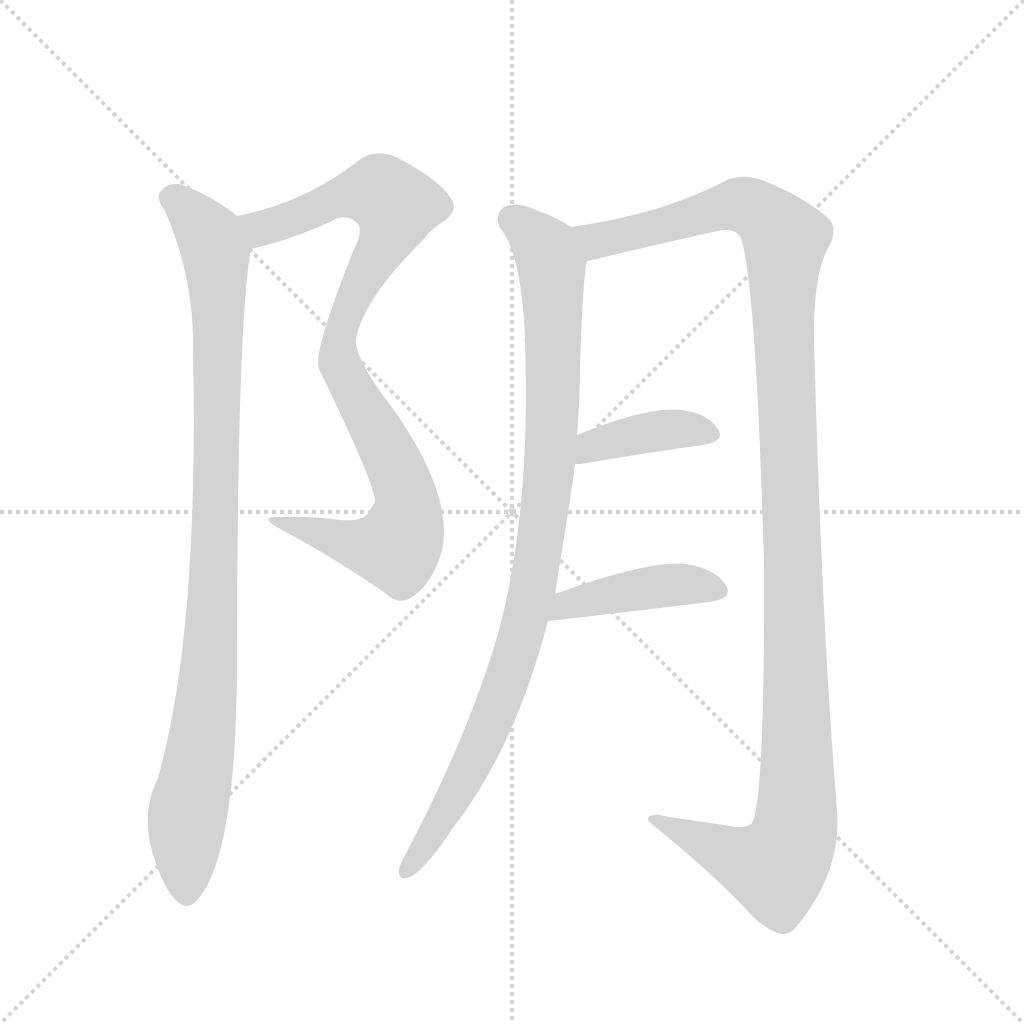
Pronounced yīn (falling tone)
Same as 隂. See "Zi Hui Bu" (字汇补) for notes.
Ancient forms of 阴 include 霒, 侌, and 瘖.
Pronounced "yū jīn qiè" in "Tang Yun" (唐韵), "Ji Yun" (集韵), and "Yun Hui" (韵会). Pronounced "yū qín qiè" in "Zheng Yun" (正韵), with the same pronunciation as 音.
"Shuo Wen Jie Zi" (说文解字) explains it as "dark."
"Shi Ming" (释名) explains it as "shade," meaning the qi is hidden and shaded within.
"Yu Pian" (玉篇) explains it as "dark, formless, profound, and unfathomable."
The "Kun" (坤) hexagram of the "Yi Jing" (易经) states: Although 阴 possesses virtue, it remains hidden and does not reveal itself, assisting the king's endeavors without claiming merit. This is the way of the earth, the way of the wife, and the way of the minister.
"Li Ji" (礼记), "Yue Ling" (月令) states: All officials should quietly attend to their duties without disturbance, thereby stabilizing the seasons achieved through the changes of 阴 and 阳.
Also, "Zhou Li" (周礼), "Tian Guan" (天官), "Nei Zai" (内宰) records: Teach the six palaces with 阴 rituals. The note states: 阴 rituals are the rituals for women.
Also, "Nei Xiao Chen" (内小臣) records: In charge of the king's inner court affairs and secret decrees.
Also, "Di Guan" (地官), "Da Si Tu" (大司徒) records: Teach the people to be intimate and harmonious with 阴 rituals, so the common people will not resent. The note states: 阴 rituals refer to the rituals between men and women.
Also refers to cloudy weather.
"Shi Jing" (诗经), "Bei Feng" (邶风) states: The sky is gloomy.
Also states: It is both cloudy and rainy.
Also, "Shuo Wen Jie Zi" (说文解字) explains it as: The north side of a mountain.
"Shang Shu" (尚书), "Yu Gong" (禹贡) records: Reaching Huayin (华阴) from the south.
Also, "Shuo Wen Jie Zi" (说文解字) explains it as: The south side of a body of water.
"Qian Han Shu" (前汉书), "Di Li Zhi" (地理志) states: Hedong Commandery has Fenyin County (汾阴县). The note states: Jieshan Mountain is to its south.
Also, "Yu Pian" (玉篇) explains it as: Shadow.
"Jin Shu" (晋书), "Tao Kan Zhuan" (陶侃传) states: Da Yu cherished every inch of time; we should cherish every moment.
Also, "Zheng Tong" (正字通) explains it as: The back side is called 阴. Yang Xiu explained the eight characters on the back of Cao E's monument.
Also, "Qian Han Shu" (前汉书), "Jiao Si Ge" (郊祀歌) sings: Spirits descend, bestowing blessings and shade upon the four directions. The note by Shi Gu says: This means the shade of the spirits covers and extends downwards.
Also, "Yu Pian" (玉篇) explains it as: In secret, silently.
"Zhan Guo Ce" (战国策) records: The interactions between the states of Qi and Qin were secretly united.
Also, "Shi Jing" (诗经), "Qin Feng" (秦风) states: Decorate chariots and horses with 阴 and 鋈续. The commentary explains: 阴 is something that covers the front of the carriage shaft.
"Shi Ming" (释名) explains: 阴 is shade. Placed horizontally in front of the carriage to shade the shaft.
Also refers to place names.
"Zuo Zhuan" (左传), Duke Xiang, Year 9 records: Crossing the river at Yinpo (阴阪) and attacking Zheng.
Also, "Zuo Zhuan" (左传), Duke Zhao, Year 19 records: Chu's Gong Yin Chi relocated the people of Yin to Xia Yin (下阴).
Also, "Zuo Zhuan" (左传), Duke Zhao, Year 22 records: Leading troops to encamp in the land of Yin.
"Qian Han Shu" (前汉书), "Di Li Zhi" (地理志) states: Nanyang Commandery has Yin County (阴县). The note states: This is Xia Yin mentioned in "Zuo Zhuan."
Also, there were two Yinshan County (阴山县) in the Han Dynasty. "Di Li Zhi" (地理志) records: Xihe Commandery has Yinshan Mountain, and Guiyang Commandery also has Yinshan Mountain.
Also refers to a mountain name.
"Shi Ji" (史记), "Qin Shi Huang Ben Ji" (秦始皇本纪) states: From Yuzhong (榆中) eastward along the Yellow River, all the way to Yinshan Mountain. The note by Xu Guang says: Yinshan Mountain is north of Wuyuan Commandery.
Also refers to a surname.
"Guang Yun" (广韵) records: Guan Xiu went from Qi to Chu and became a minister in the land of Yin; his descendants took Yin as their surname. According to: "Shi Ji" (史记), "Gui Ce Lie Zhuan" (龟策列传) supplemented by Chu Shaosun records: Yin Jing (阴兢) saved him and fled with him. Suo Yin says: Yin is the surname, Jing is the given name. This indicates that the Yin surname already existed in the Shang Dynasty.
Also, "Zuo Zhuan" (左传), Duke Xi, Year 15 records: Jin's Yin Yisheng (阴饴甥) met Duke Mu of Qin and formed an alliance at Wangcheng. Note: Yisheng's fief was in the land of Yin. "Zhan Guo Ce" (战国策) mentions Yin Ji (阴姬), who is suspected to have originated from here.
Also, "Zuo Zhuan" (左传), Duke Zhao, Year 24 records: Yin Buliang (阴不佞) led the people of Wen to raid south. It is suspected that Yin is also a surname.
Also, "Zheng Tong" (正字通) explains: The male genitalia are called 阴.
"Shi Ji" (史记), "Lu Buwei Lie Zhuan" (吕不韦列传) records: Privately sought out a man with enormous genitalia, Lao Ai, as a retainer.
Also, "Yi Zhou Shu" (逸周书) records: Red curtains and crane feather decorations were set up on the altar. The note says: 阴 refers to cranes.
"Yu Pian" (玉篇) says it is now written as 隂.
"Wu Yin Ji Yun" (五音集韵) says it is popularly written as 阥.
"Zi Hui" (字汇) says it is popularly written as 阥.
"Zi Hui Bu" (字汇补) also writes it as 阴.
Also, pronounced "wū hán qiè" in "Ji Yun" (集韵) and "Yun Hui" (韵会), with the same pronunciation as 庵. The original character is 闇, referring to a simple house where one lives during mourning.
"Lun Yu" (论语) records: Gao Zong lived in the mourning house for three years without speaking.
Also, pronounced "yū jìn qiè" in "Ji Yun" (集韵) and "Yun Hui" (韵会), with the same pronunciation as 荫.
"Ji Yun" (集韵) explains: To bury, to conceal.
"Li Ji" (礼记), "Ji Yi" (祭义) states: Bones and flesh decay in the earth, eventually turning into soil. The note says: 阴 is pronounced the same as the "yin" in "yi yin" (依荫).
Also, "Shi Jing" (诗经), "Da Ya" (大雅) states: I have already protected you, yet you threaten me. The commentary says: 阴 means protection.
"Yun Hui Xiao Bu" (韵会小补) says: 荫 can be interchanged with 阴.
Also, pronounced "yǐn" in "Zheng Tong" (正字通). In ancient medical prescriptions, there is a disease called "dan yin" (淡阴), popularly written as "dan yin" (淡饮).
Also, read as "yū róng qiè" in rhyming, with the same pronunciation as 雍.
"Shi Jing" (诗经), "Bin Feng" (豳风) states: In the twelfth month, the ice is chiseled with a clanging sound; in the first month, the ice is stored in the ice cellar. The commentary says: Ling yin (凌阴) is the ice cellar.
Yang Xiong's "Tai Xuan Jing" (太玄经) states: The sun ascends and shines, 阴 qi dissipates, and all things are harmonious and joyful.
Also, read as "yū qián qiè" in rhyming, with the same pronunciation as yān.
"Huang Ting Jing" (黄庭经) states: Above is the spiritual platform, below is Guan Yuan, to the left is Shao Yang, and to the right is Tai Yin.
Also, "Yun Hui Xiao Bu" (韵会小补) says: The original character is 殷, referring to dark black. Also written as 阴.
"Shi Jing" (诗经), "Xiao Ya" (小雅), "Wo Ma Wei Yin" (我马维骃) commentary states: Hair that is dark black mixed with white is called 骃. 阴 means dark black.
Textual research on 阴:
"Zhan Guo Ce" (战国策) records: Qi and Qin's interaction (之处). We have changed "zhi chu" (之处) to "zhi jiao" (之交) according to the original text.
"Shi Jing" (诗经), "Qin Feng" (秦风) states: 阴靷鋈续. The commentary explains: 阴 is 揜轨 (covering the axle). We have changed "gui" (轨) to "lǐng" (軓) according to the original text.
"Yi Zhou Shu" (逸周书) records: 墠上张赤奕阴羽. We have changed "chi yi" (赤奕) to "chi yi" (赤帟) according to the original text.