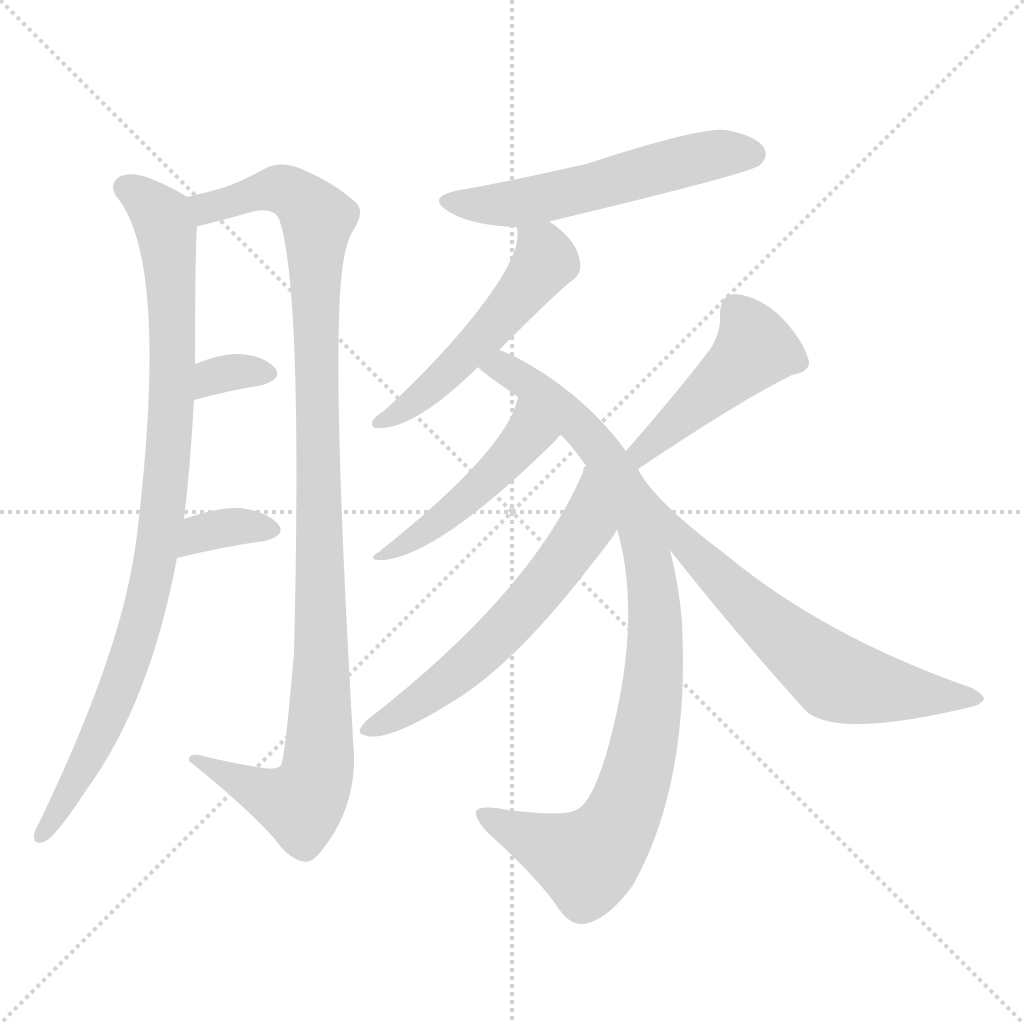
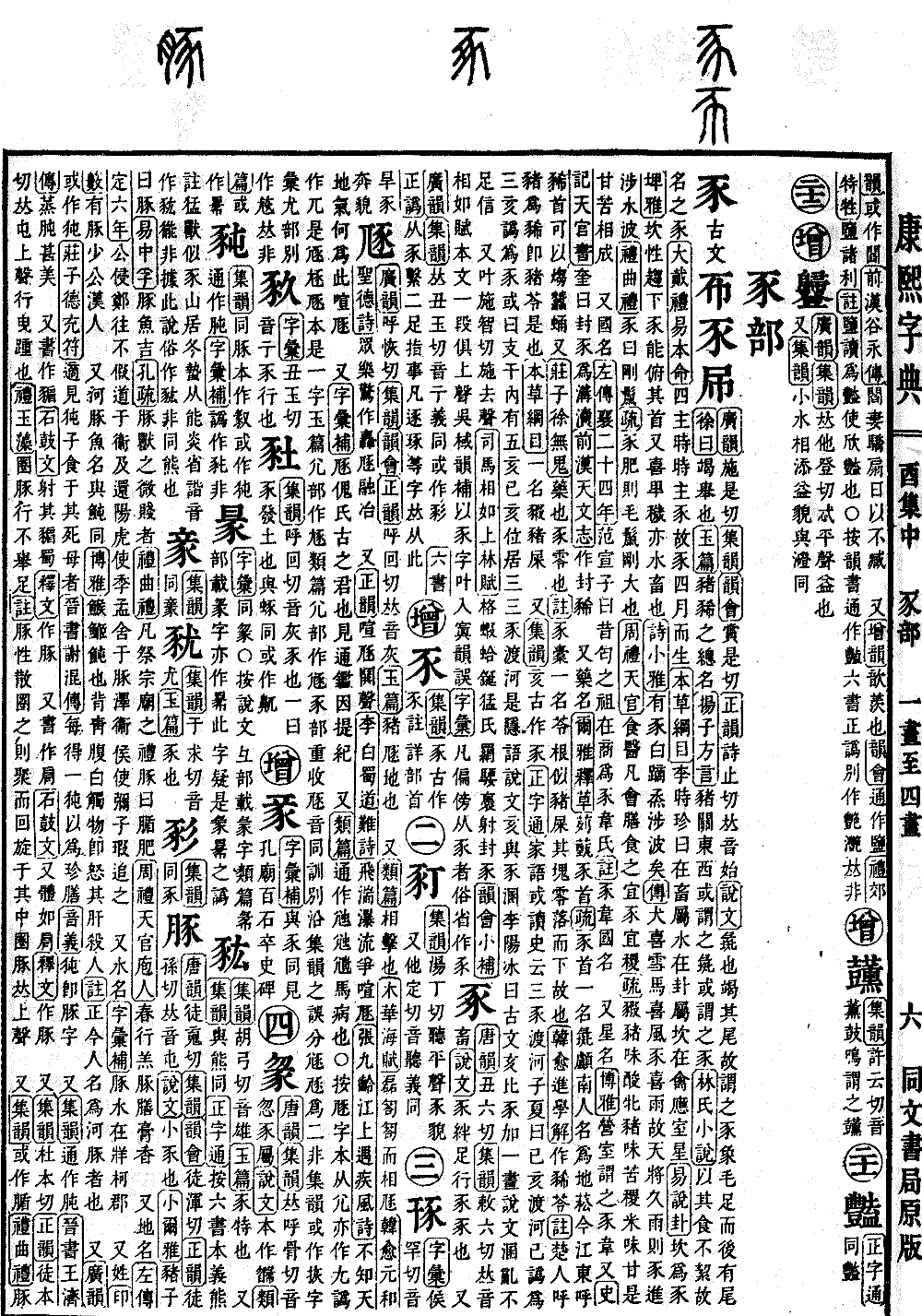
You Collection, Middle Volume
Radical: Pig (shǐ)
Kangxi Strokes: 11
Page 1194, Entry 23
Pronounced tun.
Shuowen Jiezi (Explaining Single-Component Characters and Analyzing Compound Characters): A piglet.
Xiao Erya (Small Approaches to Standard Terms): The young of a pig is called a piglet.
Book of Changes (Yijing): Using piglets and fish for sacrifice is auspicious.
Kong Yingda Commentary: The piglet is considered humble among beasts.
Book of Rites (Liji): In all rituals for ancestral temples, a piglet is referred to as fatty.
Rites of Zhou (Zhouli): In the spring, one presents lambs and piglets, cooked with fragrant fats.
Also a place name.
Zuo Commentary (Zuozhuan): In the sixth year of Duke Ding, Duke Ding of Lu attacked the State of Zheng; he did not request passage from the State of Wei on the way there. Upon his return, Yang Hu had Jisun and Mengsun stay at Tunze, and Duke Ling of Wei sent Mizi Xia to pursue them.
Also a river name.
Zihui Bu (Supplement to the Collection of Characters): Tun River, located in Zangke Commandery.
Also a surname.
Yinsou (Compendium of Seals): There was a person named Tun Shaogong, who lived during the Han dynasty.
Also refers to the pufferfish, a name of a fish. Identical to the character (tún).
Guangya (Broad Refinements): The haoyi (pufferfish) is precisely this. Its back is blue, its belly is white, and it becomes enraged when it encounters things; its liver can poison people to death.
Commentary: This is exactly what people today call the river pig (pufferfish).
Also, Guangyun (Broad Rhymes) notes it is sometimes written as (tún).
Zhuangzi (The Book of Master Zhuang): Just seeing the piglet suckling at its dead mother.
Book of Jin (Jinshu): Every time he obtained a piglet, he treated it as a precious delicacy.
Yinyi (Sounds and Meanings): This is the character for piglet.
Also, Jiyun (Compilation of Rhymes) notes it is interchangeably written as zhun.
Book of Jin (Jinshu): Steamed piglet (zhun) is extremely delicious.
Also written as (tún).
Stone Drum Inscriptions: Shooting its piglet.
Commentary: Written as piglet.
Also written as (tún).
Stone Drum Inscriptions: Also a body like a piglet.
Commentary: Written as piglet.
Also, pronounced tun (rising tone).
When walking, one drags their heels.
Book of Rites (Liji): When circling in a pen, a piglet does not lift its feet.
Commentary: The nature of a piglet is indolent; when penned, they gather and circle within. "Circling piglet" is read in the rising tone.
Also, Jiyun (Compilation of Rhymes) notes it is sometimes written as tu.
Book of Rites (Liji): Piglets are referred to as fatty.
Commentary: Tu is also written as piglet.
Also, Yunhui Xiaobu (Small Supplement to the Collection of Rhymes) notes the pronunciation tun (falling tone). The meaning is the same.
Also, Zihui Bu (Supplement to the Collection of Characters) notes the pronunciation dun. Earth piglet (tu-tun), is an earthen mound.
Records of Wei (Weizhi): Preemptively build an earthen mound (tu-tun) to block and separate the lake water.
Also, in rhyming verse, pronounced ting.
Li You, Inscription on a Seat: Spreading the mat to receive guests, among the scholars there are none who surpass the virtuous. Why must one possess sheep and piglets according to the season? (Regarding the rhyme with xian).
Shuowen Jiezi (Explaining Single-Component Characters and Analyzing Compound Characters): Formed from a modified component of tuan, representing the shape. Formed with the hand component holding meat, used to provide for sacrifices. The seal script form is written with the meat component and the pig component to form the character for piglet.
Yupian (Jade Chapters): Written as (tún).
Leipian (Classification of Characters): Written as (tún).
Jiyun (Compilation of Rhymes): Written as (tún). Also written as (zhuàn). Or written as (tún).