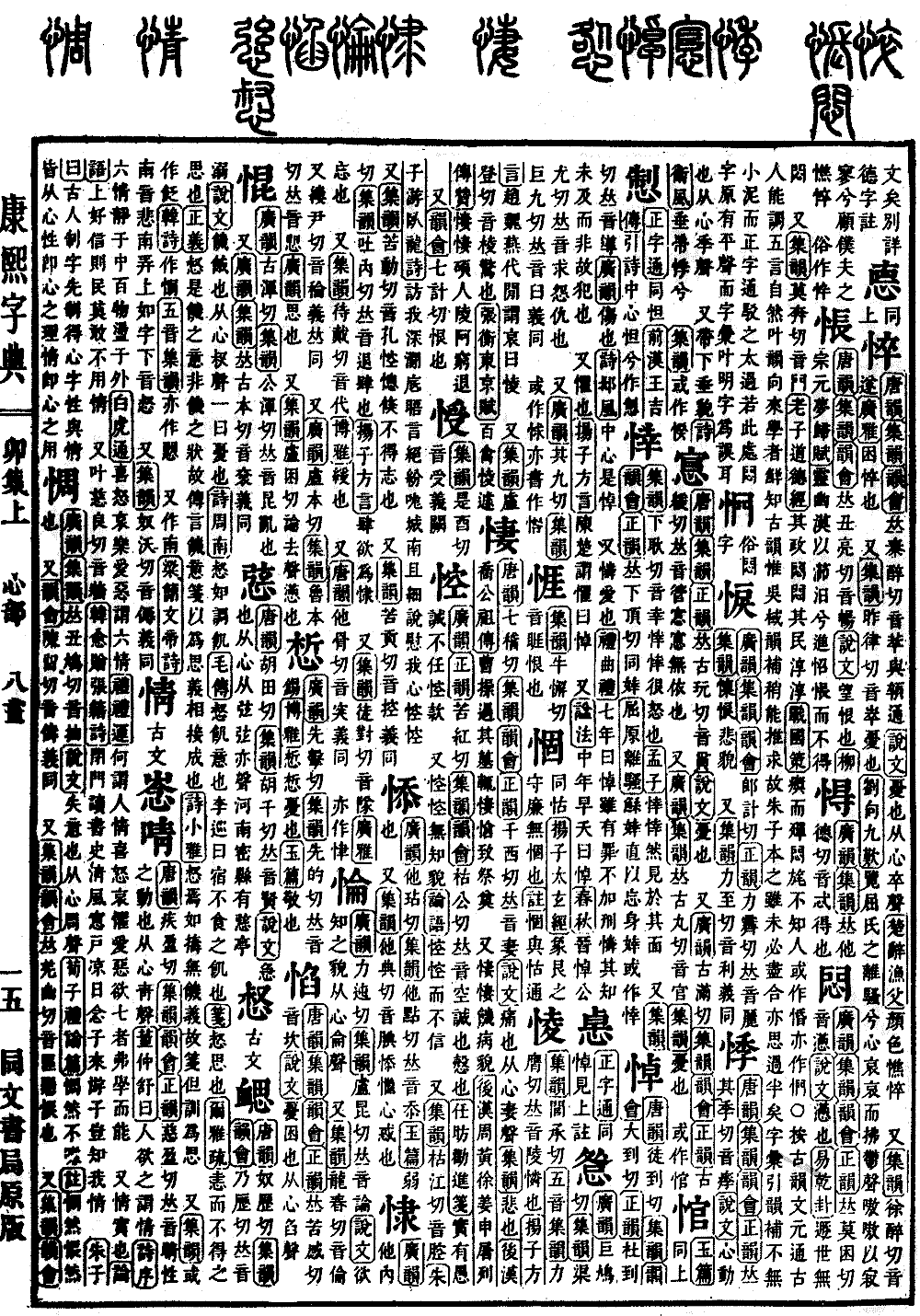
Mao Collection, Upper Volume
Radical: Heart (xīn)
Character: qíng
Kangxi strokes: 12
Page 389, Entry 31
Ancient form: qíng.
Pronounced qíng.
The movement of human nature. Derived from the heart radical, with qīng acting as a phonetic component.
Dong Zhongshu stated: The desires of a person are called emotions.
Book of Odes (Shijing) Preface states: The six emotions are quiet within, and the myriad things stir them from without.
White Tiger Hall Discussions (Baihu Tong) states: Joy, anger, sorrow, happiness, love, and hatred are called the six emotions.
Book of Rites (Liji), Section on the Evolution of Rites (Liyun): What are human emotions? Joy, anger, sorrow, fear, love, hatred, and desire. These seven are known without being taught.
Also, qíng means reality or truth.
Analects (Lunyu): If those above love trustworthiness, then the common people will dare not be anything but sincere.
Also rhymes with the sound qiáng.
Han Yu, Poem Presented to Zhang Ji: Closing the door to read history, the clear wind cools the room. Each day I think of you coming to visit, how could you know my feelings?
Zhu Xi stated: When the ancients created characters, they first created the heart radical. Both nature and emotion are derived from the heart. Nature is the principle of the heart, while emotion is the function of the heart.