Wei Collection, Lower Volume
Radical: Meat (ròu)
Kangxi Strokes: 15
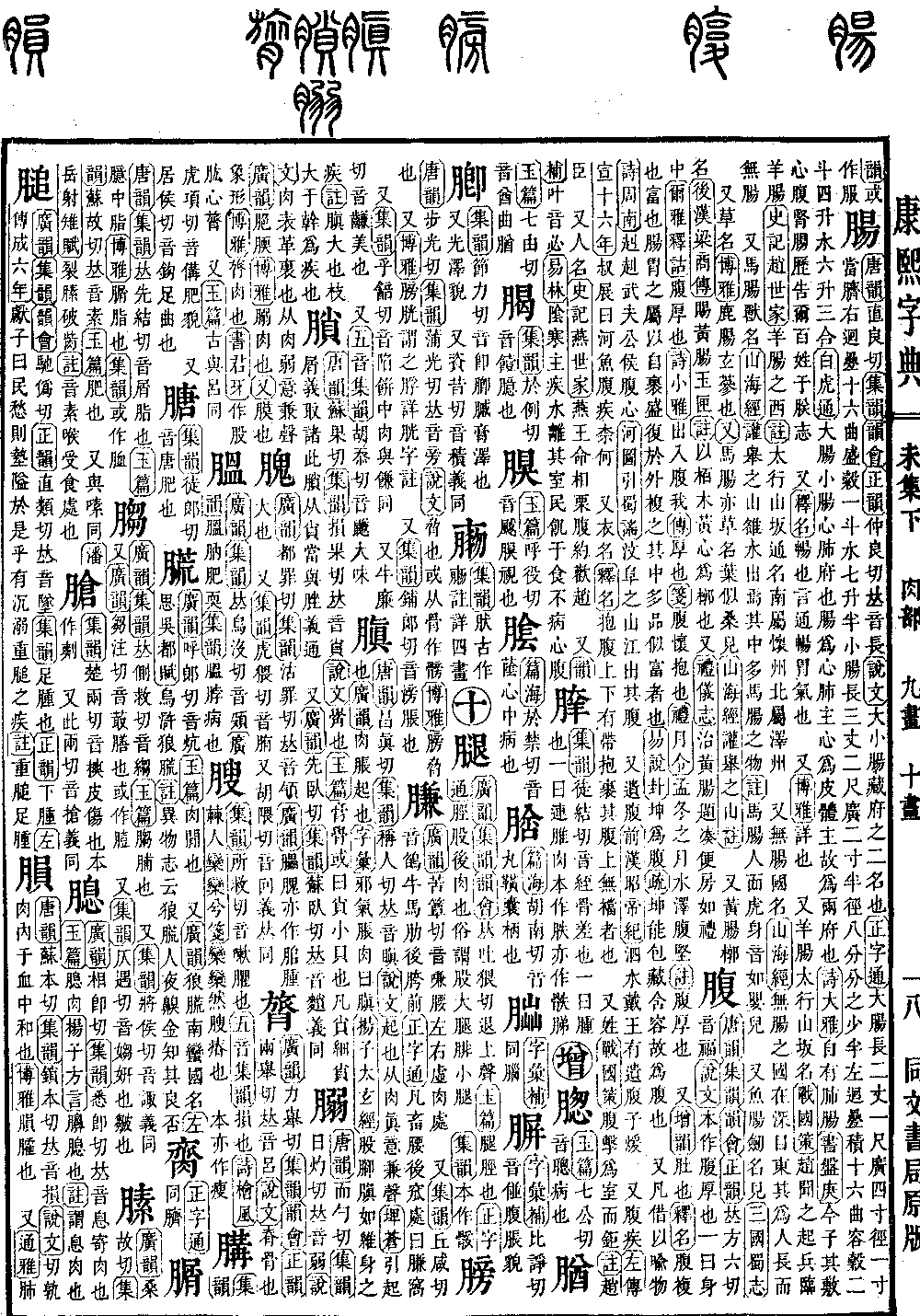
Page 990, Entry 02
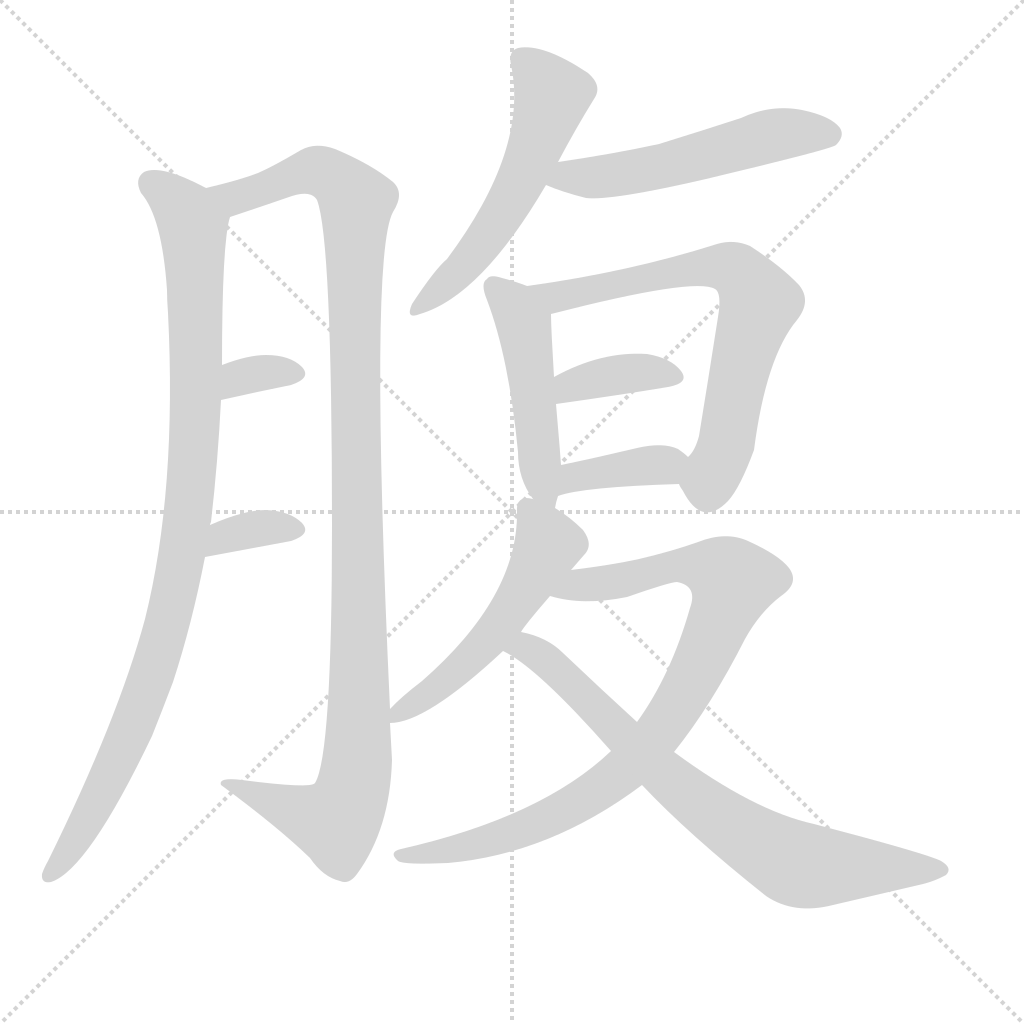
Pronounced fu.
In the Shuowen Jiezi (Shuowen), the original form of this character meant thick. Another definition is the center of the body.
In the Erya (Erya), it states: Fu means thick.
In the Book of Odes (Shijing), it states: Coming in and going out, he holds me in his embrace. The commentary states: It means thick. The箋 (jian) commentary states: Fu means to embrace.
In the Book of Rites (Liji), it states: In the first month of winter, the water and marshes are thickened with ice. The commentary states: Fu means thick.
Furthermore, according to the Zengyun, it is the belly.
In the Shiming, it states: Fu means to repeat, and it means wealth. It refers to the intestines and stomach, which wrap and contain contents, and because they contain many things, it is like being wealthy.
In the Book of Changes (Yijing), it states: Kun corresponds to the belly. The sub-commentary states: Kun can contain and embrace, therefore it is the belly.
It is also used metaphorically.
In the Book of Odes (Shijing), it states: Valiant are the warriors, the belly and heart of the lords.
The Hetu quotes the Shuyao saying: From the belly of the Mount Wenfu, the river emerges.
Also, posthumous son (yifu). In the Book of Han (Hanshu), it states: King Dai of Sishui had a posthumous son named Nuan.
Also, abdominal illness. In the Zuo Zhuan (Zuozhuan), it states: Shu Zhan said: What shall we do about the abdominal illness caused by river fish?
Also, a type of garment. In the Shiming, it states: A baofu is a garment with straps above and below, wrapped around the belly, with no crotch section.
Also, a surname. In the Strategies of the Warring States (Zhan Guo Ce), it states: Fu Ji built a house and it was large. The commentary notes: A minister of Zhao.
Also, a person's name. In the Records of the Grand Historian (Shiji), it states: The King of Yan ordered the minister Li Fu to make a pact of friendship with Zhao.
Also, according to the Yunbu, it rhymes with bi. In the Yilin, it states: Cold yin causes illness, and water departs from its chamber. The people are hungry for food, yet do not suffer from heart or abdominal pain.