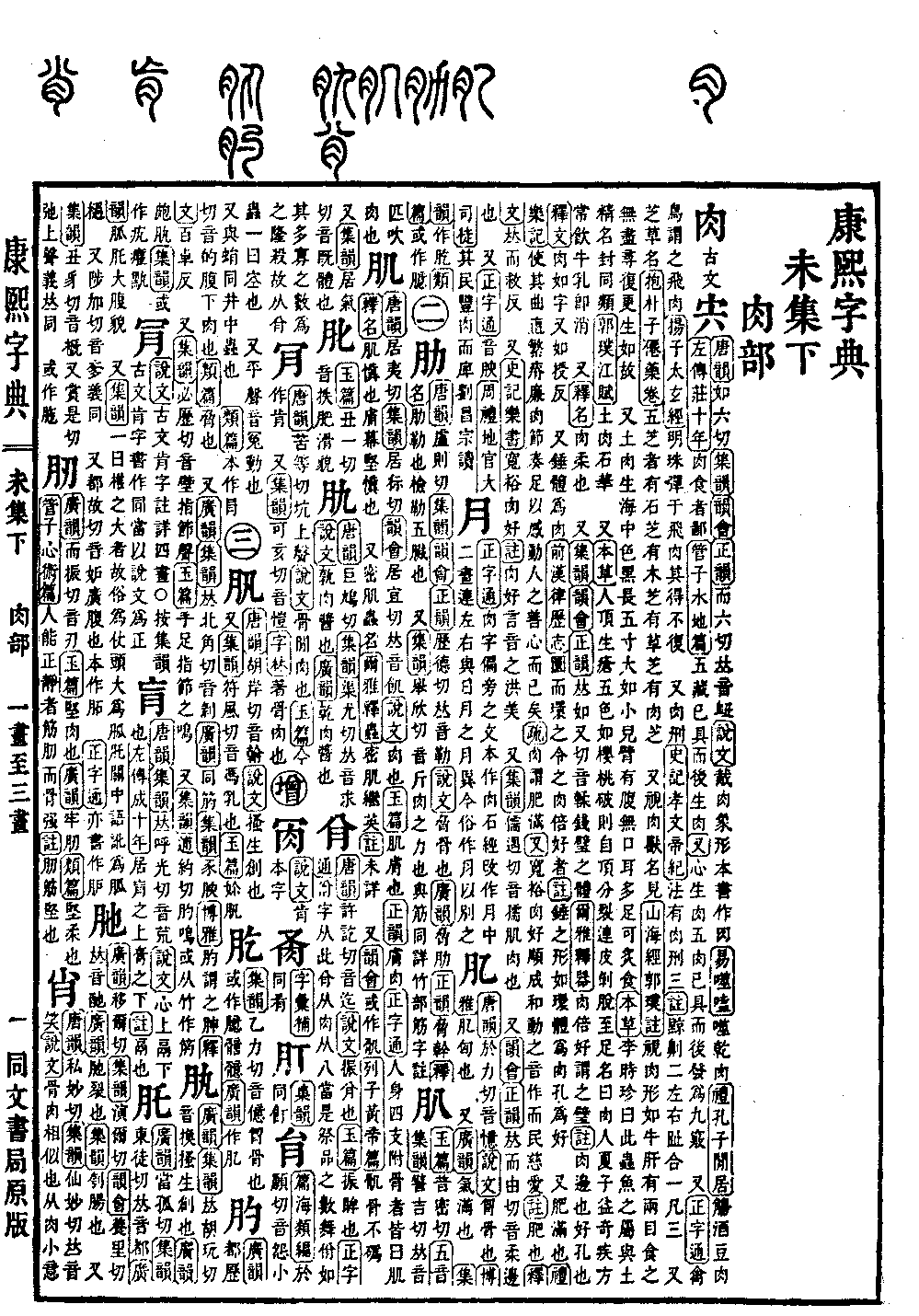
Wei Collection, Lower Volume
Radical: Meat (ròu)
Page 973, Entry 25
Pronounced xiao (falling tone). Pronounced xiao (falling tone). Pronounced the same as xiao (falling tone).
Shuowen Jiezi explains this as bones and flesh being similar. The character structure is formed from meat and small, which functions both as an ideograph and a phonetic component.
Yupian explains this as similar.
Book of Documents (Shangshu), Sayings of Yue, records: Fu Yue was building a wall in the wilds of Fu Yan, and only he was similar to the sage from the dream.
Commentary explains: Xiao means similar.
Also mentioned in Book of Rites (Liji), Doctrine of the Mean, regarding the unworthiness of husband and wife.
Yang Xiong's Regional Dialect (Fangyan) records: Xiao means to imitate. The regions of Western Chu, Liang, and Yi use the term xiao.
Note explains: Xiao means similar.
Boya explains: Xiao means to resemble. It also carries the meaning of small.
Yang Xiong's Regional Dialect (Fangyan) records: In the Zhao region, small is referred to as xiao.
Pronounced xiao (level tone). Pronounced xiao (level tone). Pronounced the same as xiao (level tone). The meaning is to wane or decline.
Records of the Grand Historian (Shiji), Preface of the Grand Historian, records: The states of Shen and Lu have waned.
Note: Xu Guang says: Xiao is pronounced the same as xiao. Xiao implies to wane. It also carries the meaning of being lost or dispersed.
Zhuangzi, Lie Yukou, records: Those who pursue intellectual cleverness to excess will become dispersed.
Note: Xiao means to be lost or dispersed.
Also used as a personal name. Zhou Xiao was a minister of the state of Wei. Found in Strategies of the Warring States (Zhanguoce).
Jiyun notes it is sometimes written in the variant form qiao. It is also written as xiao.