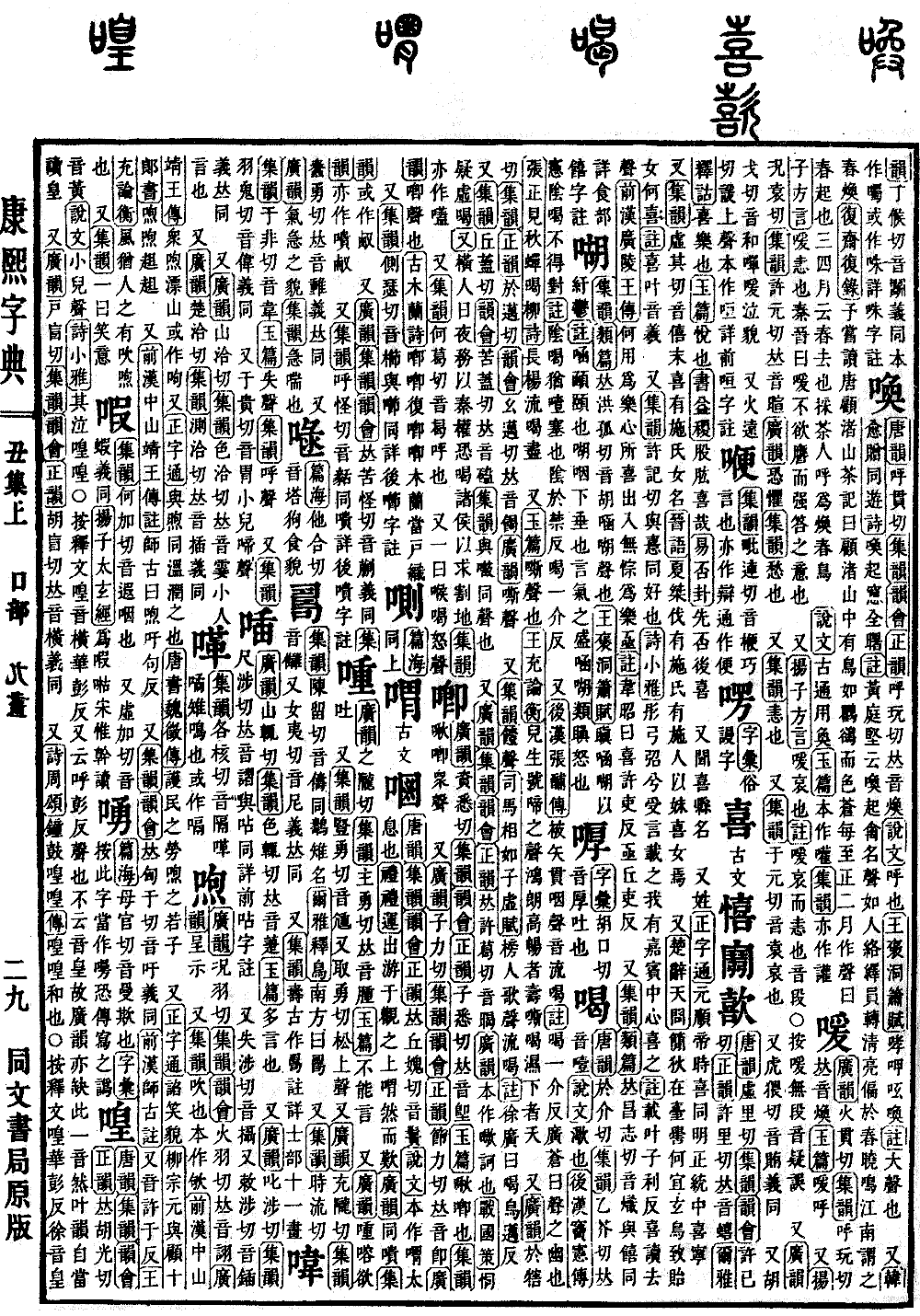
Chou Collection, Upper Volume
Radical: Mouth (kǒu)
Entry: Kui
Kangxi Stroke Count: 12
Page 199, Entry 14
Ancient text:
According to Tang Rhymes (Tangyun), Collected Rhymes (Jiyun), Rhyme Meetings (Yunhui), and Orthodox Rhymes (Zhengyun), it is pronounced kui. According to Explaining Graphs and Analyzing Characters (Shuowen), it was originally written as a variant form, meaning to sigh deeply. In the Book of Rites (Liji), it is written: He went out to travel above the terrace, sighing deeply (kui) with a lament. According to Extensive Rhymes (Guangyun), it is the same as the character kui. According to Collected Rhymes (Jiyun), it is sometimes also written in a variant form. Also, according to Extensive Rhymes (Guangyun), Collected Rhymes (Jiyun), and Rhyme Meetings (Yunhui), it is pronounced kuai. The meaning is the same. According to Collected Rhymes (Jiyun), it is also written as the character kui. Also, according to Collected Rhymes (Jiyun), it is pronounced huai. It is the same as the character kui. See the note for the character kui later in the dictionary.