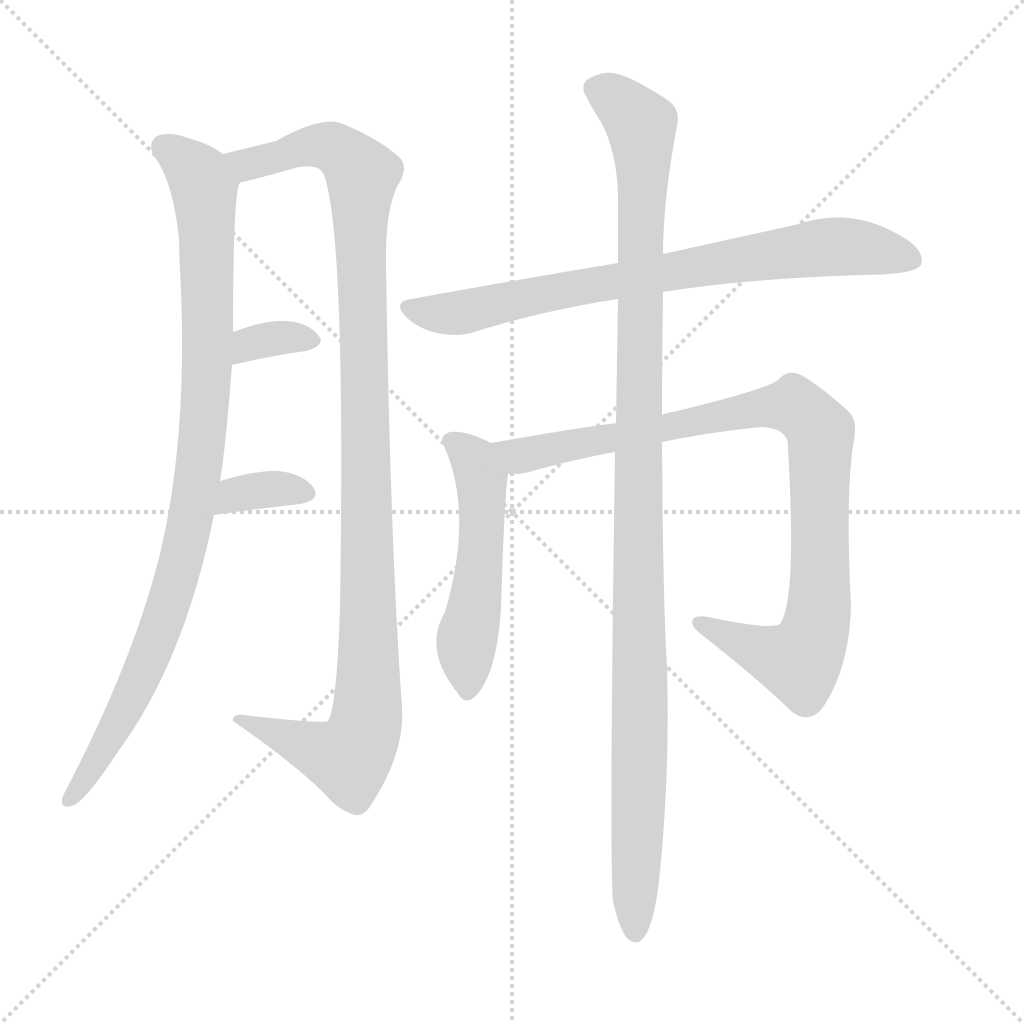
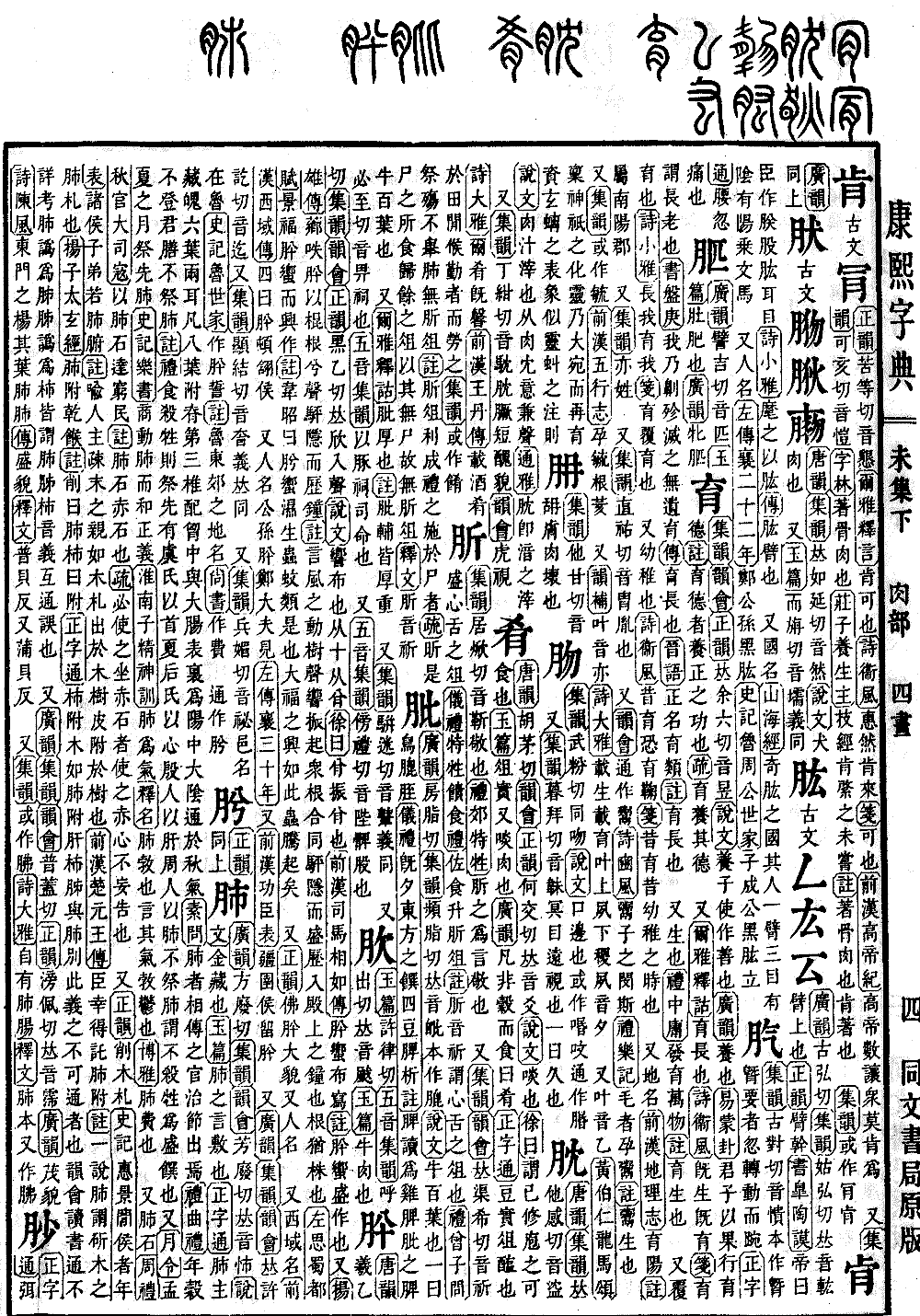
Wei Collection, Lower Volume
Radical: Flesh (ròu)
Kangxi stroke count: 10
Page 976, Entry 24
Pronounced fei (falling tone).
In the Shuowen Jiezi (Dictionary of Explaining and Analyzing Characters), it is defined as the metal organ.
In the Yupian (Jade Chapters), it is said that the word for lung is synonymous with the word for spread.
In the Zhengzitong (Proper Character Guide), it is stated that the lungs store the corporeal soul, consisting of six lobes and two ears, totaling eight lobes. They are attached to the third vertebra of the spine, correspond to the chest, and have an exterior-interior relationship with the large intestine. They are considered the great yin within the yang and connect to the energy of autumn.
In the Basic Questions (Suwen), it states that the lungs are the ministers of transmission, from which the governance of bodily functions emerges.
In the Book of Rites (Liji), in the section on Summary of the Rules of Propriety, it says: when the annual harvest is poor, the ruler should not offer the lungs in sacrifice. The commentary notes that according to the rites, when eating a slaughtered animal, one must sacrifice to the ancestors. The Yu clan offered the head, the Xia dynasty offered the heart, the Yin dynasty offered the liver, and the Zhou dynasty offered the lungs. Not offering the lungs means not slaughtering animals for a grand feast.
Also, in the Monthly Ordinances (Yueling), it is stated: in the first month of summer, offer the lungs to the ancestors.
In the Records of the Grand Historian (Shiji), in the Treatise on Music, it states that the musical note shang affects the lungs and brings harmony to proper righteousness.
In the Huainanzi (Masters of Huainan), in the section on Spiritual Training, it states the lungs are the source of energy.
In the Shiming (Explanation of Names), it says the lungs are like an obstruction, meaning their energy is repressed.
In the Boya (Broad Glossary), it says the lungs represent expenditure.
Also, lung stone. In the Rites of Zhou (Zhouli), in the Ministry of Autumn and the Office of the Grand Minister of Justice, it states: use the lung stone to reach the common people who are in distress. The commentary notes that the lung stone is a red stone. The sub-commentary explains that one must make them sit on the red stone to ensure they have a sincere heart and do not make false reports.
Also, in the Zhengzitong (Proper Character Guide), it refers to shaved wooden tablets.
In the Records of the Grand Historian (Shiji), in the Table of Years of the Princes under Emperors Hui and Jing, it mentions princes and descendants as lung and viscera. The commentary explains this is a metaphor for the ruler's distant relatives, like wooden tablets growing from a tree or bark attached to a tree.
In the History of the Former Han (Qianshan), in the Biography of Prince Yuan of Chu, it states: I am fortunate to be entrusted as lung and viscera. The commentary notes an alternate interpretation that lung refers to the shaved wooden tablets.
In the Yangzi Taixuan (Yangzi's Great Mystery), it mentions lung and viscera and dried rations. The commentary notes that a shaving is called a lung, and a layer is called a viscera.
In the Zhengzitong (Proper Character Guide), it argues that viscera being attached to wood, like lungs attached to the liver, makes viscera and lungs distinct, and this meaning is incoherent. The author of the Yunhui (Collection of Rhymes) did not examine this carefully, erroneously confusing lungs with viscera, and viscera with wood layers, claiming they all share the same sound and meaning, which is incorrect.
Also, pronounced pei (falling tone).
In the Guangyun (Broad Rhymes), it means the appearance of luxuriant growth.
In the Book of Odes (Shijing), in the Airs of Chen, it says: By the eastern gate grow the poplars, their leaves are lush and dense. The commentary states this describes a lush appearance. The explanation of the text notes this can be read as pei.
Also, in the Jiyun (Collection of Rhymes), sometimes written as a variant form.
In the Book of Odes (Shijing), in the Greater Odes, it says: They have their own hidden motives. The explanation of the text notes that the character for lung was originally also written as a variant form.