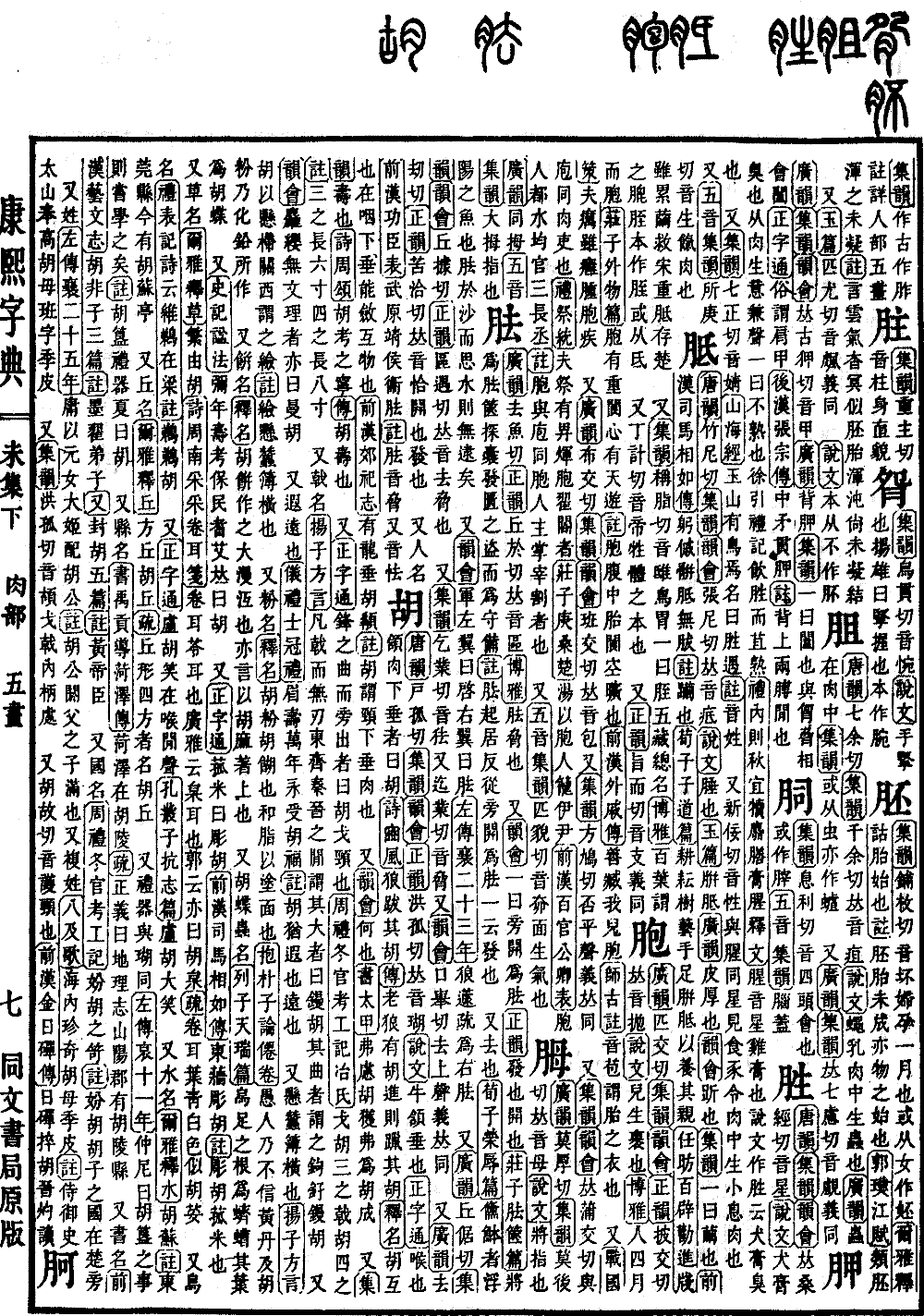
Wei Collection, Lower Volume
Radical: Meat (ròu)
胝
Kangxi stroke count: 11
Page 979, Entry 08
Pronounced zhi. Pronounced the same as zhi.
According to the Explaining Graphs and Analyzing Characters (Shuowen Jiezi), it refers to the sole of the foot.
According to the Jade Chapters (Yupian), it refers to the hardened skin on the hands or feet.
According to the Expanded Rhyme Dictionary (Guangyun), it means thick skin.
According to the Dictionary of Rhymes (Yunhui), it refers to the thick skin formed on the hands and feet due to friction.
According to the Collected Rhymes (Jiyun), another definition is a callus.
In the Biography of Sima Xiangru from the History of the Former Han (Qian Han Shu), it is written: personally laboring, with hands and feet worn to calluses, and hair worn away from the legs. The commentary notes that this refers to the thick skin on the hands and feet.
In the Way of the Son chapter of the Xunzi, it is written: plowing fields and planting trees, with hands and feet calloused, to support one's parents.
In Ren Fang’s Memorial Urging the Emperor to Accept the Throne (Bai Pi Quan Jin Jian), it is written: Even if one were to wear down the feet with layers of calluses to save the State of Song, or wear down the feet with heavy layers of thick skin to preserve the State of Chu.
Also, according to the Collected Rhymes (Jiyun), it is pronounced cheng zhi, sounding the same as the character mentioned. It refers to the gizzard of a bird. Another view suggests it is the same as chi, which is a general term for the five internal organs.
According to the Erya (Boya), the omasum, or the stomach of ruminants such as cows and sheep, is called pi chi. It was originally written as chi. Sometimes it is written with the component di.
Also, it is pronounced le ji, sounding the same as di. It refers to the fundamental part of the animal body used in sacrificial offerings.
Also, according to the Corrected Rhymes (Zhengyun), it is pronounced zhi er, sounding the same as zhi. The meaning is the same.