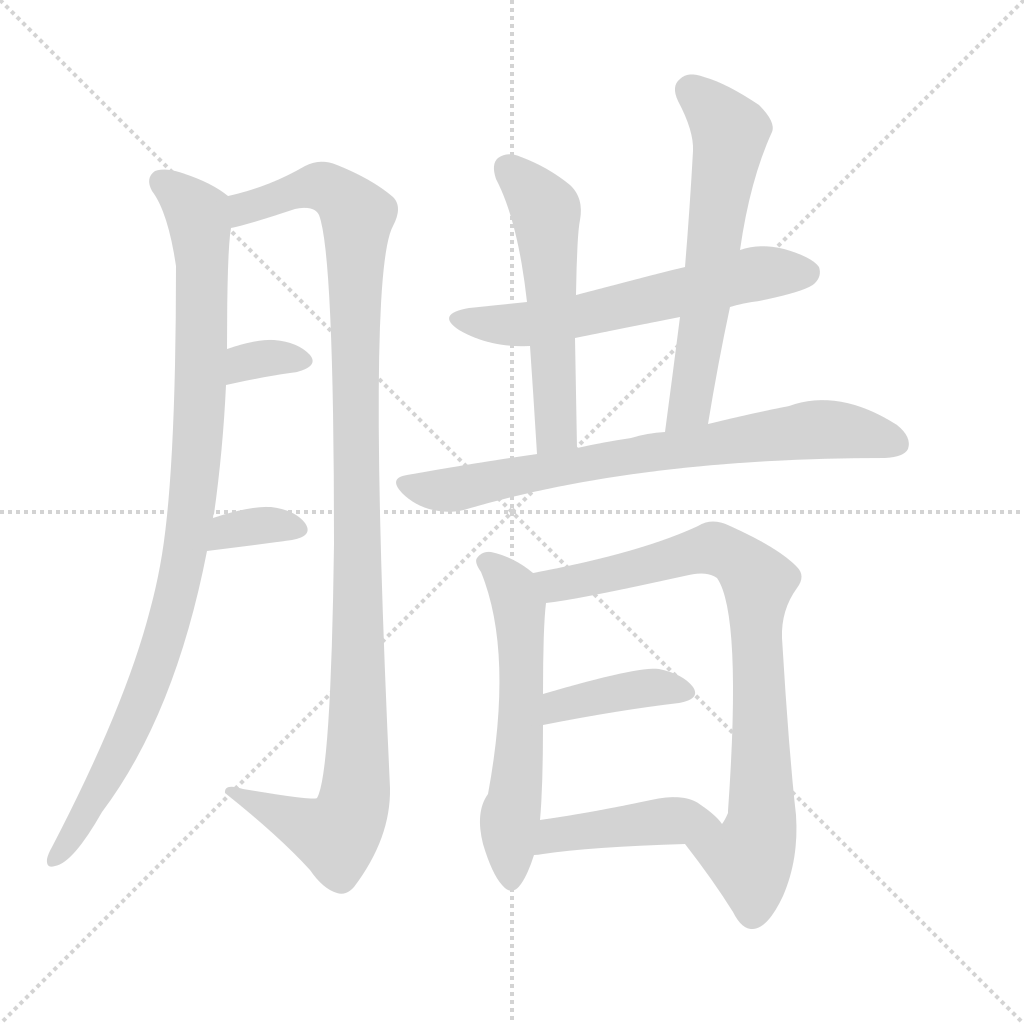
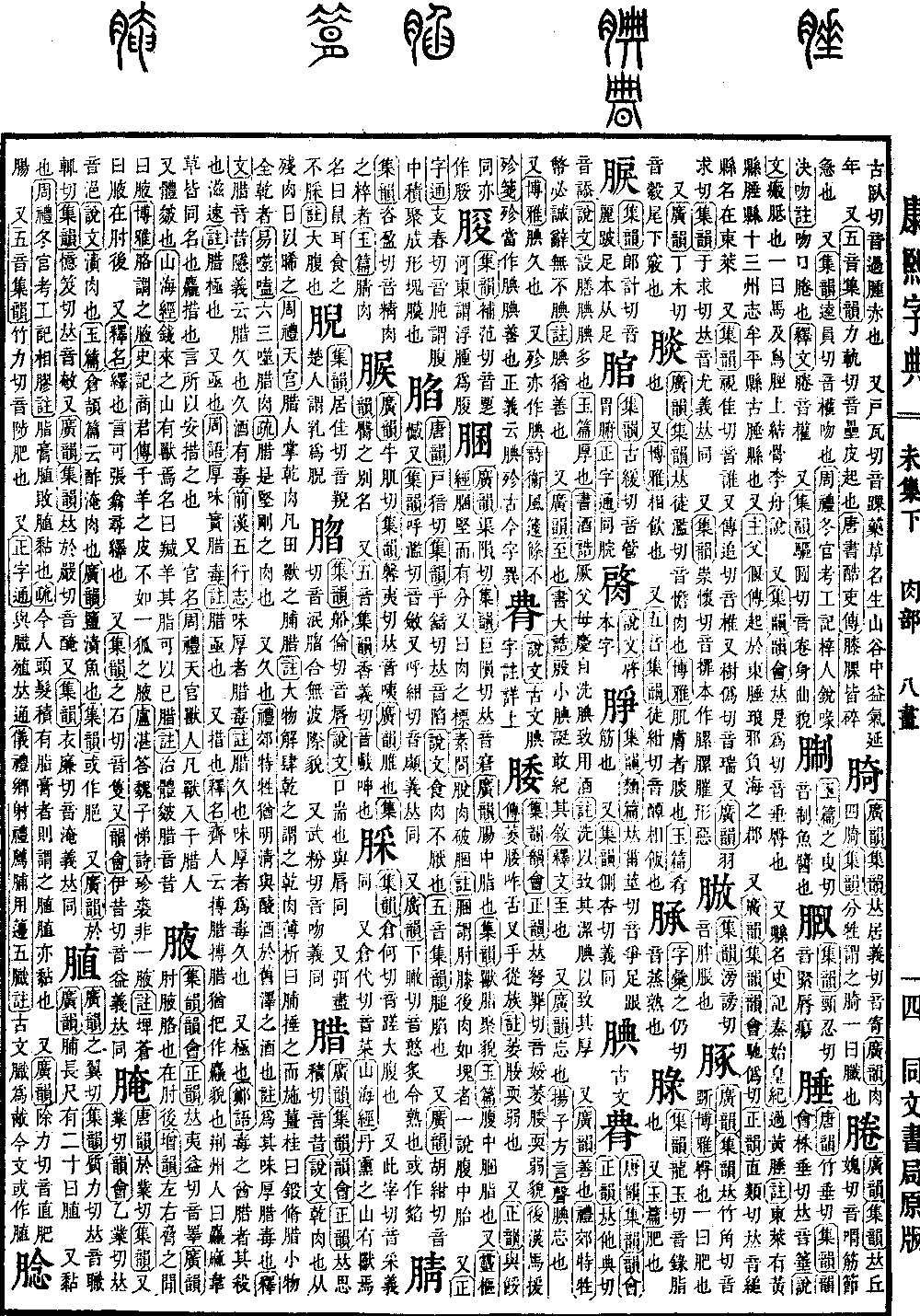
Wei Collection, Lower Volume
Radical: Meat (ròu)
Kangxi Strokes: 21
Page 986, Entry 27
Guangyun, Jiyun, Yunhui, Zhengyun: Pronounced xi.
Shuowen Jiezi: Dried meat. Composed of the character for meat with the sun symbol, signifying drying in the sun.
Book of Rites (Zhouli), Office of the Heaven: The official in charge of dried meat, overseeing the preserved and dried meat from game obtained during hunting.
Commentary: Large animals are butchered and dried, referred to as dried meat. Thinly sliced pieces are called fu, while pounded meat seasoned with ginger and cinnamon is called duanxiu. La refers to small animals dried whole.
Book of Changes (Yijing), Shihe hexagram: Six in the third place, biting on dried meat.
Sub-commentary: La refers to meat that is firm and dry.
Also: Long duration.
Book of Rites (Liji), Jiao Te Sheng: Like offering clear wine and wine from old stores. Commentary: Because its flavor is thick and the poison is persistent (la).
Explication of Texts: La, pronounced xi. The hidden meaning says: La means long duration. Long-stored wine is toxic.
History of the Former Han (Qian Hanshu), Treatise on the Five Elements: Thick flavors are poison that persists (la).
Commentary: La means long duration. Flavors that are thick have a toxicity that lasts a long time.
Also: Ultimate.
Discourses of the States (Guoyu), Zheng Yu: When poison reaches its extreme (la), the resulting death is increasingly rapid.
Commentary: La means extreme.
Also: Urgent.
Discourses of the States (Guoyu), Zhou Yu: Thick flavors are truly urgent (la) poison.
Commentary: La means urgent.
Also: To place.
Shiming: People of Qi refer to gripping and placing as la; it implies something rough or coarse. People of Jingzhou refer to coarse hemp or woven grass by the same name. Coarse means to place, referring to items used to arrange or dispose of things.
Also: A title of an official.
Book of Rites (Zhouli), Office of the Heaven, Beast Official: All beasts are entered into the account of the dried meat official.
Also: To treat chapped skin.
Classic of Mountains and Seas (Shanhaijing): On Qianlai Mountain, there is a beast called a yang goat; its fat can be used to treat chapped skin.
Commentary: Treats body chapping. La is pronounced xi.
La
Guangyun: Pronounced la.
Shuowen Jiezi: The third Xu day after the winter solstice, a sacrificial ceremony to all spirits.
Book of Rites (Liji), Monthly Ordinances: In the first month of winter, perform the la sacrifice to ancestors and the five categories of sacrificial objects.
Commentary: This is the la sacrifice mentioned in the Book of Rites (Zhouli).
History of the Former Han (Qian Hanshu), Annals of Emperor Wu: Offerings to doors and thresholds follow the pattern of the la sacrifice.
Commentary: La is the sacrificial ceremony to all spirits performed after the winter solstice.
Also:
Biography of Chen Sheng: In the la month, Chen Sheng arrived in Ruyin.
Commentary: Zhang Yan says: The la month of the Qin dynasty corresponds to the ninth month of the Xia dynasty. Chen Zan says: It is the month of the building of the Chou (the twelfth month of the Xia calendar).
Also:
Zhengzitong: Fengsu Tong and Cai Yong's Duduan both state that the Xia dynasty called it qingsi, the Yin called it jiaping, the Zhou called it la, and the Han called it la. One source states that the Monthly Ordinances mentions the la sacrifice to ancestors and the five sacrificial objects, which has existed since antiquity and did not begin in the Han dynasty.
Also: Zheng Xuan's commentary on the Monthly Ordinances states that la is the same as the la sacrifice mentioned in the Book of Rites (Zhouli). It is unknown that the la sacrifice is for ancestors and the la sacrifice mentioned in the Zhouli is for all spirits; these are two different ceremonies, and Zheng Xuan's conflation of the two is erroneous.
Also: Jin dynasty scholar Zhang Liang argued: La signifies continuity, and sacrifices are appropriate when shifting between the old and the new. Popularly, the day after la is called the beginning of the year; since the Qin and Han dynasties, there has been a custom of offering congratulations, all of which are customs inherited from ancient times.
Also: Taoist texts state there are five las: the first day of the first month is the heavenly la, the fifth day of the fifth month is the earthly la, the seventh day of the seventh month is the moral la, the twelfth day of the tenth month is the people's annual la, and the la day of the twelfth month is the noble la.
Also:
Boya: La means to seek or to demand.
Also: Refers to the edge of a sword.
Book of Rites (Zhouli), Winter Office, Artificers' Record: The Tao school crafts swords; the sword body is two and a half inches wide.
Commentary: La refers to the two edges of the sword.
Sub-commentary: The two edges refer to the blade on both sides.
Also:
Zhengzitong: Zhenla, the name of a southern barbarian kingdom.
Also:
Jiyun: Pronounced lie. Meaning is the same.