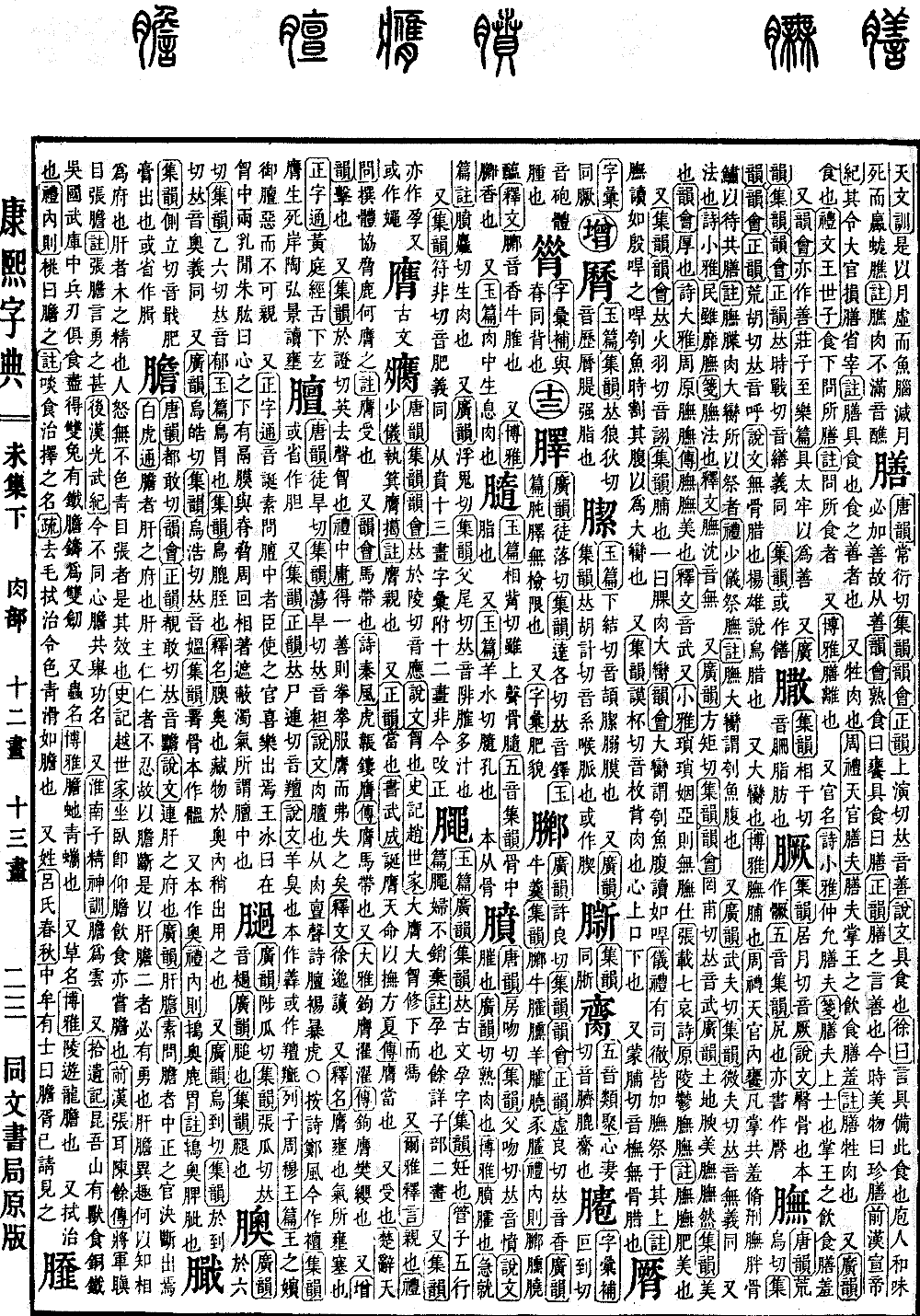
Wei Collection, Lower Volume
Radical: Meat (ròu)
膻
Kangxi Strokes: 19
Page 995, Entry 19
Pronounced tan (rising tone)
According to the Explanation of Simple and Compound Characters (Shuowen Jiezi), it refers to the smell of meat. It is formed from the radical for meat and a phonetic component indicating a level or flat sound. In the Book of Odes (Shijing), it appears in the phrase, "Wearing a sleeveless garment over the skin while attacking a tiger." Note: In the Zheng Wind section of the Book of Odes, it is currently written with a different radical.
In the Collection of Phonology (Jiyun), it is sometimes abbreviated as the character for gall.
Also pronounced shan
According to the Explanation of Simple and Compound Characters (Shuowen Jiezi), it refers to the smell of sheep. It was originally written with the radical for sheep tripled, and sometimes written in a variant form.
In the Liezi, specifically the chapter on King Mu of Zhou, it states: "The king's concubines had a pungent odor and could not be approached."
Pronounced dan (falling tone)
In the Essential Questions (Suwen), it states: "The center of the chest is the official who serves the ruler; joy and happiness emerge from it." Wang Bing comments: "It is located in the center of the chest, between the two breasts." Zhu Gong says: "Below the heart there is a diaphragm, which connects all around to the spine and the ribs, blocking and shielding turbid energies; this is what is called the center of the chest."