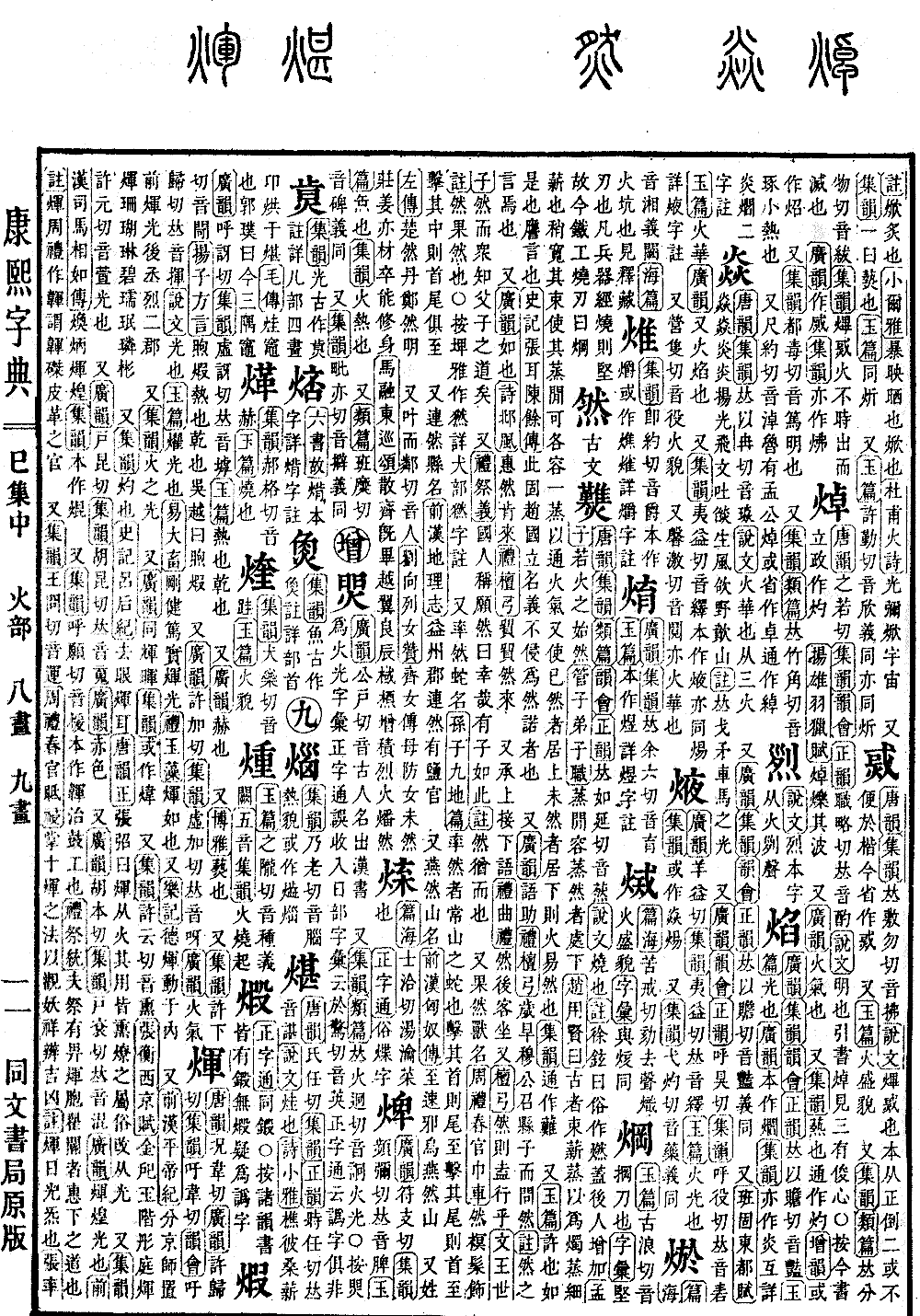
Si Collection, Middle Volume
Radical: Fire (huǒ)
Kangxi Strokes: 12
Page 675, Entry 12
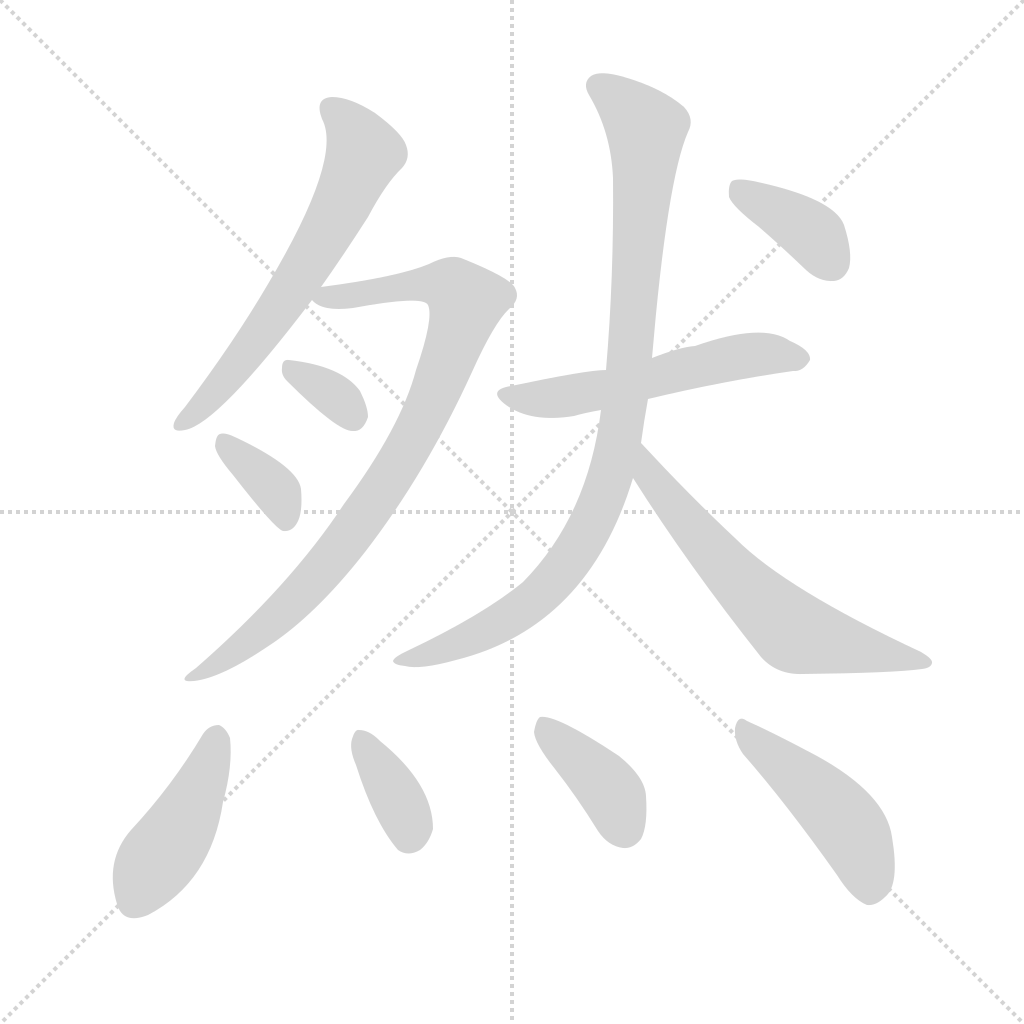
In ancient script. Pronounced rán.
According to the Shuo Wen Jiezi (Explaining Graphs and Analyzing Characters), it means to burn. Xu Xuan noted that the common form is written with an additional fire radical, added by later generations.
As in the Mencius: If a fire has just begun to burn.
In the Guanzi (Book of Master Guan), chapter Disciple's Duties: In the spaces between bundles of firewood, allow for another bundle; place the already burning ones at the bottom. Liu Ji stated: In ancient times, bundles of firewood stalks were used as candles. Stalks are thin firewood. By loosening the bundle slightly so that each gap can accommodate another bundle, the air for the fire can circulate. Furthermore, by placing those already burning at the bottom and those not yet burning at the top, the fire burns more easily. The Jiyun (Collected Rhymes) notes it is also written as a variant form.
Also, per the Yu Pian (Jade Chapters), it means to agree or to be thus. It is a word of response or promise. As in the Records of the Grand Historian (Shiji), biography of Zhang Er and Chen Yu: This is truly a case of the Zhao state establishing a reputation for righteousness and not encroaching upon those who keep their word.
Also, a particle used in speech. As in the Book of Rites (Liji), chapter Tan Gong: In a year of drought, Duke Mu summoned the recluse and asked him about the situation. The commentary notes that here, it functions as a modal particle.
Also, meaning like or similar to. As in the Book of Odes (Shijing), Odes of Bei: You kindly came. As in the Book of Rites (Liji), chapter Tan Gong: They came in a confused manner.
Also, a connective word linking preceding and following thoughts. As in the Book of Rites (Liji), chapter Qu Li: Only then shall the guest be seated. Also, Tan Gong: If that is the case, why not act? In the chapter Wen Wang Shi Zi: And because of this, the masses understood the way of father and son.
Also, in the Book of Rites (Liji), chapter Ji Yi: The people of the state expressed their desire and said: How fortunate to have a son such as this. The commentary notes it acts as a conjunction.
Also, Guo Ran, the name of a beast. As in the Rites of Zhou (Zhouli), chapter Office of Spring: Guo Ran. Painted with lacquer. The commentary notes that Guo Ran is a type of monkey. According to the Pi Ya (Essential Reference), it is written as the character for a type of monkey. Refer to the note under the Dog radical for the character guǒ.
Also, Shuai Ran, the name of a snake. As in The Art of War (Sunzi), chapter Nine Terrains: The Shuai Ran is a snake found on Mount Chang. Strike its head, and its tail arrives; strike its tail, and its head arrives; strike its middle, and both head and tail arrive.
Also, Lianran, the name of a county. As in the Book of Han (Hanshu), Treatise on Geography: In Yizhou Commandery, there is a Lianran county with a salt official.
Also, Yanran, the name of a mountain. As in the Book of Han (Hanshu), Biography of the Xiongnu: They reached the Suxiewu Yanran Mountain.
Also, a surname. As in the Zuo Tradition (Zuozhuan): Ran Dan of Chu and Ran Ming of Zheng.
Also, rhyming with lín, pronounced rén. In the eulogy by Liu Xiang for the Biographies of Exemplary Women: The governess of the woman of Qi prevented the maiden from acting improperly; Zhuang Jiang also had talent, and in the end, she was able to cultivate her character. In the poem Eastern Tour Eulogy by Ma Rong: When the ritual fasting is completed, the auspicious day arrives; the firewood is piled high, and the raging fire burns bright.