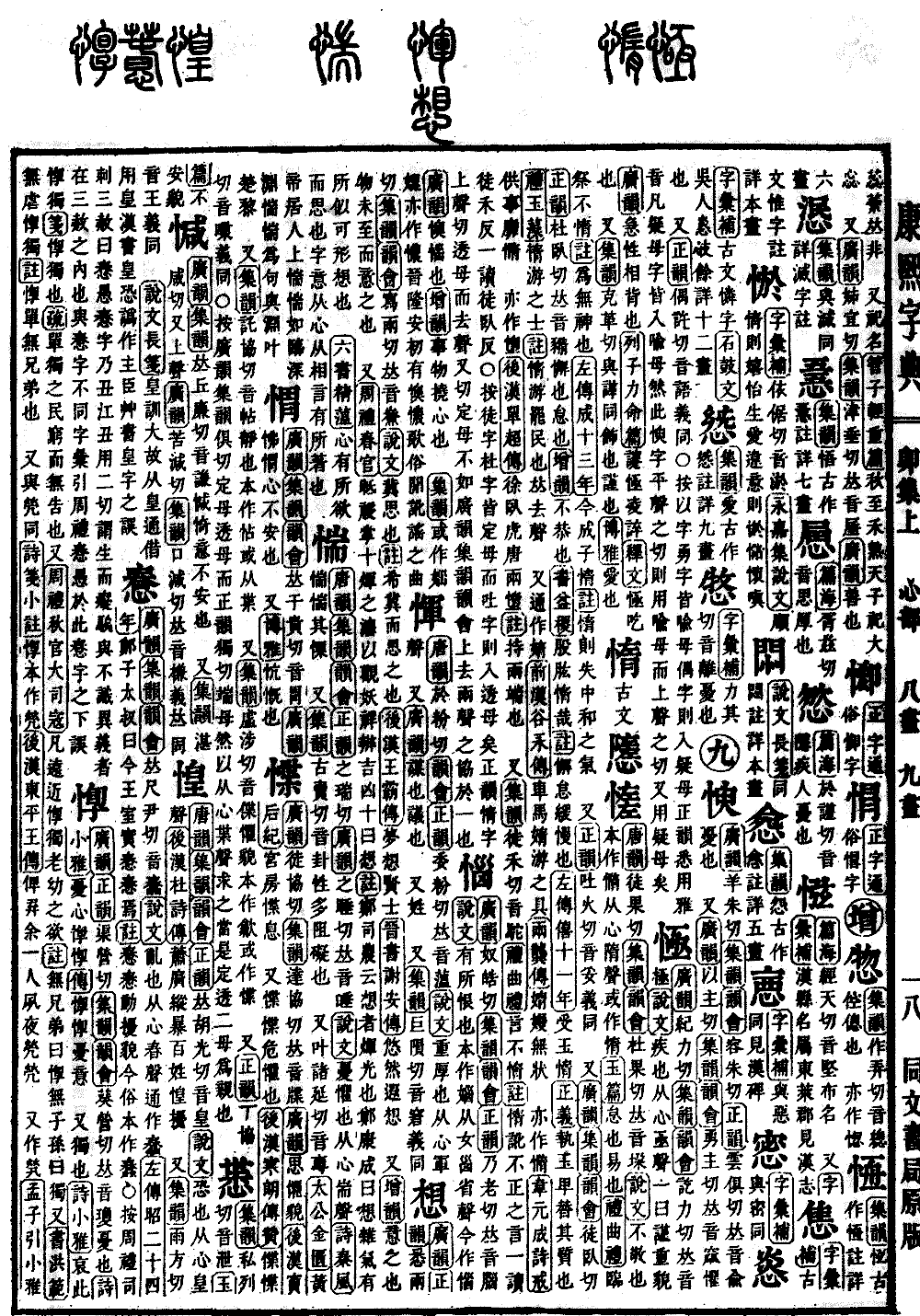
Mao Collection, Upper Volume
Radical: Heart (xīn)
Kangxi Strokes: 13
Page 392, Entry 21
Ancient form. Pronounced duo (third tone). In the Shuo Wen Jie Zi (Explaining Graphs and Analyzing Characters), it means lack of respect. Originally written as the character composed of heart and the sound element sui. Alternatively written as the current character. In the Yu Pian (Jade Chapters), it means idle or easy. In the Book of Rites (Liji), specifically the Qu Li chapter, it states, "When approaching a sacrifice, do not be idle." The commentary notes this is because there is no sense of the divine. In the Zuo Zhuan (Chronicle of Zuo), under the thirteenth year of Duke Cheng, it states, "Now Chengzi is idle." The commentary notes that idleness results in the loss of the harmonious spirit.
Also pronounced tuo (third tone). The meaning is the same.
Also pronounced duo (fourth tone). It means to be lax or sluggish. According to the Zeng Yun (Expanded Rhymes), it means to be disrespectful. In the Book of Documents (Shujing), specifically the Yi Ji chapter, it says, "The ministers are idle." The commentary explains this as being lazy, slow, and sluggish. In the Zuo Zhuan, under the eleventh year of Duke Xi, it mentions, "Accepting the jade with idleness." The Correct Meaning commentary states that to hold jade in such a manner is to neglect its essence. In the Book of Rites, the Yu Zao chapter refers to "the idle and wandering scholars." The commentary explains that this refers to unemployed commoners. This uses the falling tone.
Also commonly written as the variant form (tuo). In the History of the Former Han (Qian Han Shu), specifically the biography of Gu Yong, it mentions, "Carriages and horses are the tools of idle wandering." In the biography of the two Gongs, it mentions, "Idle and arrogant without propriety." Also written as the variant form (duo). In the poem of Wei Yuancheng, it mentions, "The service is not idle." Also written as the variant form (duo). In the History of the Later Han (Hou Han Shu), specifically the biography of Shan Chao, it mentions, "Xu, Wo, Hu, Tang are both idle." The commentary notes this means to hold both sides.
Also pronounced tuo (second tone). In the Book of Rites, the Qu Li chapter says, "Speech should not be idle." The commentary explains that idle speech means erroneous or incorrect words. One pronunciation is indicated by the character for 'tu' and 'he', while another is indicated by the character for 'tu' and 'wo'.
Note: The characters for 'tu' and 'du' both belong to the 'ding' initial group, while 'tu' belongs to the 'tou' initial group. The Zheng Yun (Correct Rhymes) provides a third-tone pronunciation for the 'tou' initial and a fourth-tone pronunciation for the 'ding' initial, which is not as consistent as the third and fourth tone alignments provided in the Guang Yun (Broad Rhymes), Ji Yun (Collection of Rhymes), and Yun Hui (Collection of Rhymes).