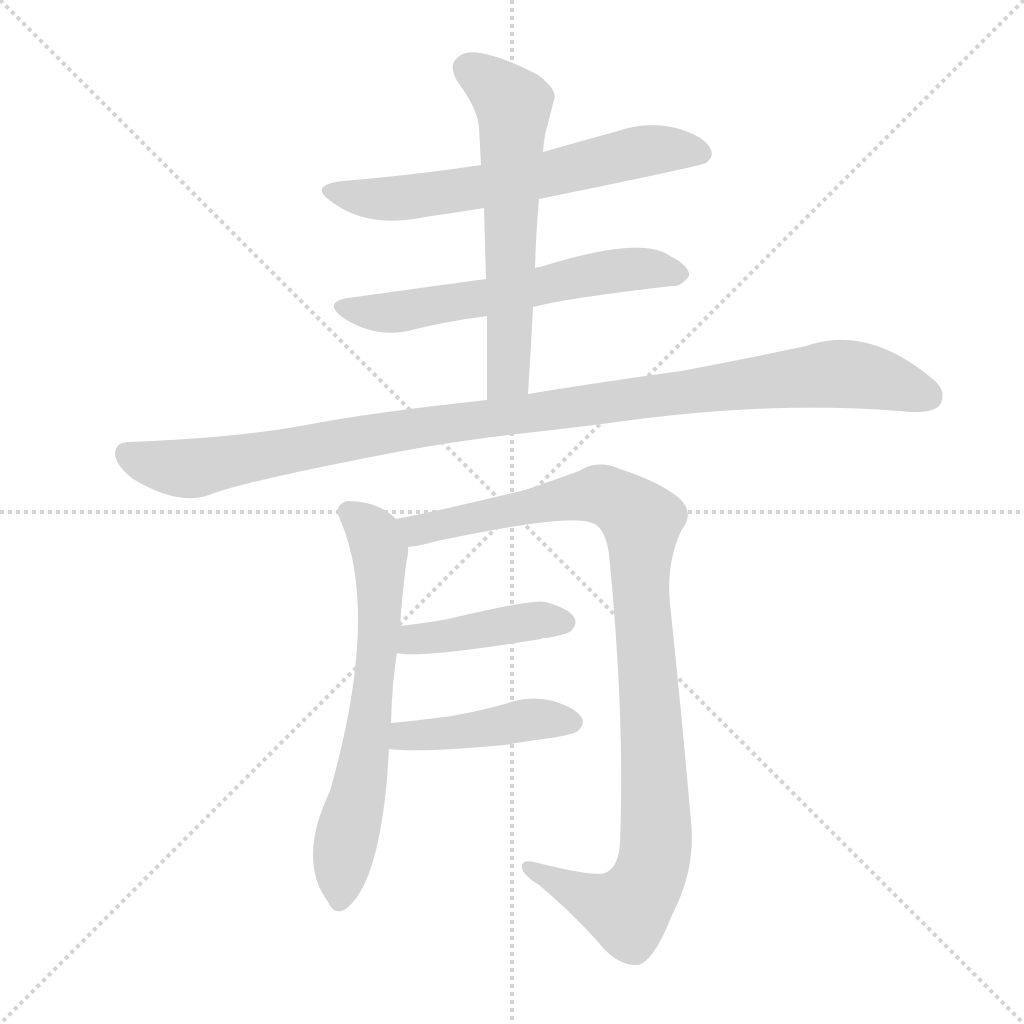
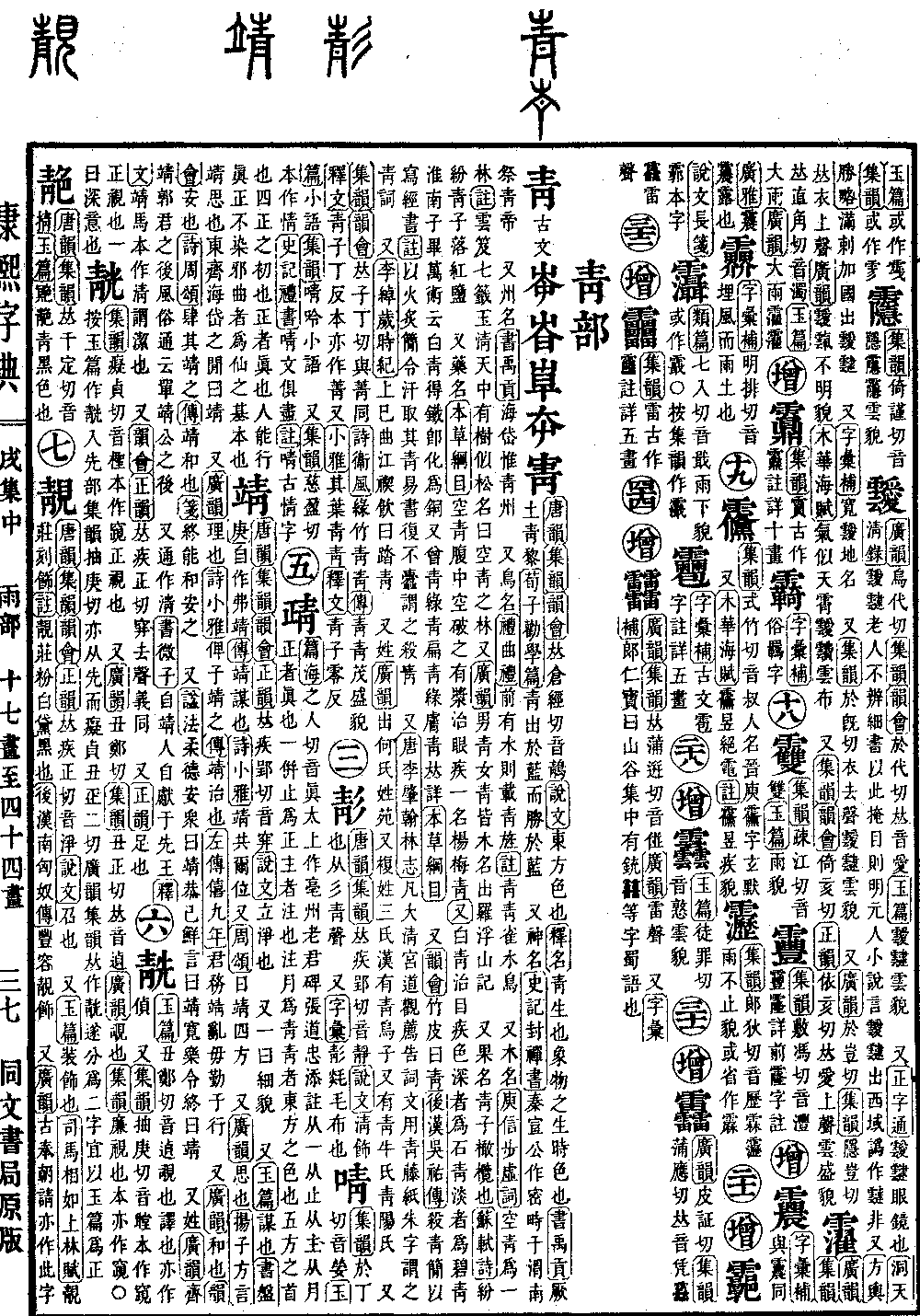
Xu Collection, Middle Volume. Radical: Blue (qīng). Kangxi Strokes: 8. Page 1381, Entry 19.
Written in ancient script as qīng.
According to Tang Rhyme (Tangyun), Collection Rhyme (Jiyun), and Rhyme Assembly (Yunhui), the pronunciation is cang jing (level tone), read the same as the character for a type of waterfowl (jīng).
Explanations from Explaining Graphs and Analyzing Characters (Shuowen Jiezi) state it is the color of the east.
Explaining Names (Shi Ming) states: Blue is the meaning of birth. It resembles the color of plants when they grow.
Book of Documents (Shujing), Tribute of Yu (Yugong) records that the soil there is blue-black.
Xunzi, Exhortation to Learning (Quanxue Pian) states: Blue is extracted from the indigo plant, but it is a deeper color than the indigo plant itself.
It is also the name of a deity. Records of the Grand Historian (Shiji), Treatise on the Feng and Shan Sacrifices (Fengshan Shu) records that Duke Xuan of Qin built the Mi Altar south of the Wei River to sacrifice to the Blue Emperor.
It is also the name of a province. Book of Documents (Shujing), Tribute of Yu (Yugong) states that the region between the great sea and Mount Tai is Blue Province (Qingzhou).
It is also the name of a bird. Book of Rites (Liji), Summary of the Rules of Propriety (Quli) states: When there is a body of water in front, raise the banner painted with a blue sparrow. The commentary states: Blue refers to the blue sparrow, a type of water bird.
It is also the name of a tree. Yu Xin, Verses on Walking in the Void (Buxu Ci) writes: The empty blue trees form a forest. The commentary cites the Seven Bamboo Tablets of the Cloudy Satchel (Yunji Qiqian), stating that in the Jade Purity Heaven, there is a tree resembling a pine tree, called the forest of empty blue.
Furthermore, Broad Rhyme (Guangyun) records: Male blue and female blue are both names of trees. Cited from Records of Mount Luofu (Luofushan Ji).
It is also the name of a fruit. Blue fruit refers to the olive. Su Shi, in his poetry, writes: The abundant blue fruits fall into red salt.
It is also the name of a medicinal substance. Compendium of Materia Medica (Bencao Gangmu) records: Empty blue is hollow in the middle, and when broken open, contains a thick liquid used to treat eye diseases. Another name is waxberry blue. It also records: White blue is used to treat eye diseases; the dark colored variety is stone blue, and the light colored variety is jade blue. Huainanzi, The Techniques of Bi Wan (Biwan Shu) states: White blue can turn into copper when it encounters iron. There are also layering blue, green blue, flat blue, and green-skinned blue; detailed records are found in Compendium of Materia Medica (Bencao Gangmu).
According to Rhyme Assembly (Yunhui), the outer skin of bamboo is called blue. Book of the Later Han (Hou Hanshu), Biography of Wu You records: Stripping the blue is used for copying classics. The commentary states: Using fire to roast bamboo slips to make them sweat (remove moisture) to obtain the blue color makes writing easy and prevents insect damage; this is called stripping the blue (shaqing).
Li Zhao, Chronicles of the Hanlin Academy (Hanlin Zhi) records: Whenever written offerings are presented to the Grand Purity Palace or Daoist temples, they are written in red ink on blue-vine paper, which is called blue text (qingci).
Li Chuo, Seasonal Records (Suishi Ji) records: During the Third Day of the Third Month festival, holding a purification feast on the banks of the Qu River is called treading the blue (taqing).
It is also a surname. Broad Rhyme (Guangyun) records it as originating from the He Family Surname Register (He Shi Xingyuan).
There are also three multi-character surnames: During the Han dynasty, there was the surname Qingwuzi. There are also the Qingniu clan and the Qingyang clan.
According to Collection Rhyme (Jiyun) and Rhyme Assembly (Yunhui), the pronunciation is zi ding (level tone). It is the same as the character for lush vegetation (jīng). Book of Odes (Shijing), Odes of Wei (Weifeng) writes: The green bamboo is lush. The commentary explains: Lush is the appearance of abundant growth. The Explanatory Text states: Blue is read as zi ding (rising tone). Some versions are also written with the character for lush vegetation (jīng).
Book of Odes (Shijing), Minor Odes of the Kingdom (Xiaoya) writes: Its leaves are lush. The Explanatory Text states: Blue is read as zi ling (rising tone).