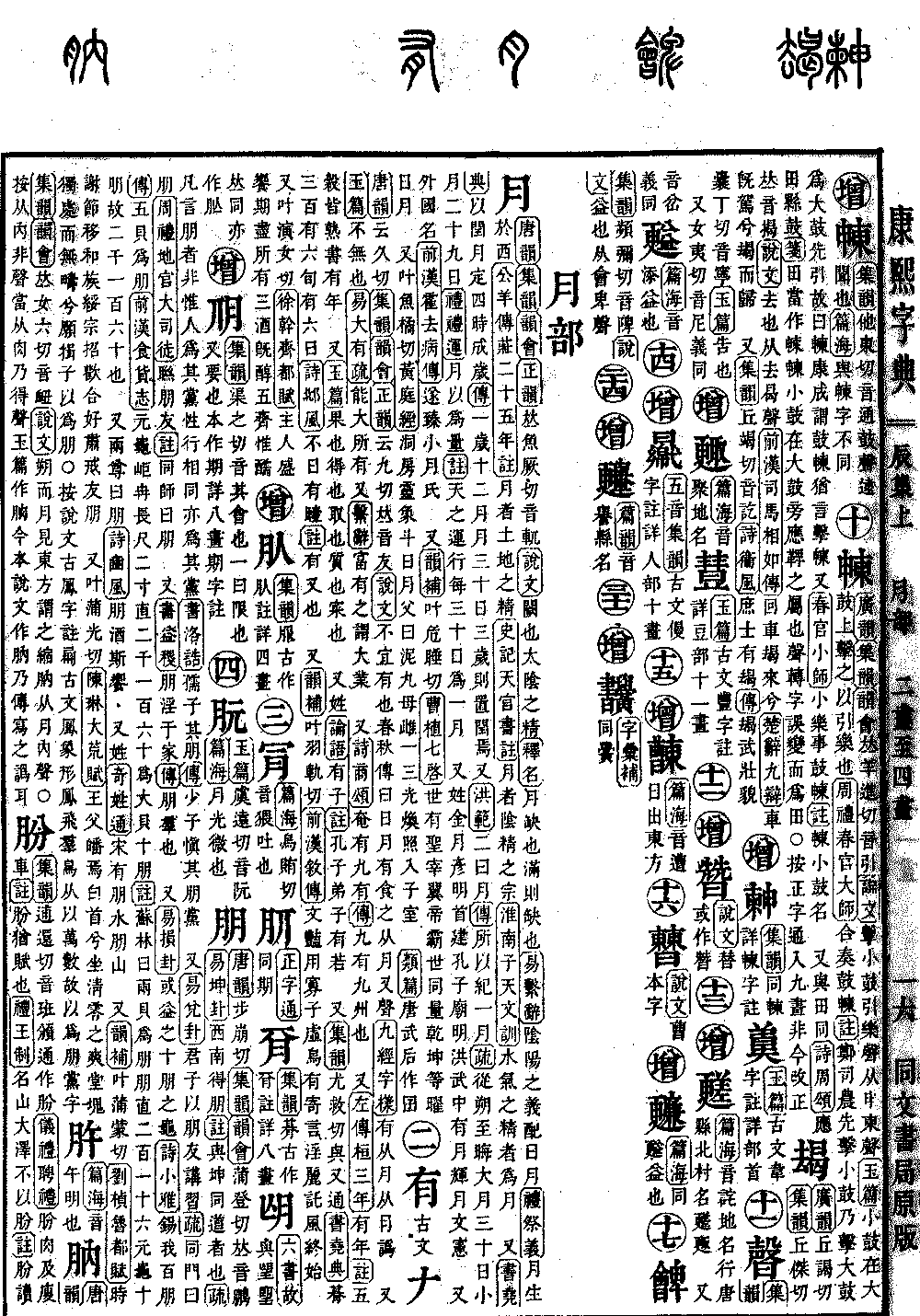
Chen Collection, Upper Volume
Radical: Moon (yuè)
Kangxi Strokes: 6
Page 504, Entry 20
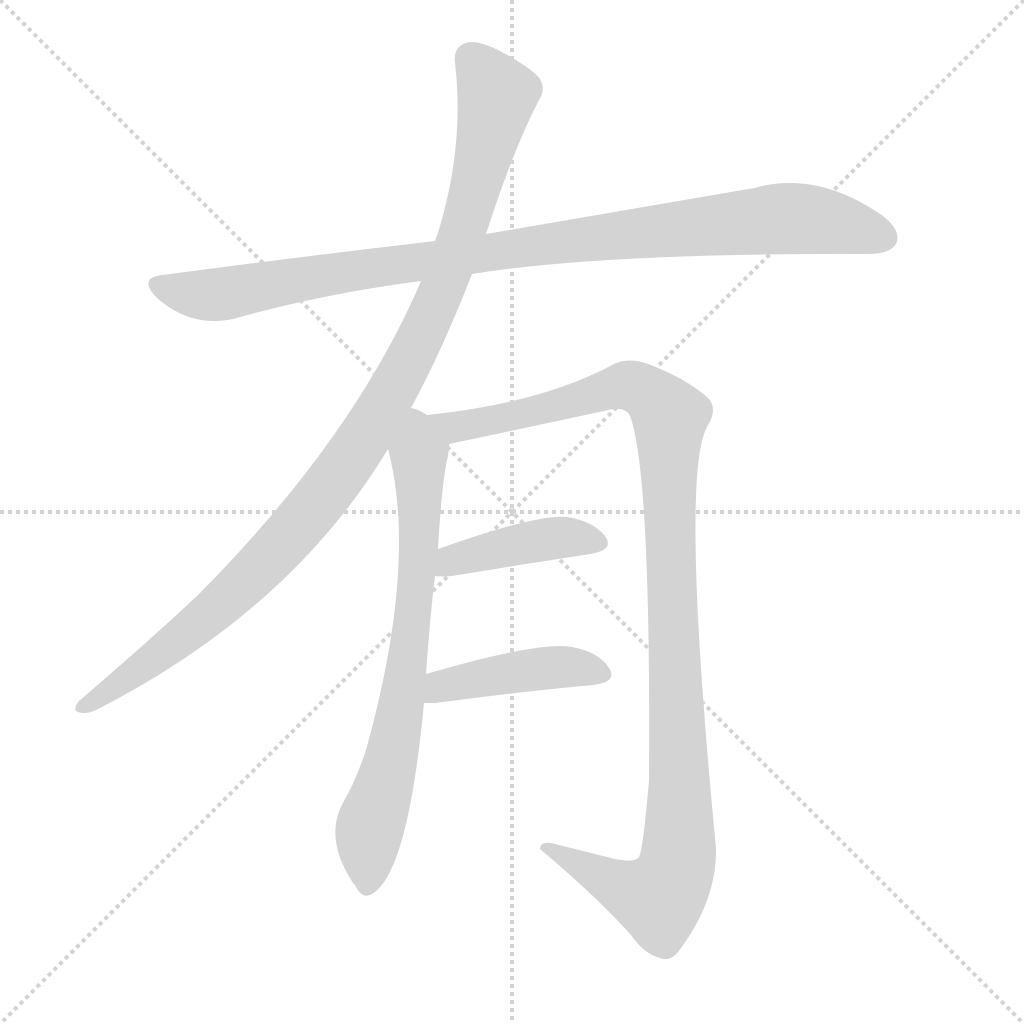
Archaic form. In Tang Rhymes (Tangyun), pronounced you (rising tone). In Collected Rhymes (Jiyun), Rhymes of the Empire (Yunhui), and Orthodox Rhymes (Zhengyun), pronounced you (rising tone).
According to the Explaining Graphs and Analyzing Characters (Shuowen Jiezi), it denotes that which is not suitable. The Spring and Autumn Annals Commentary (Chunqiu Zhuan) states: The sun and moon have eclipses. It is formed from the radical for moon and the phonetic element you. According to the Nine Classics Character Styles (Jiujing Ziyang), the character you is formed from the radical for moon. The form using the character for cap is incorrect.
Also, according to the Jade Chapters (Yupian), it denotes not empty. The Book of Changes (Yi Jing), Great Possessions Commentary (Da You Shu), states: Capable of possessing greatness. Furthermore, the Great Commentary (Xi Ci) states: Great wealth is called a grand undertaking.
Furthermore, the Book of Odes (Shijing), Shang Eulogies, states: Truly possess the nine regions. The commentary states: The nine regions are the nine provinces.
Furthermore, the Zuo Commentary (Zuo Zhuan), Duke Huan Third Year, mentions: A prosperous year. The commentary states: When the five grains all ripen, it is recorded as a prosperous year.
Furthermore, according to the Jade Chapters (Yupian), it means fruit, to obtain, to take, quality, and officials.
Also, a surname. The Analects (Lunyu) mentions: Master You. The commentary states: A disciple of Confucius named You Ruo.
Furthermore, according to Collected Rhymes (Jiyun), pronounced you (falling tone). Interchangeable with the word for also. The Book of Documents (Shujing), Canon of Yao (Yao Dian), states: A year of three hundred and sixty-six days. The Book of Odes (Shijing), Odes of Bei (Beifeng), states: Not a day without gloom. The commentary states: Here, you means also.
Furthermore, according to Rhyme Supplements (Yunbu), it rhymes with the sound gui (rising tone). In the Former Han History (Qian Han Shu), Narrative Biography (Xu Zhuan), it states: Literary beauty is used sparingly, and the existence of Zixu is null. Sentiments are expressed through excessive beauty, relying on wind to reach the end.
Furthermore, it rhymes with the sound nü (rising tone). In Xu Gan's Rhapsody on the Capital of Qi (Qi Du Fu), it states: The host offers a grand feast, hoping to exhaust all he possesses. The three types of wine are already mellow, and the five types of fermented grain are thick.