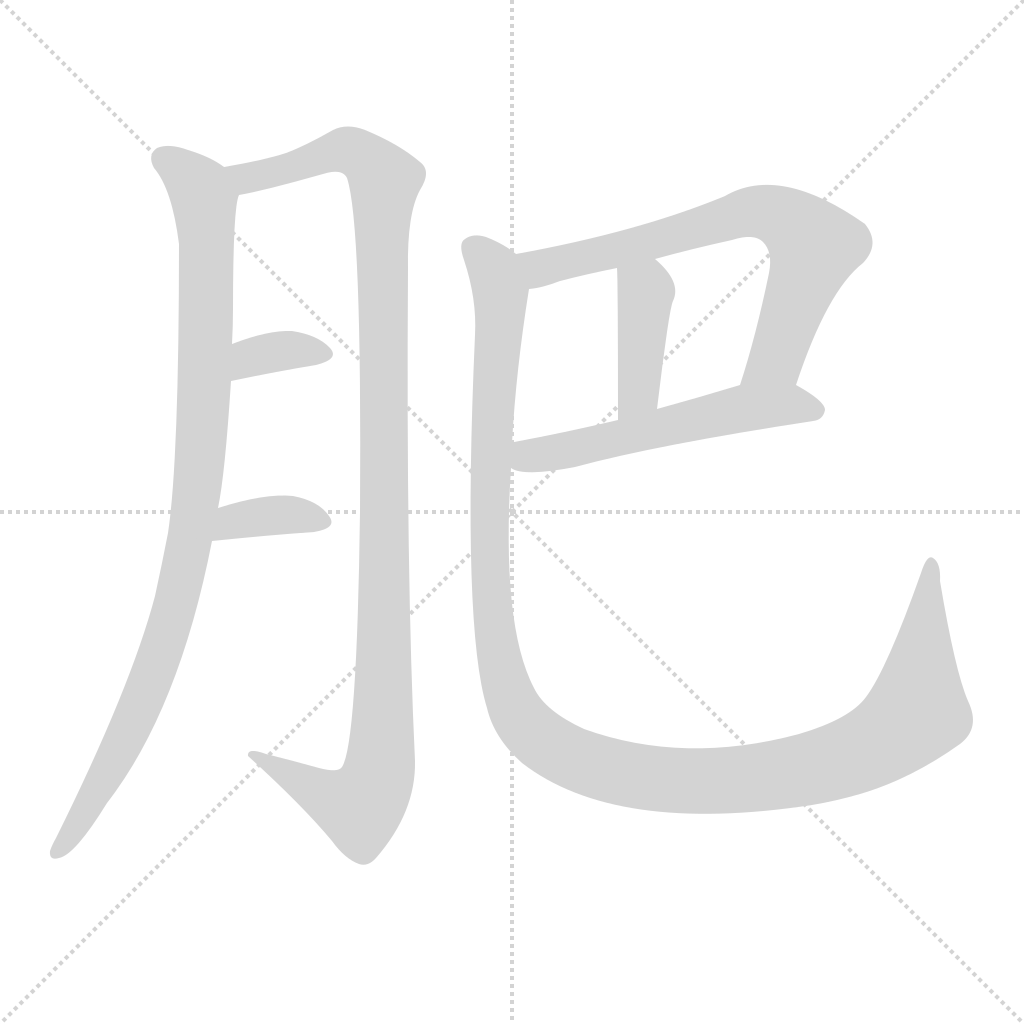
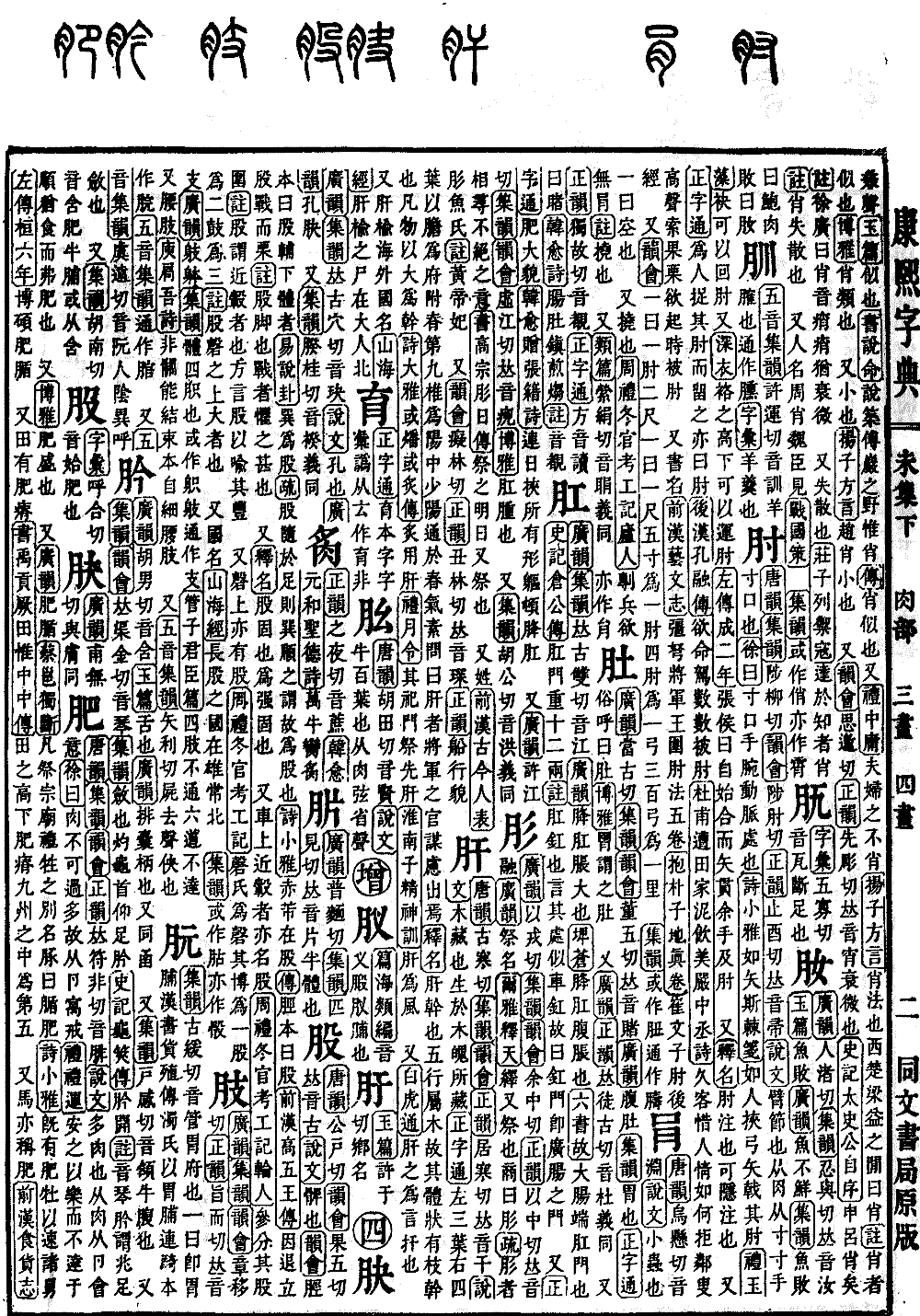
Wei Collection, Lower Volume
Radical: Meat (ròu)
Kangxi Strokes: 10
Page 974, Entry 23
Tang Rhyme (Tangyun), Collection Rhymes (Jiyun), Rhyme Meetings (Yunhui), Correct Rhymes (Zhengyun): Pronounced fei (rising tone). The pronunciation is the same as fei (rising tone).
Explaining Characters (Shuowen Jiezi): Defined as having abundant flesh. The character is a compound ideograph consisting of meat and a seal/bamboo joint component.
Xu Kai says: Meat should not be excessive, thus the seal/bamboo joint is used to represent a warning or restraint.
Book of Rites (Liji): Using music to bring people peace, yet failing to achieve harmony, is like eating food without becoming fat.
Broad Refinement (Boya): Fei implies abundance or greatness.
Broad Rhymes (Guangyun): Fei tu (referring to livestock being fat and strong).
Cai Yong, Sole Decisions (Duduan): Regarding rituals for ancestral temples, sacrificial animals each have specific names; a pig is called tu fei.
Book of Odes (Shijing): Already having fat and strong bulls, used to invite the various maternal uncles.
Zuo Tradition (Zuo Zhuan): Sacrificial animals must be large, fat, and strong.
Also, fields are divided into fertile and barren. Book of Documents (Shangshu): The commentary on the fields being of a middle grade states: fields are distinguished by high and low, fertile and barren. In the Nine Provinces, this is categorized as the fifth rank.
Horses can also be called fei. History of the Former Han (Qian Hanshu): The officials could see each other's carriage covers, riding in sturdy carriages, whipping fat and strong horses.
It also means rich and affluent. Book of Changes (Yijing): The top nine line says: fei dun (retiring in a state of comfort). Kong Yingda's commentary: Fei refers to being rich and affluent.
Also the name of a flag. Discourses of the States (Guoyu): Hoisted the fei hu flag. Commentary: Fei hu is a type of flag.
Also the name of a bird. Classic of Mountains and Seas (Shanhaijing): On Mount Ying there is a bird called fei yi.
Also the name of a snake. Classic of Mountains and Seas (Shanhaijing): On Mount Taihua there is a snake called fei. Commentary: Fei and a similar insect are both venomous creatures.
A tributary branching from a water source when it first flows out is called fei. Literary Expositor (Erya): Watercourses with different sources that eventually converge, whose common source branches, are called fei. Xing Bing's commentary: It means that while the small water branches that eventually return to the sea are different, they share a common source when first flowing from the spring; such branches are called fei.
The name of a river. Book of Odes (Shijing): I long for the Fei Spring. Kong Yingda's commentary: The Fei Spring is a river in the State of Wei.
A place name. History of the Former Han (Qian Hanshu): Hefei. Commentary: Belonged to Jiujiang Commandery. Ying Shao says: The Xia River flows out from the southeast of Fucheng and joins the Huai River here, hence it is called Hefei.
A county name. Records of the Grand Historian (Shiji): Fei Ru Marquis Cai Yin. Commentary: Fei Ru is a county name belonging to Liaoxi Commandery.
A feudal state name. Zuo Tradition (Zuo Zhuan): In autumn, the eighth month, on the day of Renwu, the Fei State was extinguished. Commentary: The Fei State was a branch of the Bai Di people.
A surname. Records of the Grand Historian (Shiji): First inquire about the late king's noble minister Fei Yi.
A person's name. Ji Kangzi's personal name was Fei. Found in Zuo Tradition (Zuo Zhuan).
Collection Rhymes (Jiyun): Pronounced bi (rising tone). The meaning is thin. Liezi: What the mouth is biased toward as thin (flavor), the people of Jin disparage. Commentary: Meaning thin.
A river name. The character fei is also used interchangeably with fei (a different character representing the same river name). Book of Odes (Shijing): I long for the Fei Spring. Lu Deming's Explanation of Text: In some versions, fei is written as the variant character fei.