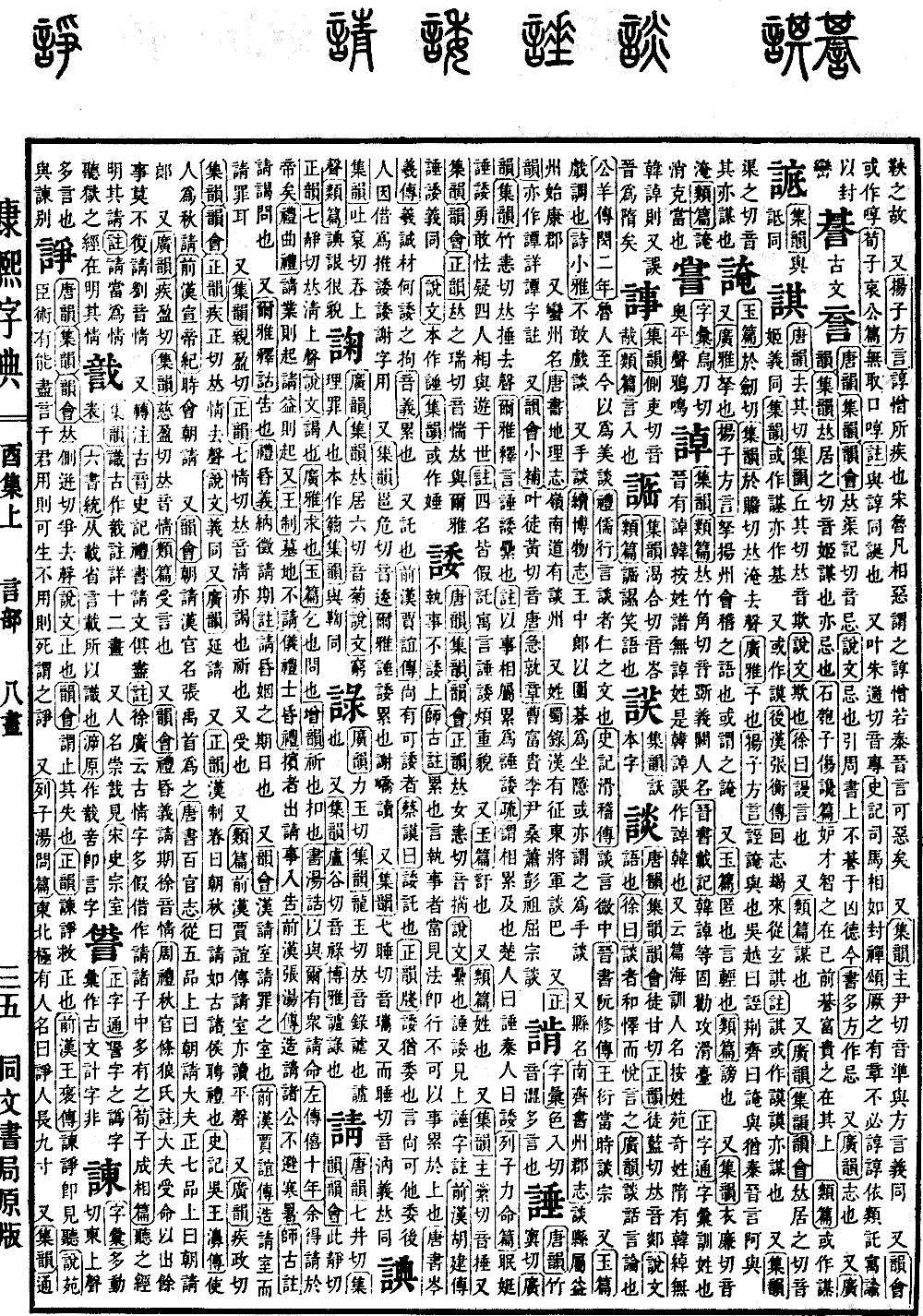
You Collection, Upper Volume
Radical: Speech (yán)
Kangxi Strokes: 15
Page 1167, Entry 01
Pronounced qǐng (rising tone)
Shuowen Jiezi (Shuowen): To visit or request an audience.
Guangya: To request.
Yupian: To beg or seek; to inquire.
Zengyun: To pray or request; to inquire.
Book of Documents (Shangshu), Tang Gao: Use this to request the preservation of lives from all of you.
Zuo Tradition (Zuo Zhuan), Year 10 of Duke Xi: I have requested and received permission from the Heavenly Emperor.
Book of Rites (Liji), Quli: When a teacher asks about studies, stand up to answer; to request further explanation, stand up.
Wangzhi: Burial grounds cannot be requested for private occupation.
Book of Etiquette and Ceremonial (Yili), Shi Hunli: The usher goes out, asks for instructions regarding the matter, and returns to report.
History of the Former Han (Qian Hanshu), Biography of Zhang Tang: To visit and pay respects to various high officials, regardless of heat or cold.
Shigu Commentary: Please means to visit and pay respects.
Also, Erya: To tell or inform.
Book of Rites (Liji), Hunyi: After the betrothal gifts are presented, request the date for the marriage.
Commentary: Requesting the date of the marriage.
Also, Yunhui: In the Han dynasty, there was a Request Chamber (qingshi), a place for admitting guilt.
History of the Former Han (Qian Hanshu), Biography of Jia Yi: Just go to the Request Chamber to admit guilt.
Also, pronounced qīng. Also meaning to visit or to request. Also meaning to accept.
Also, Leipian: In the Biography of Jia Yi in the History of the Former Han, Request Chamber is also pronounced in the level tone.
Also, pronounced qìng.
Shuowen Jiezi (Shuowen): Same meaning.
Also, to invite.
Also, Zhengyun: In the Han dynasty system, a spring audience was called chao, and an autumn audience was called qing, similar to the diplomatic visits of feudal lords in ancient times.
Records of the Grand Historian (Shiji), Biography of King Bi of Wu: Sent men to conduct the autumn court request.
History of the Former Han (Qian Hanshu), Annals of Emperor Xuan: To pay respects and greetings on time.
Also, Yunhui: Court Request (chaoqing) was a Han dynasty official title. Zhang Yu was the first to hold this position.
History of the Tang (Tangshu), Treatise on Officials: The rank of Senior Fifth Grade Upper was called Court Request Grand Master, and Senior Seventh Grade Upper was called Court Request Gentleman.
Also, pronounced qíng.
Leipian: To accept advice or speech.
Also, Yunhui: In the Book of Rites (Liji), Hunyi, the phrase request the date is read as qíng by Xu Miao.
Book of Rites (Zhouli), Autumn Official, Tiaolangshi Commentary: When an official receives orders to go abroad, all other matters must be requested again. Liu Changzong reads it as qíng.
Also, Zhuanzhu Guyin: In the Records of the Grand Historian (Shiji), Book of Rites (Lishu), the meaning of the character is fully expressed.
Commentary: Xu Guang stated: In ancient times, the character for emotion (qíng) was often used as a loan for this character; this occurs frequently in the works of the various philosophers.
Xunzi, Chengxiang: The root of hearing a lawsuit lies in clarifying the facts (qíng).
Commentary: The character should be emotion (qíng). The root of hearing and deciding a lawsuit lies in clarifying the facts.