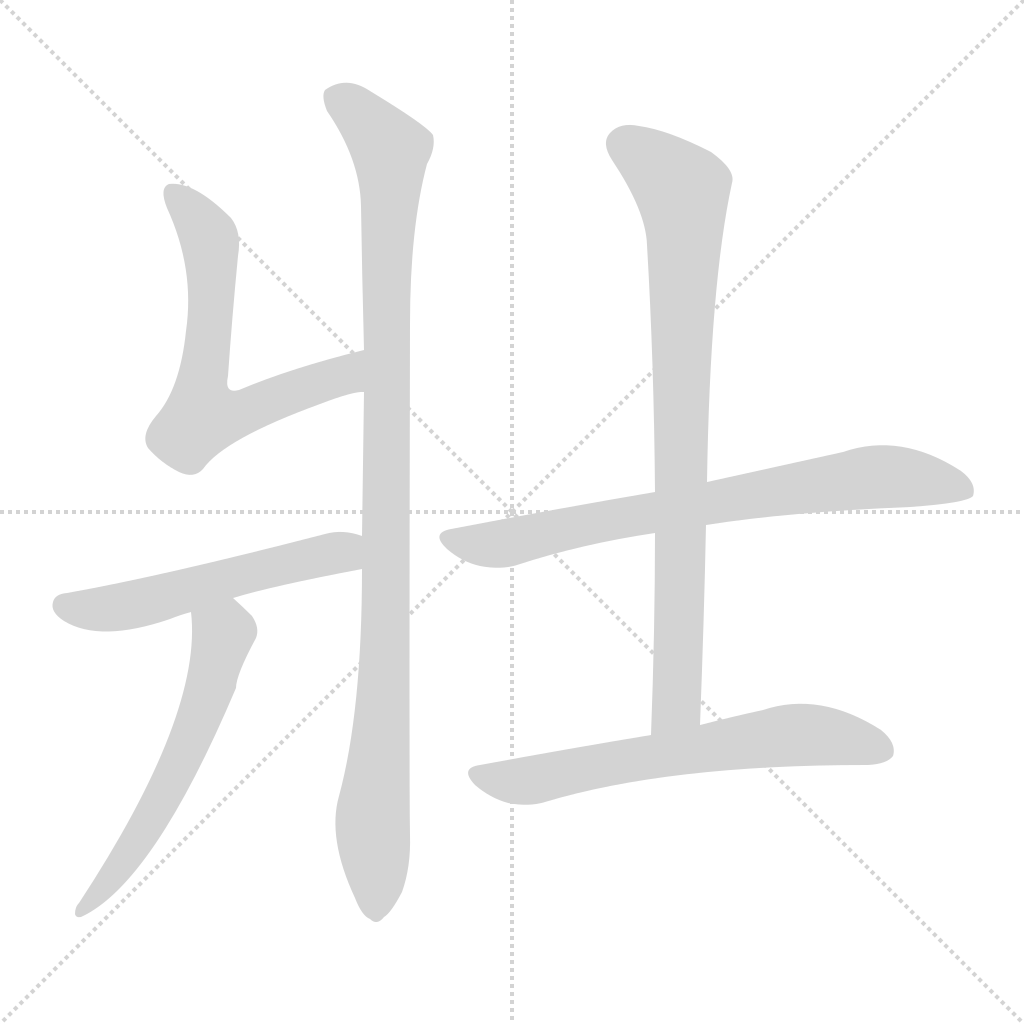
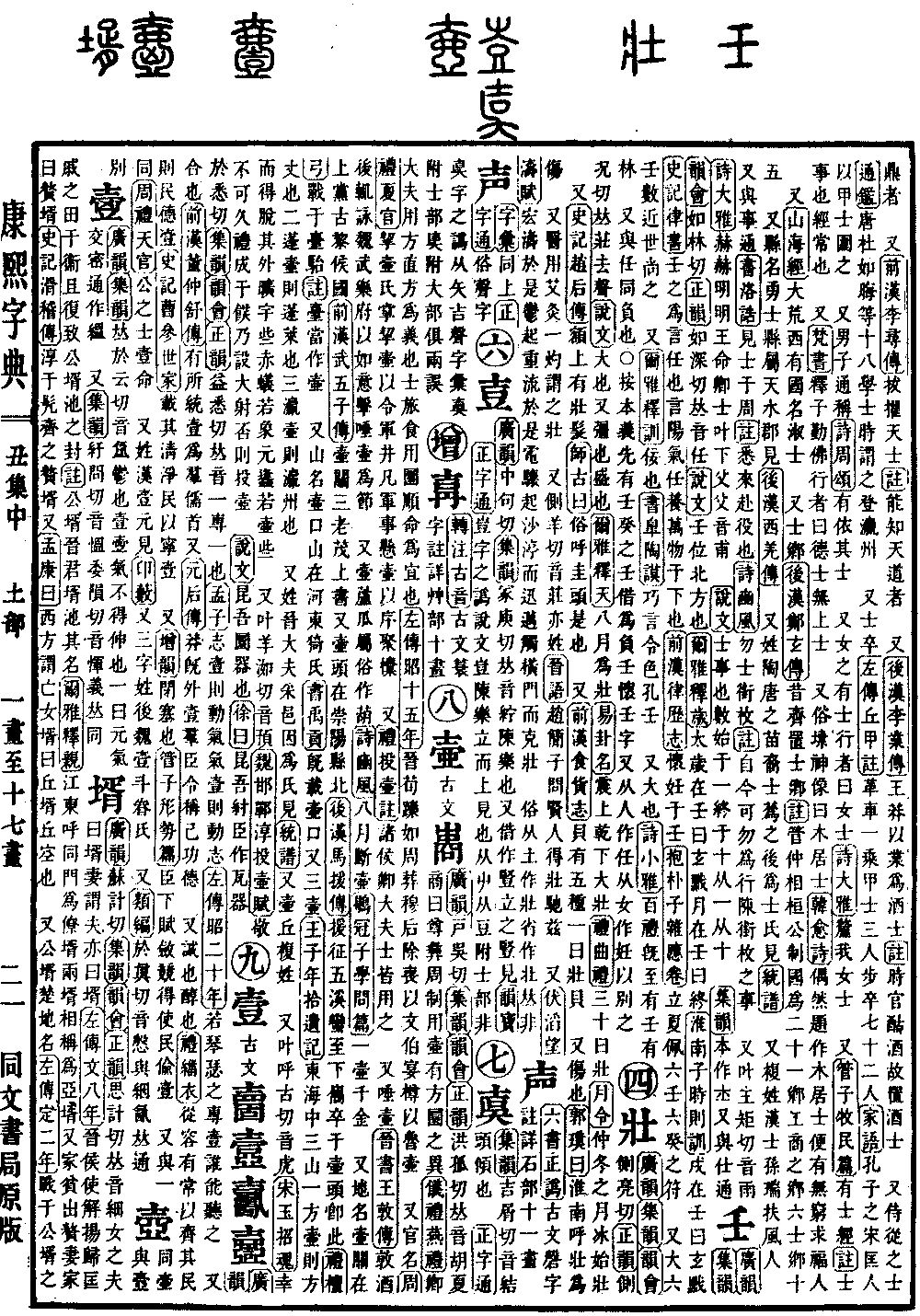
Chou Collection, Middle Volume. Radical: Scholar (shì). Kangxi strokes: 7. Page 243, Entry 02.
According to the Expanded Rhymes (Guangyun), Rhyme Collection (Jiyun), and Rhyme Meeting (Yunhui), the pronunciation is zhuang (falling tone); according to the Orthodox Rhymes (Zhengyun), the pronunciation is zhuang (falling tone). It is read as the falling tone of zhuang.
The Explaining Graphs and Analyzing Characters (Shuowen Jiezi) defines it as great. It also carries the meanings of strong, healthy, and vigorous.
The Literary Expositor (Erya), in its chapter explaining the heavens, names the eighth month as zhuang.
In the Book of Changes (Yijing), in the names of the hexagrams, the hexagram with Thunder above and Heaven below is called Great Vigor (Dazhuang).
The Book of Rites (Liji), in its chapter on summary rules, states that the age of thirty is called zhuang.
The Monthly Ordinances (Yueling) records that during the middle of winter, ice begins to become solid.
The Records of the Grand Historian (Shiji), in the biography of Empress Zhao, mentions that she had a type of hairstyle on her forehead called zhuang.
Shigu says: The popular term for this is the crest of a jade tablet.
The Book of Han (Hanshu), in the treatise on food and money, records that there were five types of cowrie shells used as currency, and the first type was called the zhuang shell.
It also carries the meaning of injury. Guo Pu says: In the Huainan region, they refer to zhuang as shang (injury).
In addition, in traditional Chinese medicine, moxibustion is used to treat illnesses, and one instance of burning is called one zhuang.
It is also read as zhuang (level tone), with the same sound as zhuang. It is also a surname.
The Discourses of the States (Guoyu), in the narratives of Jin, records that Zhao Jianzi asked about virtuous men and found Zhuang Chi-zi.
Fu Tao, in his Rhapsody on Gazing at the Tides (Wangtao Fu), writes: The vast waves rise surging, and the heavy currents rush forward like lightning. They rise from the sandbars and advance swiftly, striking the cross-gates and appearing all the more majestic.
The popular form of the character replaces the radical with earth to write the traditional form, and the simplified form is written as zhuang, both of which are incorrect.