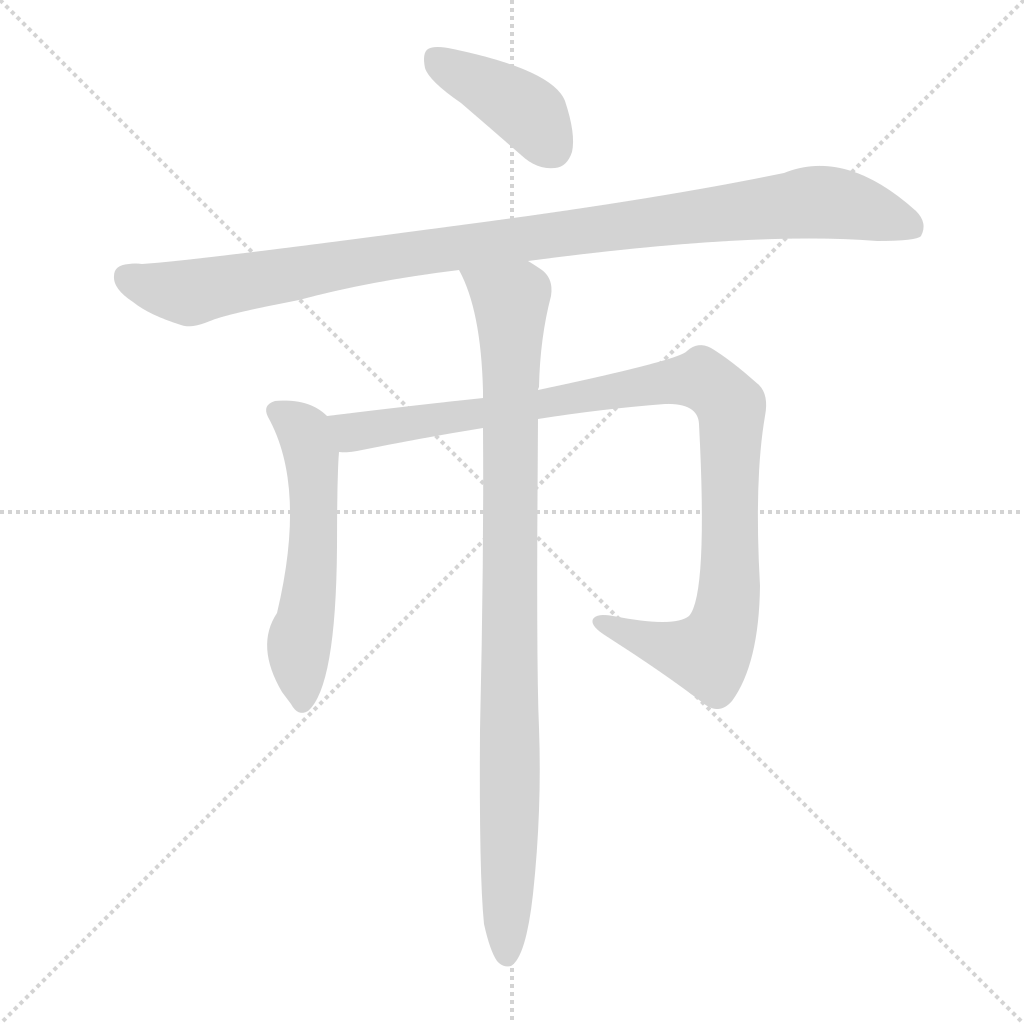
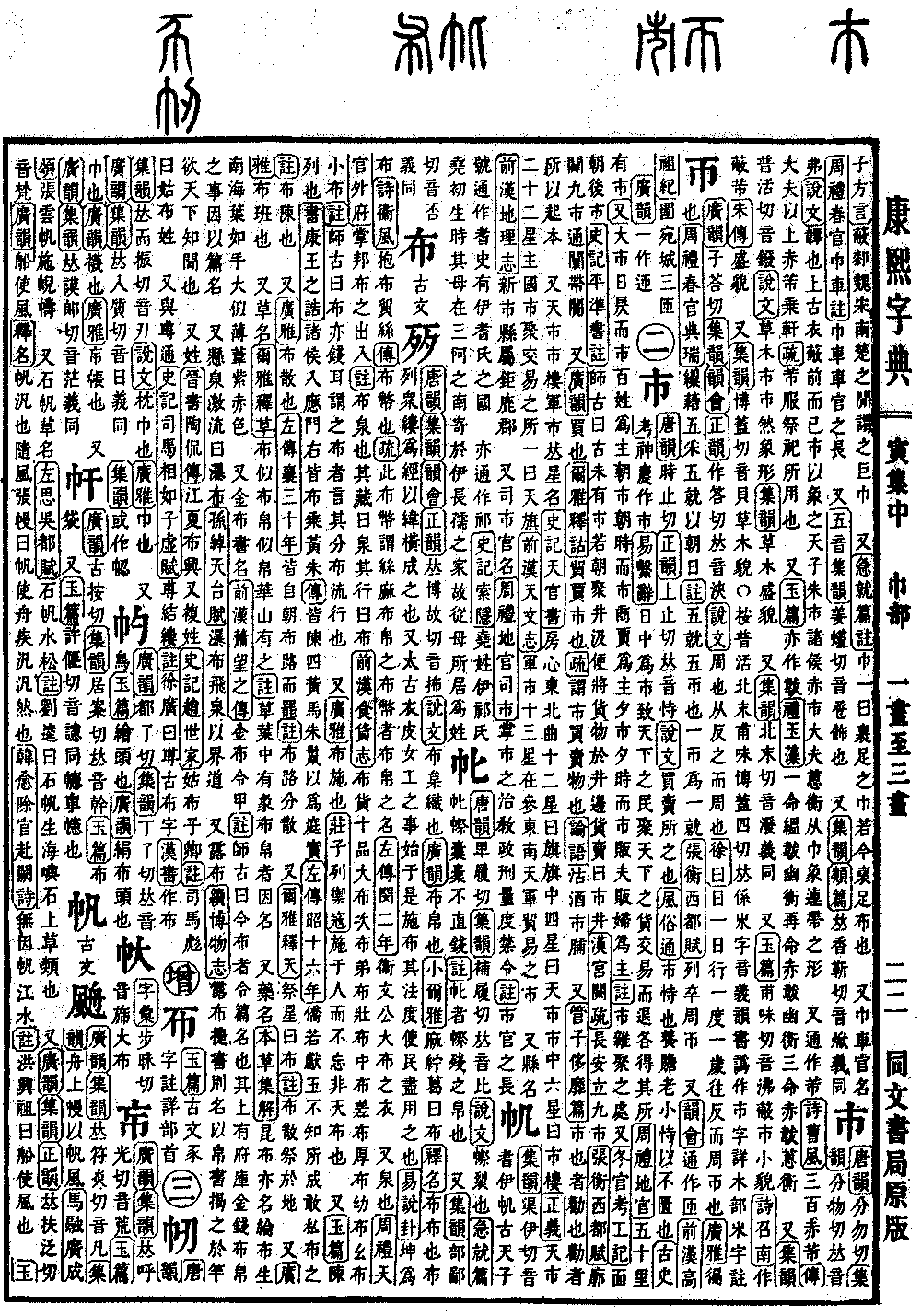
Yin Collection, Middle Volume. Radical: Cloth (bù). Kangxi stroke count: 5. Page 328, Entry 03.
Pronounced shi. Pronounced shi. Pronounced shi (falling tone), reads the same as shi.
Explaining Characters and Phrases (Shuowen): A place to which one goes to buy and sell goods.
Customs and Traditions (Fengsu Tong): Market means to rely upon. Providing for and supporting the elderly and the young, relying on it to avoid shortages.
Investigation of Ancient History (Gushi Kao): Shennong established the markets.
Book of Changes (Yi), Commentary on the Appended Statements (Xici): Markets are opened at midday to summon the people of the world and gather the goods of the world; once transactions are finished, they depart, each obtaining what they require.
Rites of Zhou (Zhouli), Offices of Earth (Diguan): A market is established every fifty li.
Also: The Great Market is opened when the sun passes the meridian in the afternoon, primarily for the multitudes of travelers. The Morning Market is opened in the morning, primarily for merchants. The Evening Market is opened at dusk, primarily for petty traders.
Commentary: A market is a place where various types of people gather.
Also: Winter Offices (Dongguan), Record of Trades (Kaogong Ji): In front is the royal court, behind is the market.
Records of the Grand Historian (Shiji), Commentary on the Treatise on the Balance of Standards (Pingzhun Shu): Shigu says: In ancient times, there were no fixed markets; if people gathered by a well in the morning to draw water, they would bring their goods to the well to buy and sell, which is called a market well.
Annals of Han Palaces (Han Gongque Shu): Chang'an established nine markets.
Zhang Heng, Western Metropolis Rhapsody (Xidu Fu): Opening vast markets, connecting streets and alleys.
Also: Pronounced shi. Means to purchase.
Literary Expositor (Erya), Explanation of Ancient Words (Shigu): To trade or to buy and sell is called market.
Commentary: This refers to the buying and selling of goods.
Analects (Lunyu): Bought wine and dried meat.
Also: Guanzi, Treatise on Extravagance (Chimi Pian): The market is a means of encouragement. Encouragement is used to promote essential enterprises.
Also: Celestial Market, Market Tower, and Army Market are names of star constellations.
Records of the Grand Historian (Shiji), Treatise on Celestial Offices (Tianguan Shu): The twelve stars curving to the northeast of the Room (Fang) and Heart (Xin) mansions are called the Banner Stars. The four stars between the Banner Stars are called Celestial Market. The six stars within the Celestial Market are called Market Tower.
Correct Meaning (Zhengyi): The Celestial Market has twenty-two stars and governs the places where national markets gather for trade. Another account calls it the Celestial Banner.
History of the Former Han (Qianhan), Treatise on Astronomy (Tianwen Zhi): The Army Market consists of thirteen stars located to the southeast of the Triad (Shen) mansion, acting as the trading market for the celestial army.
Also: Name of a county. History of the Former Han (Qianhan), Treatise on Geography (Dilizhi): Xinshi County, belonging to Julu Commandery.
Also: Controller of Markets is the name of an official post. Rites of Zhou (Zhouli), Offices of Earth (Diguan), Controller of Markets: Responsible for the management, instruction, administration, weights and measures, and prohibitions of the market.
Commentary: This is the chief official who manages the market.
Textual Research: Rites of Zhou (Zhouli), Offices of Earth (Diguan), Great Market, opened when the sun passes the meridian, primarily for travelers. In accordance with the original text, the character for people has been changed to travelers.