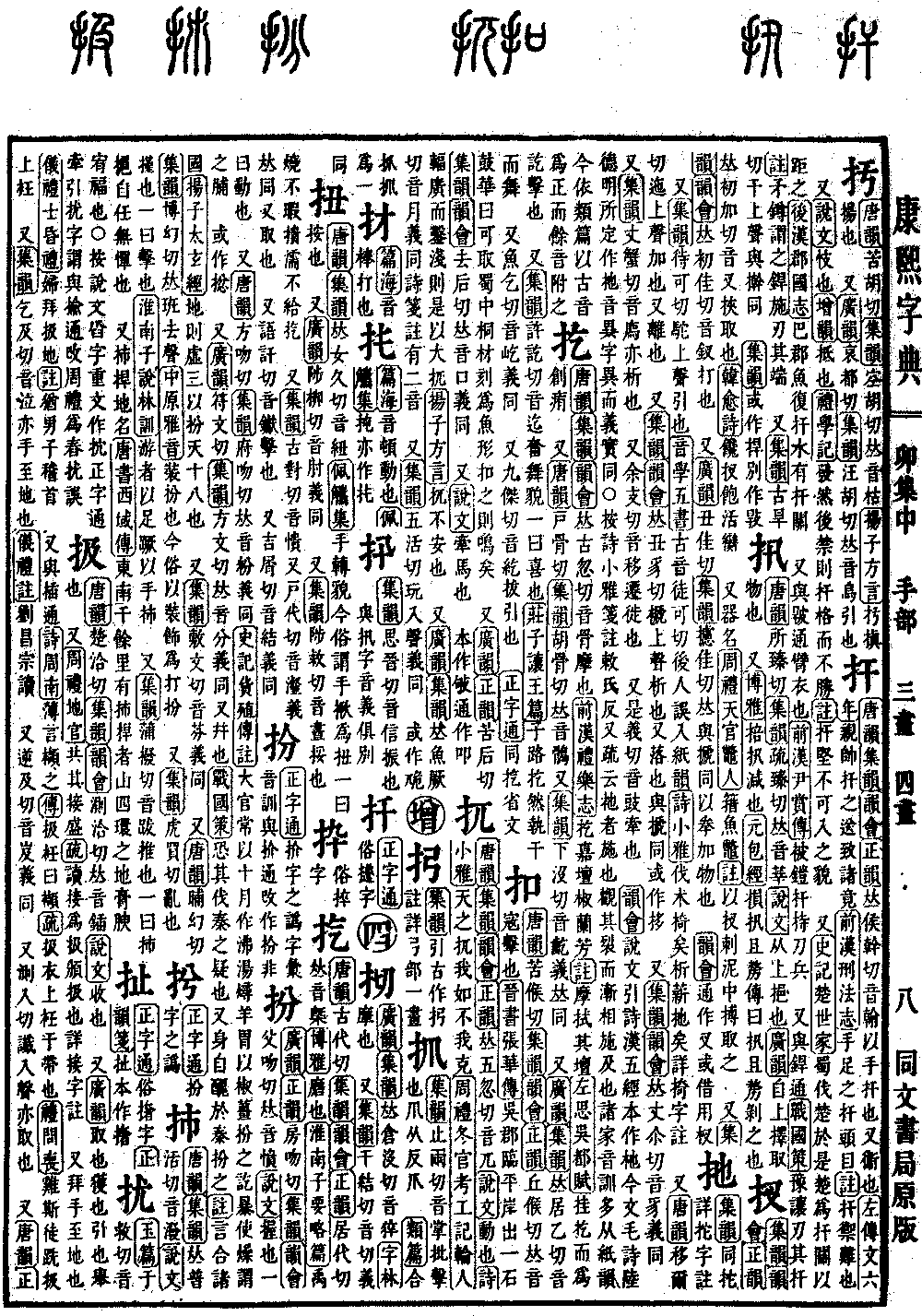
Mao Collection, Middle Volume
Radical: Hand (shǒu)
Kangxi stroke count: 8
Page 418, Entry 25
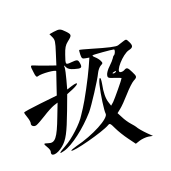
Pronounced cha.
Shuowen Jiezi: to collect.
Guangyun: to take, to harvest, to pull, to lift.
Zhou Rites (Zhouli), Earth Office: to provide for the reception of sacrificial vessels. Commentary: Read as cha, meaning to distribute and collect. See the commentary on the character jie.
Also, to bow with hands touching the ground. Ceremonial Rites (Yili), Marriage Rites of Scholars: The wife bows with hands touching the ground. Commentary: Equivalent to a man performing the koutou.
Also, interchangeable with insert. Book of Odes (Shijing), Zhou Nan: gently tucking it into the belt. Commentary: Tucking the front of a robe is called xie. Commentary: To tuck the upper front of the robe into the belt. Record of Rites (Liji), Questions on Mourning: walking barefoot while tucking up the front of the robe.
Pronounced qi. Also means hands touching the ground. Ceremonial Rites (Yili) commentary: read by Liu Changzong.
Pronounced ji. Meaning is the same.
Pronounced cha (entering tone). Also means to take.
Pronounced xi. To collect or harvest. Record of Rites (Liji), Summary of Rites (Quli): using a winnowing basket to face and collect it. Commentary: Read as xi, meaning because the filth is small, to collect it all up.
Pronounced ji. Also means to pull.
Pronounced qie. To insert. Sometimes written as insert.