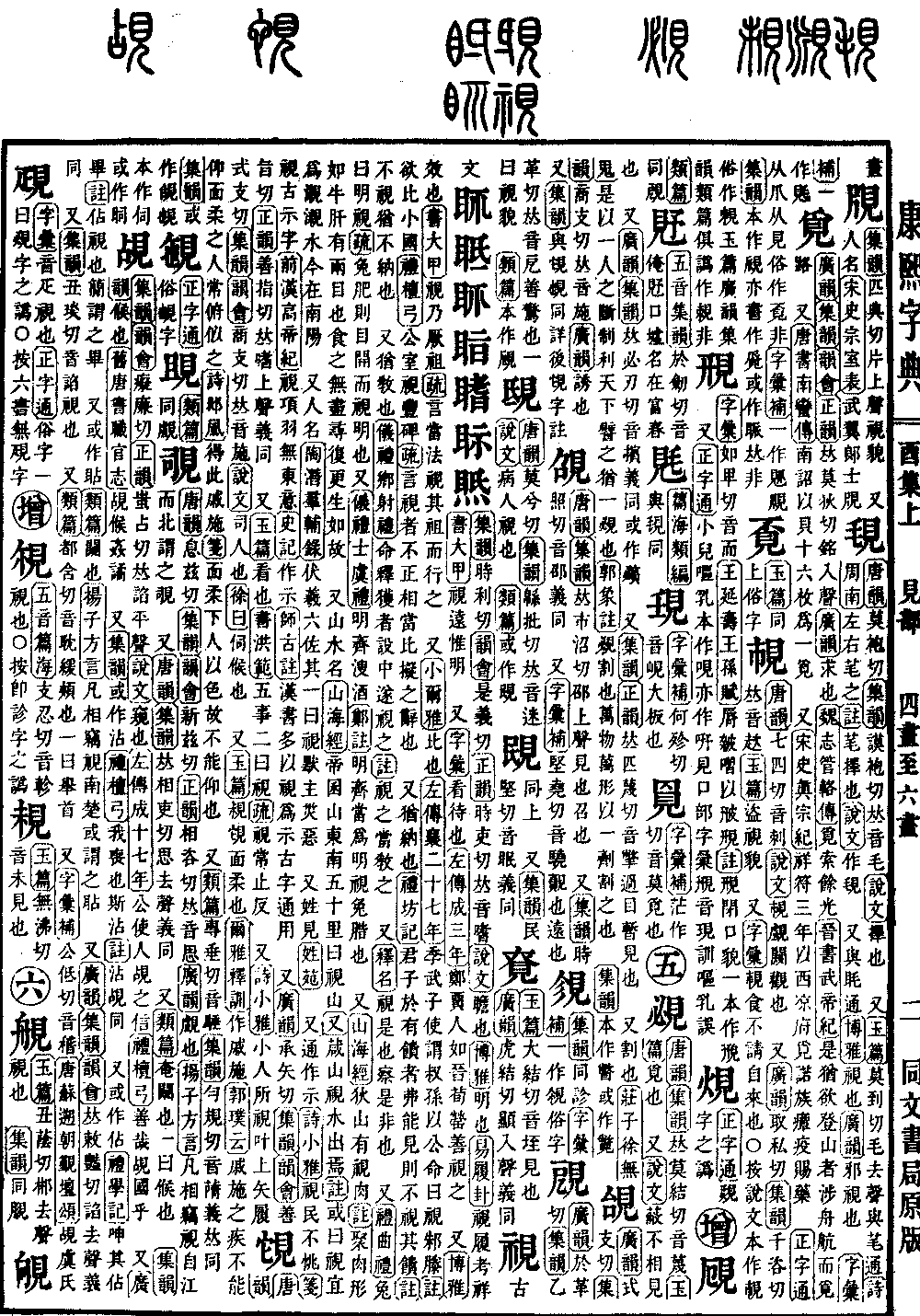
You Collection, Upper Volume
Radical: See (jiàn)
Kangxi Strokes: 12
Page 1134, Entry 21
Ancient characters include those written in the forms of shì and shì.
According to Collected Rhymes (Jiyun), pronounced shi. According to Rhyme Compilation (Yunhui), pronounced shi. According to Correct Rhymes (Zhengyun), pronounced shi. The sound is shi (falling tone).
According to Explanation of Simple and Compound Characters (Shuowen), it means to look or gaze. According to Broad Refinements (Boya), it means bright or clear.
In the Book of Changes (Yijing), Hexagram of Treading (Lü): "Observe the treading and examine the omens."
In the Book of Documents (Shujing), Dajia chapter: "Looking far away enables one to be clear-sighted."
Also, according to Dictionary Compilation (Zihui), it means to treat or regard.
In the Zuo Tradition (Zuo Zhuan), Third Year of Duke Cheng: "The merchant from Zheng went to the state of Jin, and Xun Ying treated him well."
Also, according to Broad Refinements (Boya), it means to imitate.
In the Book of Documents (Shujing), Dajia chapter: "Follow the example of your ancestors." The commentary states that this means one should emulate and follow the path of one's ancestors.
Also, according to Small Erya (Xiao Erya), it means to compare.
In the Zuo Tradition (Zuo Zhuan), Twenty-seventh Year of Duke Xiang: "Ji Wuzi sent a message to Shusun conveying the Duke's command, saying: Compare yourselves to the states of Zhu and Teng." The commentary explains that this expresses the desire to be on par with these small states.
In the Book of Rites (Liji), Tan Gong chapter: "The ducal palace compares itself to the state of Feng." The commentary states that this refers to an improper comparison or being on an equal footing.
Also, it means to accept or receive.
In the Book of Rites (Liji), Fangji chapter: "If a gentleman cannot meet the person who brings a gift, he does not accept the gift." The commentary notes that "not accepting" here means not taking it in.
Also, it means to teach.
In the Book of Etiquette and Ceremonial (Yili), Village Archery Ceremony (Xiangsheli): "Command the one who places the game to set up the target, and then instruct him." The commentary notes that this means to give instruction.
Also, according to Explanation of Names (Shiming), it means to determine; to examine what is right and what is wrong.
Also, in the Book of Rites (Liji), Qu Li chapter: "A rabbit is called 'bright-sighted'." The commentary explains that when a rabbit is fat, its eyes are open and its vision is bright.
Also, in the Book of Etiquette and Ceremonial (Yili), Shi Yu Li chapter: "Bright fermented liquor and strained wine." Zheng’s commentary notes that 'bright fermented' should be 'bright-sighted,' which refers to dried rabbit meat.
Also, in the Classic of Mountains and Seas (Shanhai Jing): "On Mount Di there is 'vision-flesh'." The commentary describes it as a mass of flesh shaped like an ox liver with two eyes. If you eat it, it never runs out; it regenerates as it was before.
Also, names of mountains and waters.
In the Classic of Mountains and Seas (Shanhai Jing): "Fifty miles southeast of Mount Di-Jun is Mount Shi."
Also: "Mount Zhen, where the Shi River originates." The commentary notes that some say Shi should be Qin, and the Qin River is now in Nanyang.
Also, a personal name.
In the Records of Various Assistants (Qunfu Lu) by Tao Qian: "Among the six assistants of Fuxi, one was named Shimo, who presided over disasters and evils."
Also, a surname, found in the Collection of Surnames (Xingyuan).
Also, commonly used interchangeably with the character for "to show" (shi).
In the Book of Odes (Shijing), Xiao Ya: "To show the people that one is not reckless." The gloss states that this is an ancient character for "to show."
In the History of the Former Han (Qian Han Shu), Annals of Gaozu: "He looked at Xiang Yu as if he had no intention of going east." The Records of the Grand Historian (Shiji) uses the character for "to show." The commentary by Shigu notes that the History of Han often uses this character for "to show," as they were interchangeably used in ancient times.
Also, according to Broad Rhymes (Guangyun), pronounced cheng-shi. According to Collected Rhymes (Jiyun) and Rhyme Compilation (Yunhui), pronounced shan-zhi. According to Correct Rhymes (Zhengyun), pronounced shan-zhi. Pronounced shi (rising tone). The meaning is the same.
Also, according to Jade Chapters (Yu Pian), it means to look.
In the Book of Documents (Shujing), Hongfan chapter: "Among the five affairs, the second is vision." The commentary states that the sound is regular.
Also, in the Book of Odes (Shijing), Xiao Ya: "What the small men look upon." It rhymes with the characters for arrow and treading.