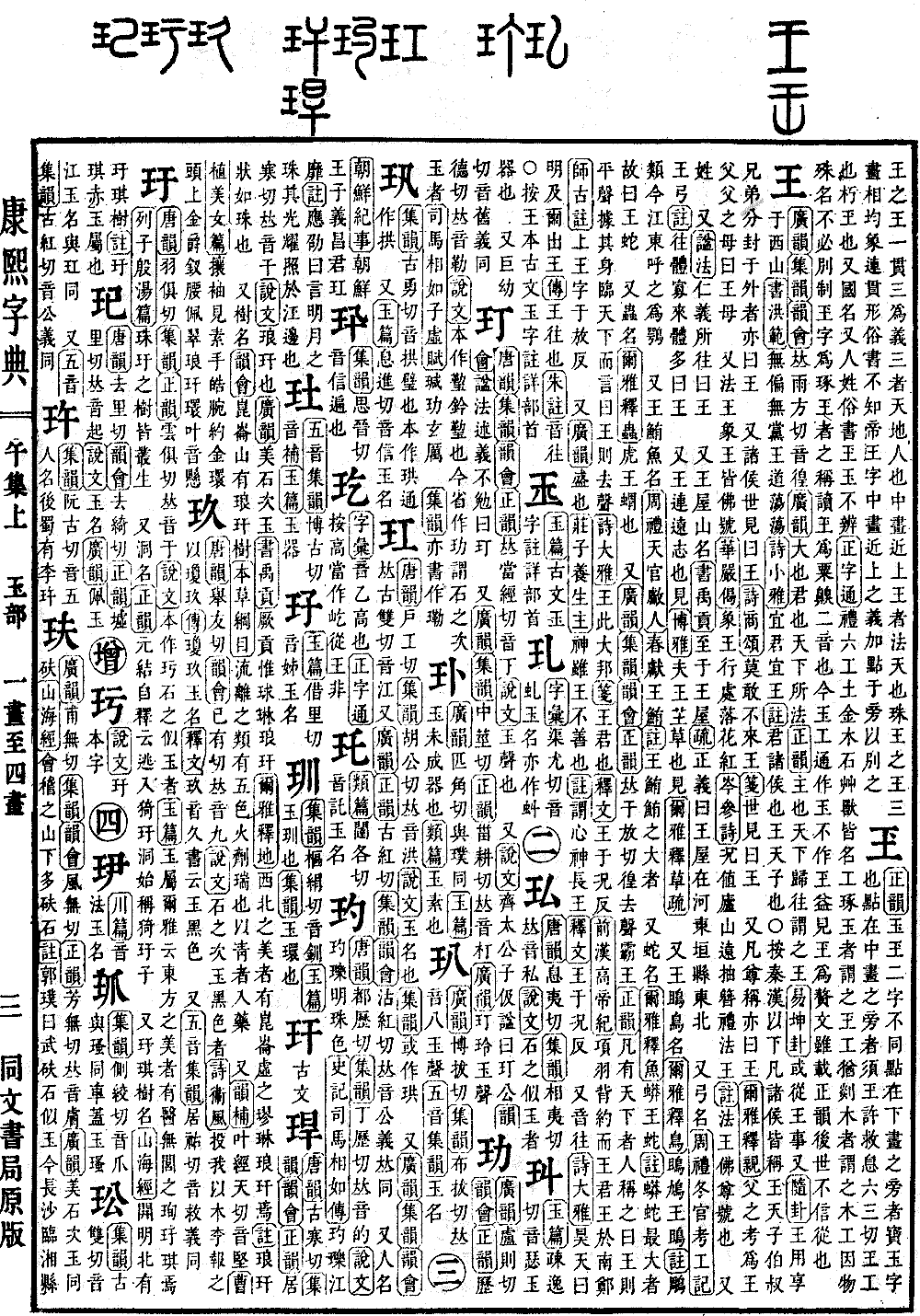
Wu Collection, Upper Volume
Radical: Jade (yù)
Kangxi Strokes: 4
Page 727, Entry 02
According to Expanded Rhymes (Guangyun), Collection of Rhymes (Jiyun), and Rhyme Compilation (Yunhui), pronounced huang (level tone), same sound as huang.
According to Expanded Rhymes (Guangyun), it is defined as: great, a monarch, an object of emulation for the world.
According to Correct Rhymes (Zhengyun), it is defined as: one who rules, one to whom the world turns and looks toward is called a king (wang).
Book of Changes (Yijing), Kun Hexagram: Contains the phrase "perhaps following kingly affairs." Also, in the Sui Hexagram, it contains "the king uses offerings at Western Mountain."
Book of Documents (Shangshu), Great Plan (Hongfan): States "without partiality or faction, the kingly way is vast and open."
Book of Odes (Shijing), Lesser Odes (Xiaoya): States "suitable for a lord, suitable for a king."
Annotation: The lord refers to feudal lords. The king refers to the Son of Heaven. Note: After the Qin and Han dynasties, all feudal lords were called kings; the paternal uncles and brothers of the Son of Heaven who were enfeoffed in external territories were also called kings.
Also, when feudal lords periodically pay court to the Son of Heaven, it is called "paying a royal visit."
Book of Odes (Shijing), Eulogies of Shang (Shangsong): States "none dared not come to pay a royal visit."
Commentary: Every generation paying court is called a royal visit.
Also, any honorific title can also be called a king.
Literary Expositor (Erya), Explanation of Kinship: States: the father of a father is called a grandfather (wangfu), the mother of a father is called a grandmother (wangmu).
Also, Dharma King and Elephant King are both titles of the Buddha.
Flower Adornment Sutra (Huayan) verses: State "where the Elephant King walks, falling flowers turn red."
Cen Shen’s poetry: States "happily meeting the distance of Mount Lu, I remove my hairpin to pay homage to the Dharma King."
Annotation: Dharma King is the honorific title of the Buddha.
Also, a surname.
Also, in the Rules of Posthumous Titles (Shifa): A person to whom benevolence and righteousness return is called a king.
Also, Wangwu, a mountain name.
Book of Documents (Shangshu), Tribute of Yu (Yugong): States "reaching Wangwu."
Sub-commentary: The righteous meaning is that Wangwu Mountain is located in the northeast of Yuan County in Hedong.
Also, a type of bow name.
Book of Rites (Zhouli), Winter Offices, Record of Trades (Kaogongji), Bow Maker section: The curvature where the bow body bends outward is small, and the curvature where it bends inward is large, called a king bow or similar.
Also, Wanglian is an alias for polygala (yuanzhi). See Broad Miscellany (Boya).
Fu Wang is a type of grass. See Literary Expositor (Erya), Explanation of Plants (Shicao), Sub-commentary.
Also, Wangju is a bird name. Literary Expositor (Erya), Explanation of Birds (Shiniao): States: the ju-dove is the Wangju.
Annotation: It belongs to the eagle family; nowadays people in Jiangdong call it the osprey.
Also, Wangwei is a fish name. Book of Rites (Zhouli), Heavenly Offices, Chef section: States "in spring, offer the Wangwei."
Annotation: Wangwei is a large-bodied wei-fish.
Also, a snake name. Literary Expositor (Erya), Explanation of Fish (Shiyu): States: the python is the king snake.
Annotation: The python is the largest among snakes, therefore it is called the king snake.
Also, an insect name. Literary Expositor (Erya), Explanation of Insects (Shichong): States: Wang tieyi. Annotation: That is the trapdoor spider; it resembles a spider and lives in a burrow with a cover over the opening. Nowadays people in Hebei call it tieyi.
Broad Miscellany (Boya) states: The tiger is the king hedgehog.
According to Expanded Rhymes (Guangyun), Collection of Rhymes (Jiyun), Rhyme Compilation (Yunhui), and Correct Rhymes (Zhengyun), pronounced wang (falling tone), same sound as wang, meaning to claim kingship or hegemony.
According to Correct Rhymes (Zhengyun): Whoever possesses the world, others call him "king," pronounced in the level tone. Regarding his own rule over the world, it is called "king," pronounced in the falling tone.
Book of Odes (Shijing), Greater Odes (Daya): States "king over this great state."
Commentary: King means to rule.
Explanation of Text (Shiewen) phonetic notation: Wang, pronounced wang (falling tone).
History of the Former Han (Qian Han), Annals of Emperor Gaozu: States "Xiang Yu violated the agreement and made the lords kings at Nanzheng."
Yan Shigu's annotation: The first "king" character is pronounced wang (falling tone).
Also, according to Expanded Rhymes (Guangyun), it is defined as: flourish.
Zhuangzi, Nurturing the Lord of Life (Yangshhengzhu): States "though the spirit is flourishing, it is not good."
Annotation: This means the mind and spirit are flourishing.
Explanation of Text (Shiewen) phonetic notation: Wang, pronounced wang (falling tone).
Also, pronounced the same as wang (to go).
Book of Odes (Shijing), Greater Odes (Daya): States "Great Heaven is bright, and you go out and go."
Commentary: Wang means to go.
Zhu Xi's annotation: Pronounced as wang (to go).
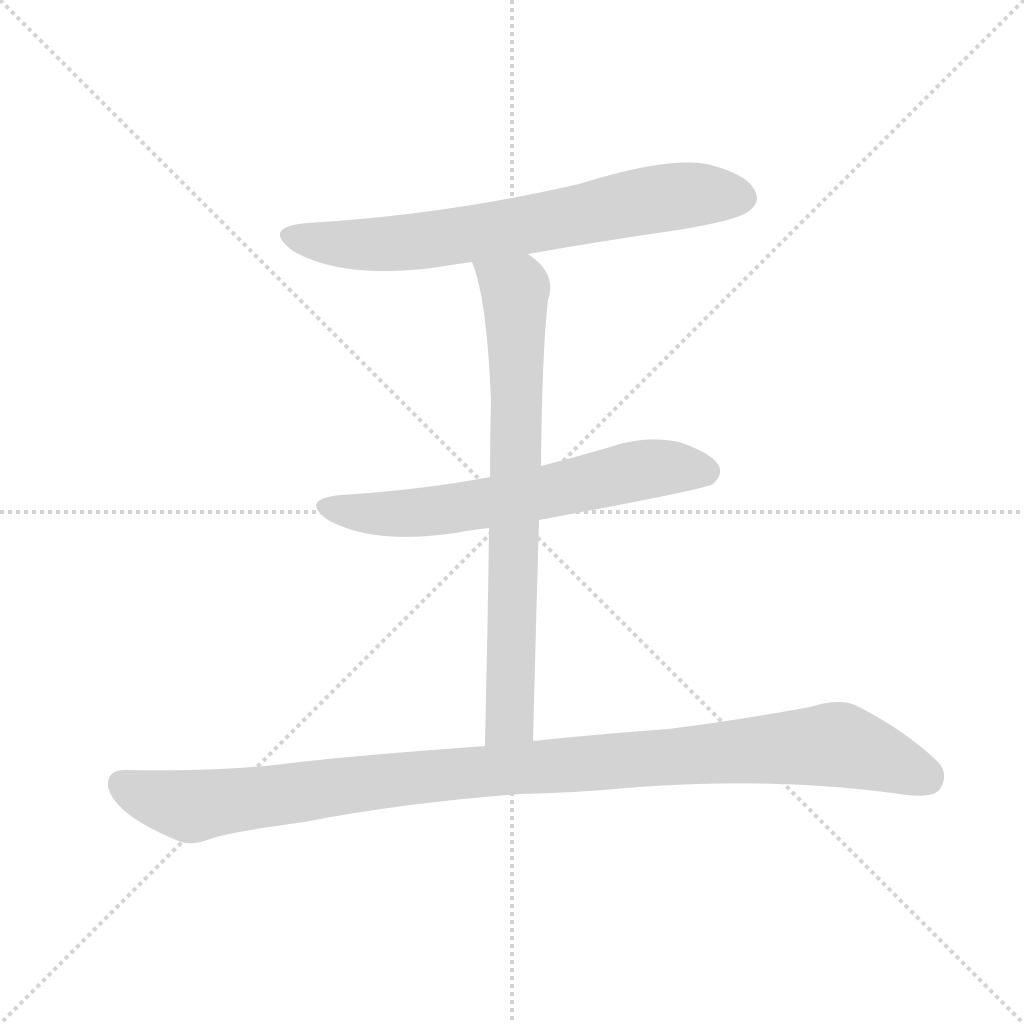
Note: The character for king was originally the ancient form of the character for jade. Detailed annotations are provided in the radical section.