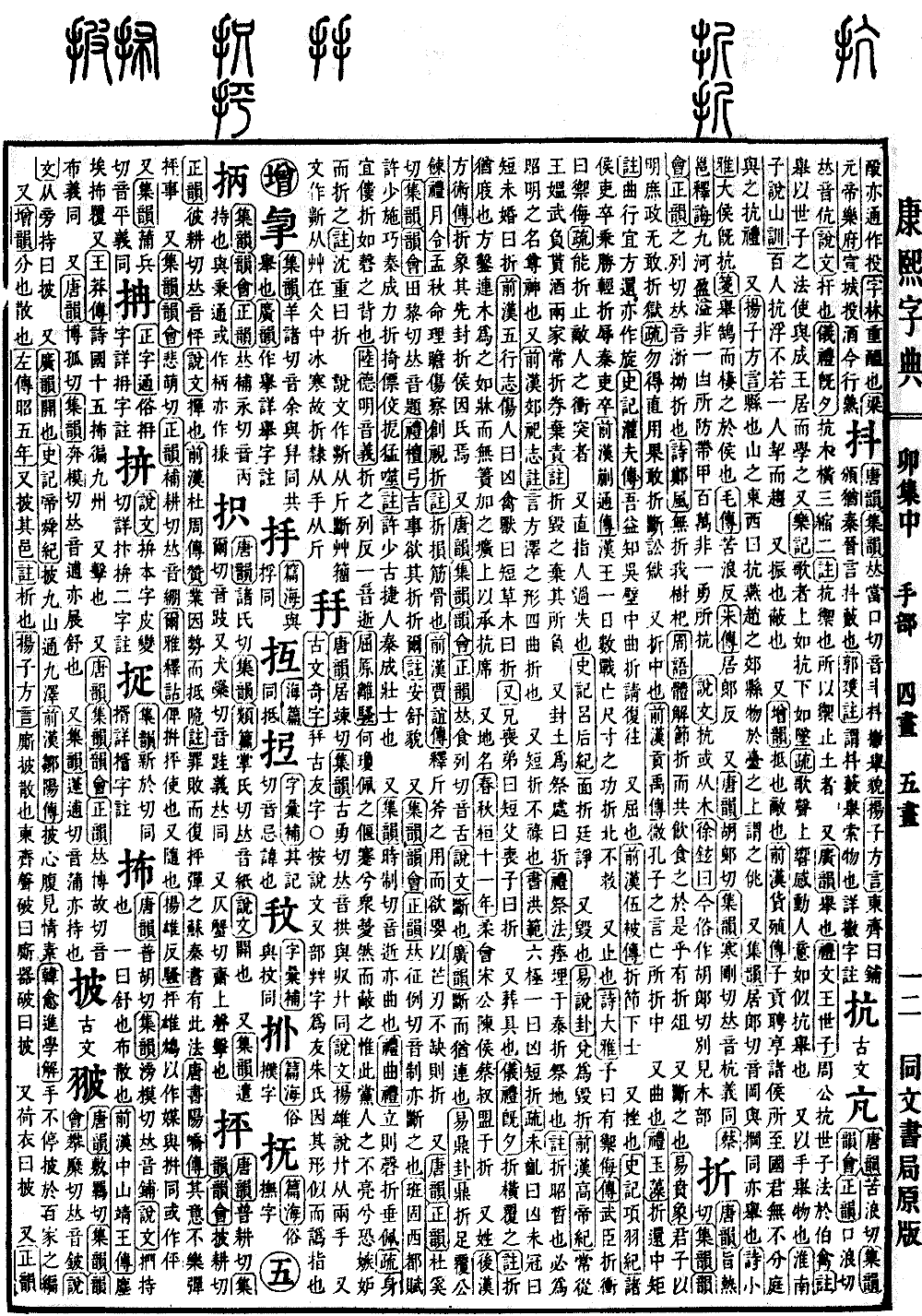
Mao Collection, Middle Volume. Radical: Hand (shǒu); Kangxi strokes: 8; Page 422, Entry 04.
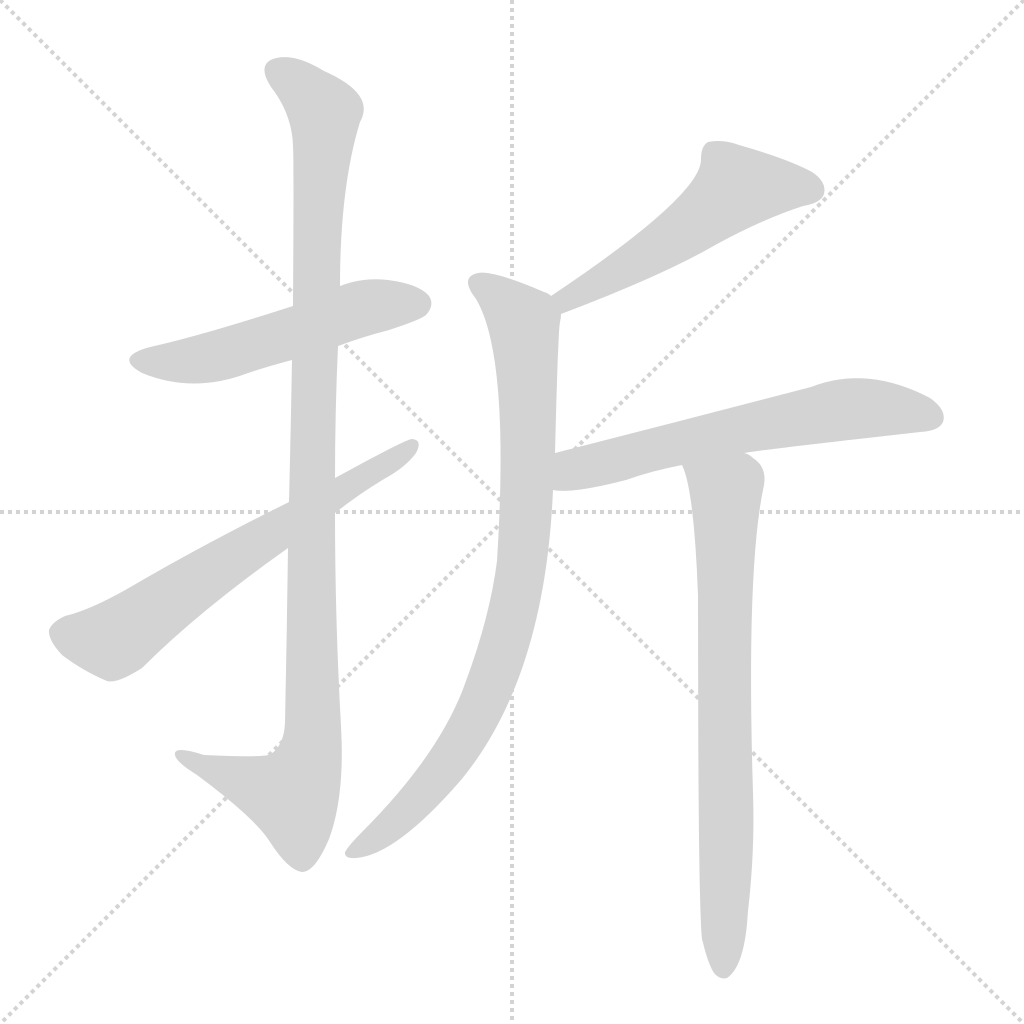
Pronounced zhe. Meaning: to bend or to break.
Book of Odes (Shijing), Zheng Feng: Do not break the trees I have planted.
Discourses of the States (Guoyu), Zhou Yu: When preparing a sacrifice, one dismembers the body and breaks the joints before cooking; this resulted in the banquet rite known as "zhezhu" (sacrificial meat arranged on a tray).
Also means to judge or decide.
Book of Changes (Yijing), Bi Gua Xiang Zhuan: The superior person uses this to investigate legal matters clearly, not daring to judge litigation cases lightly.
Kong Yingda Commentary: One cannot directly use arbitrary decision-making to judge legal cases.
Also means to reconcile or to take as a standard.
History of the Han (Hanshu), Gong Yu Zhuan: Without Confucius, there would be nothing to take as a standard.
Also means to bend or curve.
Book of Rites (Liji), Yuzao: Turning and walking must accord with the square and the compass.
Zheng Xuan Commentary: To walk with a curve should be in accordance with the square. The word huan is also written as xuan.
Records of the Grand Historian (Shiji), Guan Fu Zhuan: I have a deeper understanding of the twists and turns within the Wu army camp; please let me go once more.
Also means to humble oneself or lower one's status.
History of the Han (Hanshu), Wu Bei Zhuan: Lowering one's status to treat scholars with humility.
Also means to suffer defeat or to cause a setback.
Records of the Grand Historian (Shiji), Xiang Yu Benji: The feudal officials and soldiers, riding the momentum of victory, arrogantly insulted the Qin officials and soldiers.
History of the Han (Hanshu), Kuai Tong Zhuan: The King of Han fought many battles in a single day, but had no merit of land to show for it; having failed and retreated, he could not save himself.
Also means to stop or to block.
Book of Odes (Shijing), Da Ya: I declare there are warrior-officials who can resist foreign insults.
Mao Heng Commentary: A warrior-official who can repel the charge of enemy chariots is called "yowu" (resisting insults).
Kong Yingda Commentary: One who can stop the enemy's assault.
Also means to confront someone regarding their faults.
Records of the Grand Historian (Shiji), Empress Lü Benji: To argue openly and directly in the imperial court.
Also means to ruin or destroy.
Book of Changes (Yijing), Shuo Gua: The Dui hexagram symbolizes destruction and breaking.
History of the Han (Hanshu), Gao Di Ji: He frequently went to the shops of Wang Ao and Wu Fu to purchase wine on credit. He would often get drunk and fall asleep. Wang Ao and Wu Fu frequently saw a dragon hovering over his body and were astonished. Whenever the High Ancestor came to buy wine and stayed in the shop to drink, the sales of wine would multiply several-fold. Seeing this strange phenomenon, at the end of the year, both establishments would break the wooden tallies used for recording debts, thereby canceling the wine debts owed by the High Ancestor.
Yan Shigu Commentary: To break them and discard the debts he owed.
Also, burying soil at a site for sacrificial purposes is called "zhe."
Book of Rites (Liji), Jifa: To bury the sacrifice at the "Taizhe," which is the site for sacrificing to the Earth god.
Zheng Xuan Commentary: "Zhe" means bright and manifested; one must use a name that implies brightness and manifestation to honor the divine.
Additionally, the History of the Han (Hanshu), Jiao Si Zhi Commentary, states that the shape of the Earth altar (fangze) is bent or winding on all four sides.
Also refers to "duanzhe," meaning premature death or dying young.
Book of Documents (Shangshu), Hongfan: Six kinds of extreme misfortune. The first is premature death.
Kong Yingda Commentary: Dying before changing one's teeth is called "xiong"; dying before the age of twenty is called "duan"; dying unmarried is called "zhe."
History of the Han (Hanshu), Five Elements Records: Harm caused to humans is called "xiong," to animals is called "duan," to plants is called "zhe."
Also: The death of an elder brother resulting in the younger brother's sorrow is "duan"; the death of a father resulting in the son's sorrow is "zhe."
Also means burial tools.
Book of Etiquette and Ceremonial (Yili), Jixi Li: Placing the "zhe" like a frame to cover the coffin.
Zheng Xuan Commentary: "Zhe" is like a rack for storing objects. It is made by connecting wood with square mortise joints, shaped like a bed but without a mat, placed over the grave pit to support the "kangxi" (burial mat).
Also refers to a place name.
Spring and Autumn Annals (Chunqiu), Duke Huan, Year 11: Rou met with the Duke of Song, the Marquis of Chen, and the Viscount of Cai to form an alliance at the place called Zhe.
Also refers to a surname.
Book of the Later Han (Hou Hanshu), Fangshu Zhuan: Zhe Xiang; his ancestors were enfeoffed as the Marquis of Zhe, and thus they took Zhe as their surname.
Pronounced zhe.
Explanation of Script (Shuowen Jiezi): Meaning to break.
Guangyun: To break, but remain partially connected.
Book of Changes (Yijing), Ding Gua: The legs of the cauldron break, spilling the noble's gourmet meal.
Book of Rites (Liji), Yueling: In the first month of autumn, the officials are ordered to inspect injuries and wounds, and to examine bone fractures.
Zheng Xuan Commentary: "Zhe" refers to damage to the tendons and bones.
History of the Han (Hanshu), Jia Yi Zhuan: Abandoning the use of an axe, yet wanting to touch a hard object with a sharp blade; if it does not chip, it will break.
Pronounced ti.
Book of Rites (Liji), Tangong: Auspicious events are desired to have a composed and relaxed appearance.
Zheng Xuan Commentary: An appearance of being calm and relaxed.
Pronounced zhi. Also means to break.
Ban Gu, Western Capital Rhapsody (Xidu Fu): Skill is displayed only slightly, while the strength of Qin Cheng is used to snap the prey. Grabbing the swift and strong (beasts), killing them with fierce combat and devouring them.
Li Shan Commentary: Xu Shao was a man of great agility in ancient times. Qin Cheng was a brave warrior.
Pronounced shi. Also means to bend.
Book of Rites (Liji), Quli: When standing, one should bend the waist like a stone chime to let the jade pendant hang down.
Kong Yingda Commentary: The body should be bent like the back of a stone chime.
Lu Deming, Sound and Meaning: "Zhe," pronounced zhe, another pronunciation is "shi."
Qu Yuan, Li Sao: Why does my beautiful jade pendant rise so high, yet the crowd incessantly hides its light? Thinking of the dishonesty of this faction, I fear they will destroy it out of jealousy.
Wang Yi Commentary: Shen Zhong says it is pronounced "zhe." The Explanation of Script (Shuowen Jiezi) writes it with "axe" (jin) breaking "grass" (cao). The ancient seal script writes it with "grass" inside "ice" (bing), because in the cold of ice, grass breaks. The clerical script follows "hand" and "axe."
Verification: In Book of Rites (Liji), Jifa: Burying the sacrifice at the Taizhe, sacrificing to the Earth. Commentary: Zhe, means bright (zhe). We have carefully corrected the original text "xi" to "zhe" (brightness).