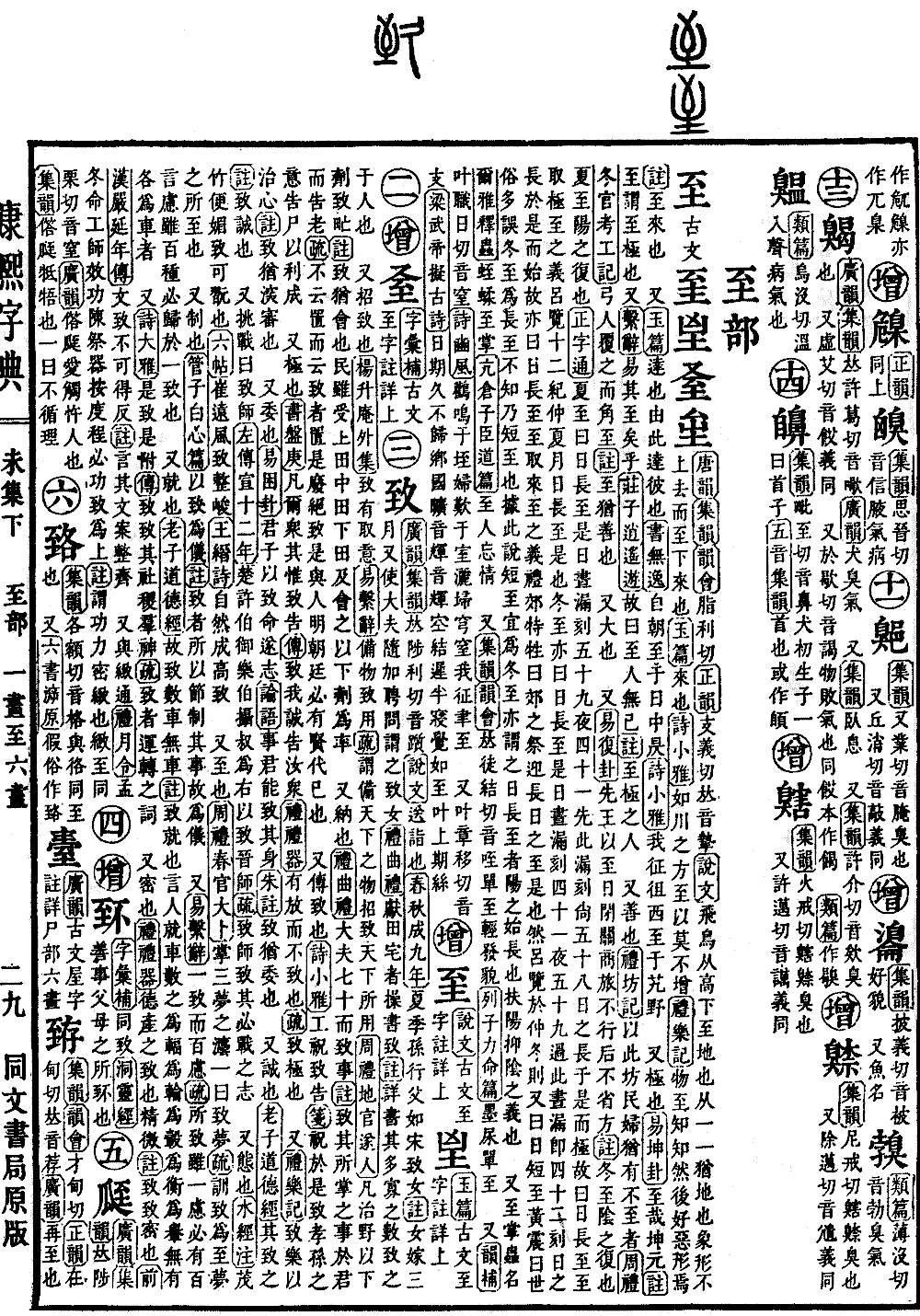
Wei Collection, Lower Volume
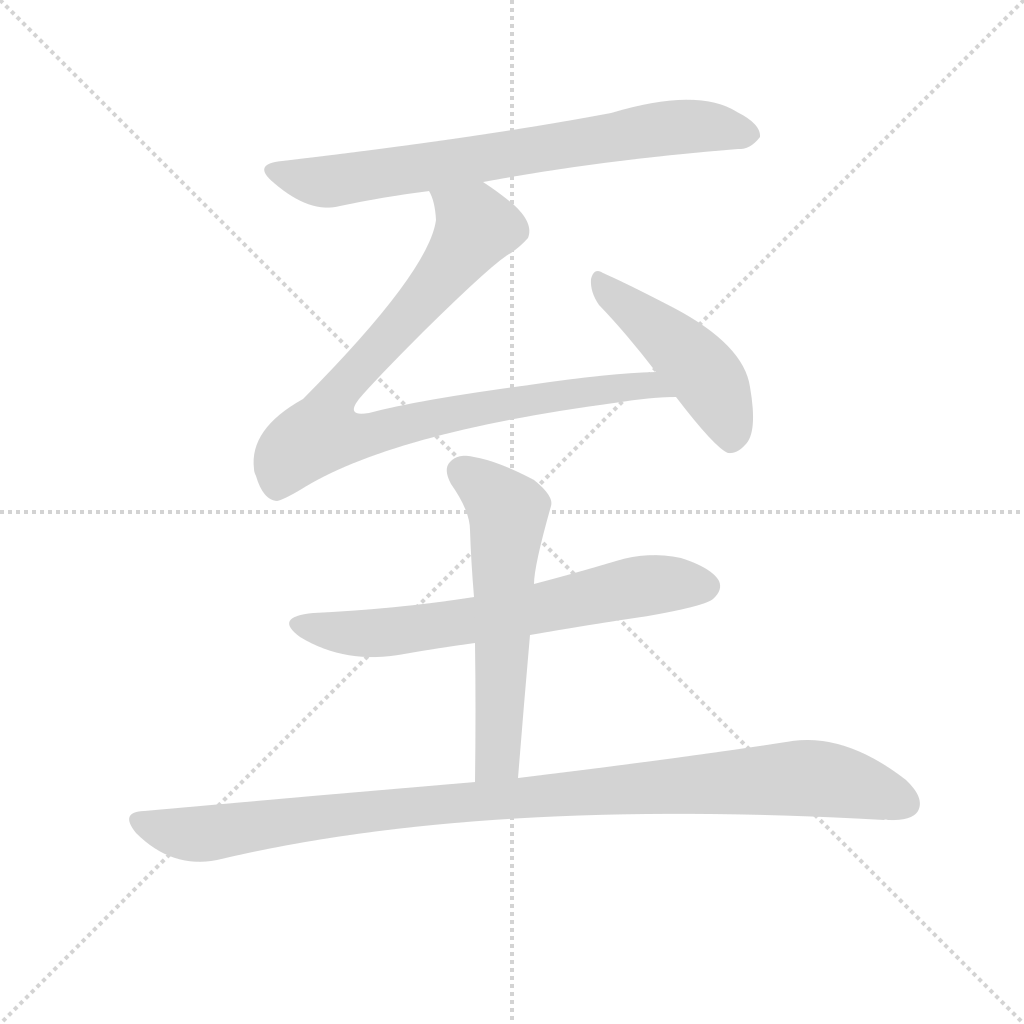
Radical: Arrive (zhì)
Kangxi Strokes: 6
Page 1001, Entry 11
Ancient form: From the Tang Rhyme (Tangyun), Collection Rhyme (Jiyun), and Rhyme Compilation (Yunhui), the pronunciation is zhi (falling tone). From the Orthodox Rhyme (Zhengyun), the pronunciation is zhi (falling tone). The sound is zhi (falling tone).
According to the Explaining Graphs and Analyzing Characters (Shuowen): Refers to a flying bird descending from a high place to the ground. Derived from the character one, where one represents the earth. It is a pictograph. It depicts not going up, but arriving down.
According to the Jade Chapters (Yupian): Means to come.
Book of Odes (Shijing), Minor Odes: Like a river rising, there is nothing that does not increase.
Book of Rites (Liji), Record of Music: When things arrive, knowledge is recognized, and then likes and dislikes are formed. Note: Zhi means to come.
Also, according to the Jade Chapters: Means to reach, to go from here to there.
Book of Documents (Shangshu), Against Luxurious Ease: From morning until midday and then to sunset.
Book of Odes (Shijing), Minor Odes: I marched and traveled to the west, arriving at the remote wilderness.
Also means the extreme.
Book of Changes (Yijing), Kun Hexagram: Ultimate is the origin of the earth. Note: Zhi refers to the extreme limit.
Also, in the Appended Remarks: The Book of Changes is indeed the ultimate.
Zhuangzi, Free and Easy Wandering: Therefore, it is said: The ultimate person has no self. Note: A person of ultimate reach.
Also means good.
Book of Rites (Liji), Record of Embankments: Using this to restrain the people, yet there are still those who are not good.
Rites of Zhou (Zhouli), Winter Officials, Record of Artificers: The bow-maker covers it and the horn is good. Note: Zhi means good.
Also means great.
Also, Book of Changes (Yijing), Return Hexagram: The former kings, on the day of the solstice, closed the passes, merchants did not travel, and rulers did not inspect the regions. Note: Winter solstice is the return of yin. Summer solstice is the return of yang.
Orthodox Character Guide (Zhengzitong): The summer solstice is called the day of the longest arrival. On this day, the water clock measures fifty-nine units for day and forty-one for night; before this, it was fifty-eight units. The length of the day reaches its extreme here, hence it is called the long arrival, with the meaning of reaching the limit. The Twelve Chronicles of the Lu Family (Lüshi Chunqiu): In the month of mid-summer, the day reaches its longest, which is this. The winter solstice is also called the day of the longest arrival. On this day, the water clock measures forty-one units for day and fifty-nine for night; after this, the day length becomes forty-two units. The growth of the day begins here, hence it is also called the long arrival, with the meaning of arrival. The Suburban Sacrifices (Jiao Te Sheng) of the Book of Rites says: The suburban sacrifice is to welcome the arrival of the longest day. However, the Lu Family Chronicles for mid-winter says the day reaches its shortest. Huang Zhen says: The world mistakenly calls the winter solstice the long arrival, not knowing it is the short arrival. According to this theory, the short arrival should be the winter solstice; it is also called the long arrival because the yang begins to grow, signifying the support of yang and the suppression of yin.
Also, zhi-zhang, a type of insect. According to the Erya, Explaining Insects: The leech and the zhi-zhang.
Kang Cangzi, Chapter on the Way of the Subject: The ultimate person forgets emotions.
Also, from the Collection Rhyme (Jiyun) and Rhyme Compilation (Yunhui), the pronunciation is die (entering tone). Dan-zhi, describing a light, quick utterance. Liezi, Chapter on Power and Fate: Mo-chi dan-zhi.
Also, according to Rhyme Supplements (Yunbu), rhyming with zhi (entering tone). Book of Odes (Shijing), Odes of Bin: The osprey calls on the mound, the wife sighs in the room. Sweeping and cleaning the dome, I march and soon arrive.
Also, rhyming with zhi (level tone). In the imitative ancient poetry of Emperor Wu of Liang: The date of our meeting is long and I do not return, my hometown is distant and the sound of fame is far. The sound of fame is empty and knots of longing are slow, half-asleep I wake as if having arrived. Matches with the rhyme of period and silk.