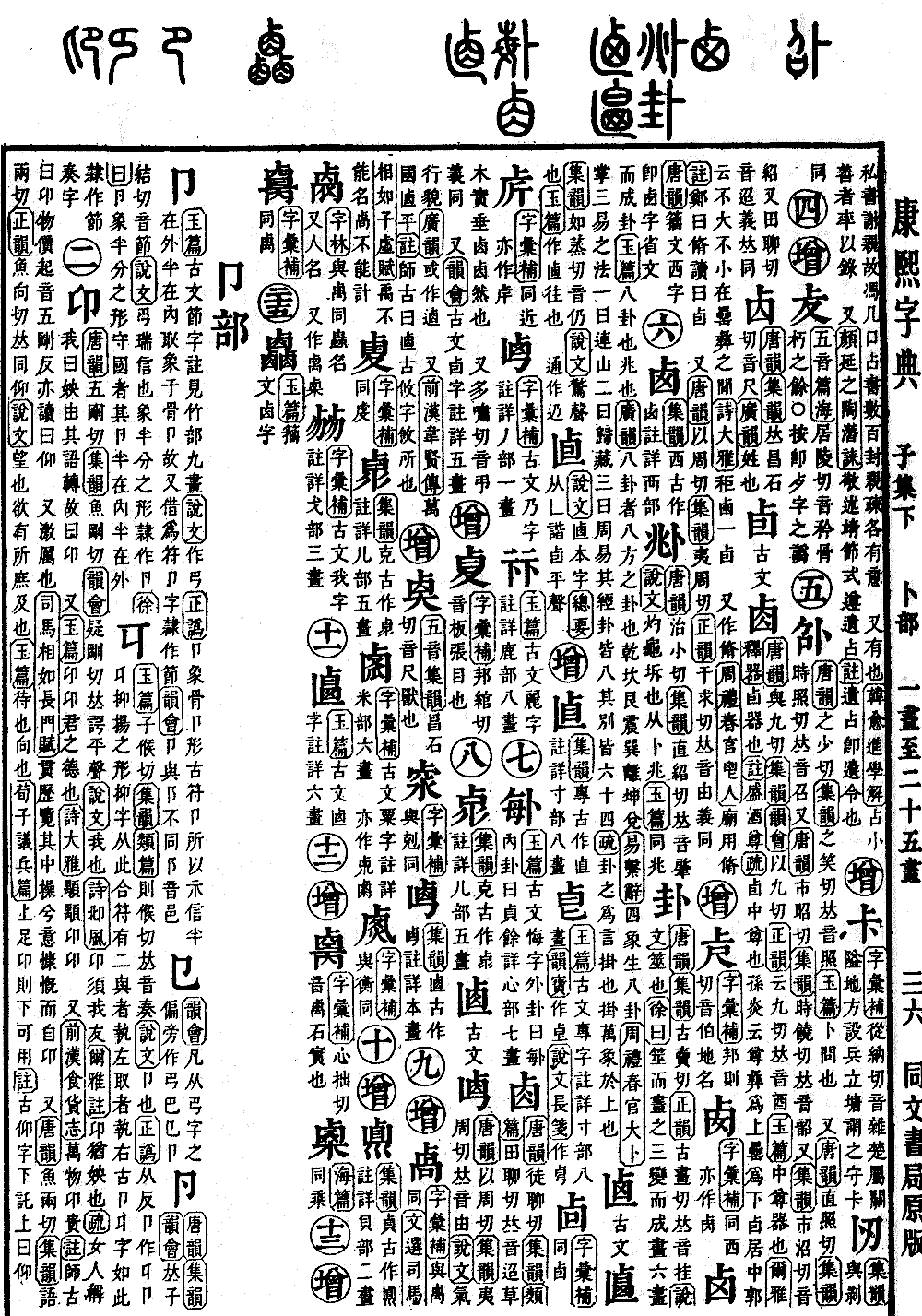
Zi Collection, Page Position: Lower
Radical: Divination (bǔ)
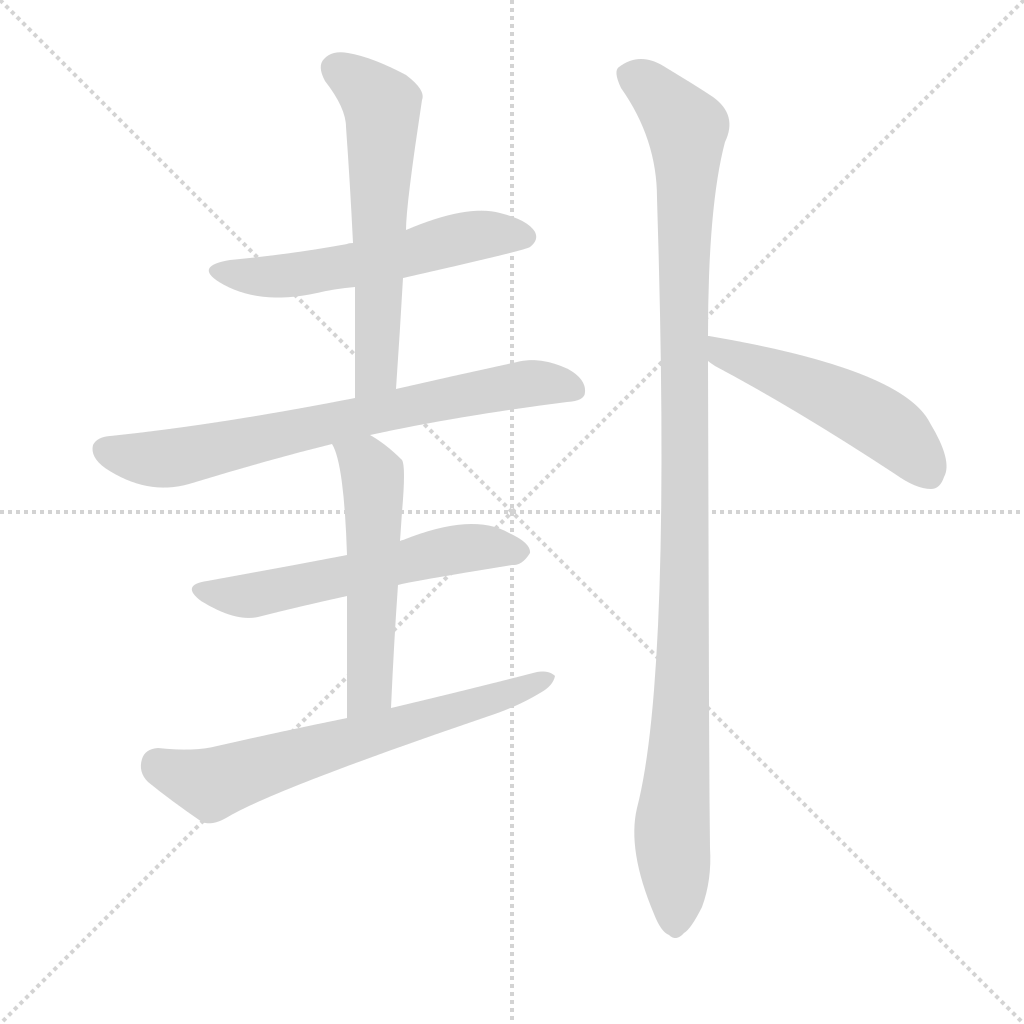
Character: Gua
Kangxi Dictionary Stroke Count: 8
Page 158, Line 13
Tang Dynasty Rhymes (Tangyun) and Collected Rhymes (Jiyun) record the phonology as gǔ mài qiè. Standard Rhymes (Zhengyun) records the phonology as gǔ huà qiè. The pronunciation is the same as guà. The Origin of Chinese Characters (Shuowen Jiezi) explains this character as divination. A commentary by Xu Kai notes that it refers to drawing hexagram images through divination; after three changes a single line (yáo) is formed, and six lines compose a hexagram (guà). The Jade Chapters (Yupian) refers to the eight trigrams and also refers to omens. The Expanded Rhymes (Guangyun) states the eight trigrams represent eight directions, being qián, kǎn, gèn, zhèn, xùn, lí, kūn, and duì. The Book of Changes (Yijing), Commentary on the Appended Phrases (Xici) says the four images give rise to the eight trigrams. The Rites of Zhou (Zhouli), Spring Offices (Chunguan), Grand Diviner (Dabu) records the administration of three methods of change divination: first is Lianshan, second is Guizang, and third is Zhouyi. Their primary trigrams are eight in number, and the derived hexagrams each total sixty-four. The Commentary and Explanation (Shujie) says the meaning of guà is to hang, referring to symbolizing the myriad phenomena of heaven and earth upon the hexagram images.