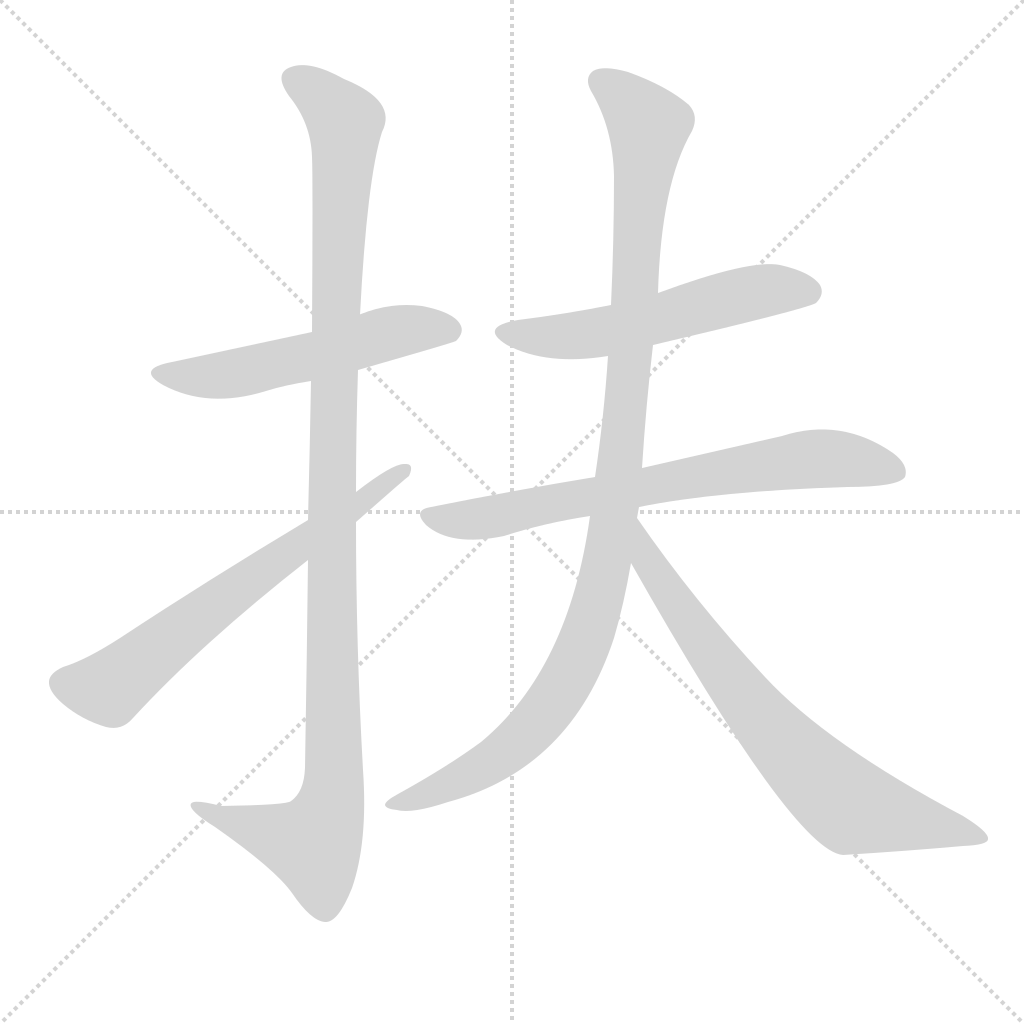
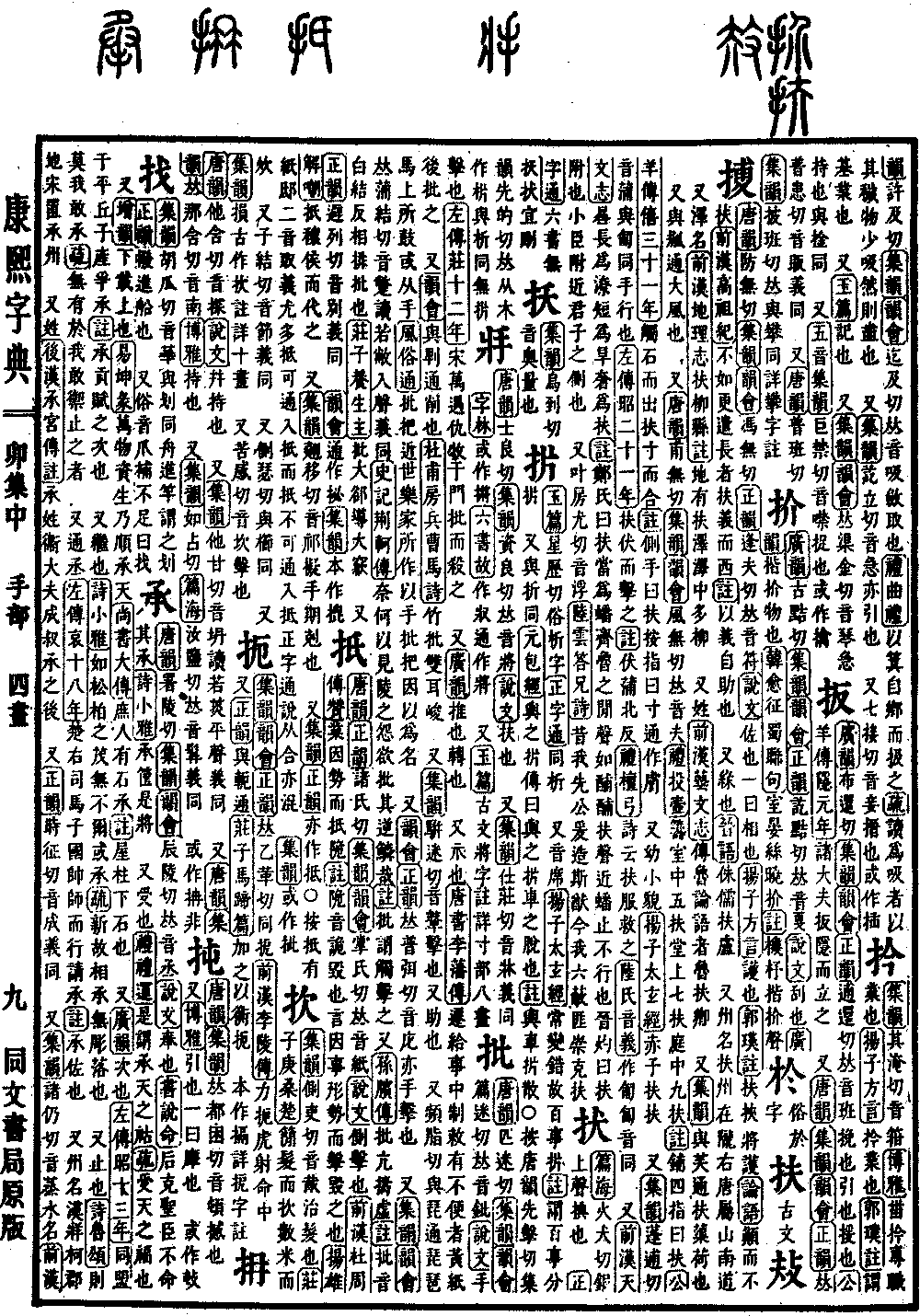
Mao Collection, Middle Volume. Radical: Hand (shǒu). Kangxi strokes: 8. Page 419, Entry 05.
Ancient script. According to the Tang Rhyme (Tangyun), pronounced fú. According to the Collected Rhymes (Jiyun) and the Rhyme Association (Yunhui), pronounced fú. According to the Correct Rhymes (Zhengyun), pronounced fú.
According to the Explaining Graphs and Analyzing Characters (Shuowen), it means to assist. Another interpretation is to sustain. According to the Regional Speech (Fangyan) by Yang Xiong, it means to protect. Guo Pu comments that it means to support, hold, and guard. In the Analects (Lunyu), it is written: if it falls and is not supported. In the History of the Former Han (Qianhan), Biography of Emperor Gaozu, it is written: it would be better to send a virtuous person to support justice and move west. The commentary explains this as using justice to help oneself.
It also means to follow or rely upon. In the Discourses of Jin (Jinyu), it refers to a dwarf holding onto a carriage.
It is also the name of a prefecture. Fu Prefecture was located in Longyou and belonged to the Shannan Circuit during the Tang Dynasty.
It is also the name of a marsh. In the History of the Former Han (Qianhan), Treatise on Geography, commentary on Fuliu County, it states the area has Fu Marsh, which is rich in willows.
It is also a surname. In the History of the Former Han (Qianhan), Treatise on Literature and Arts, it mentions Fu Qing of Lu, who transmitted the Lu version of the Analects.
According to the Collected Rhymes (Jiyun), it is interchangeable with fú (lotus). Fuqu refers to the lotus. It is also interchangeable with fú (a great wind).
According to the Tang Rhyme (Tangyun), pronounced fū. According to the Collected Rhymes (Jiyun) and the Rhyme Association (Yunhui), pronounced fū. In the Book of Rites (Liji), section on the Pitch-Pot Game (Touhu), it says: for the arrows, five fu in the room, seven fu in the hall, and nine fu in the courtyard. The commentary notes that spreading four fingers constitutes a fu. It is generally written as fū. In the Commentary of Gongyang (Gongyang Zhuan), 31st year of Duke Xi: emerging from the stones, covering a square inch and coming together. The commentary notes that a side-handed measure is called a fu, and a thumb-width measure is called a cun.
It also describes a young or small appearance. In the Great Mystery (Taijing) by Yang Xiong, it describes an infant as fúfú.
According to the Collected Rhymes (Jiyun), pronounced pú. It is the same as pú (to crawl). It means to move on hands and knees. In the Commentary of Zuo (Zuo Zhuan), 21st year of Duke Zhao: crawling forward and striking. The commentary notes that fu is pronounced pú. In the Book of Rites (Liji), section on Tan Gong: the poem says, crawling to save them. Lu's Phonetic Glossary (Yinyi) writes this as púpú, with the same pronunciation.
In the History of the Former Han (Qianhan), Treatise on Astronomy, it says: if the shadow is long it indicates floods, if short it indicates drought, and if it is luxurious it is called a fu. Zheng comments: fu should be pán; in the Qi and Lu regions, the sound is like pú; the sound of fu is close to pán, meaning to stop and not proceed. Jin Zhuo says: fu means to adhere, referring to a petty official staying close to the side of a gentleman.
It also rhymes with fú in the category of fángyóu. In the poem Responding to My Elder Brother by Lu Yun: formerly our ancestors created these plans; now my six deceptions do not honor what can be supported.