You Collection, Lower Volume
Radical: Dà (chuò)
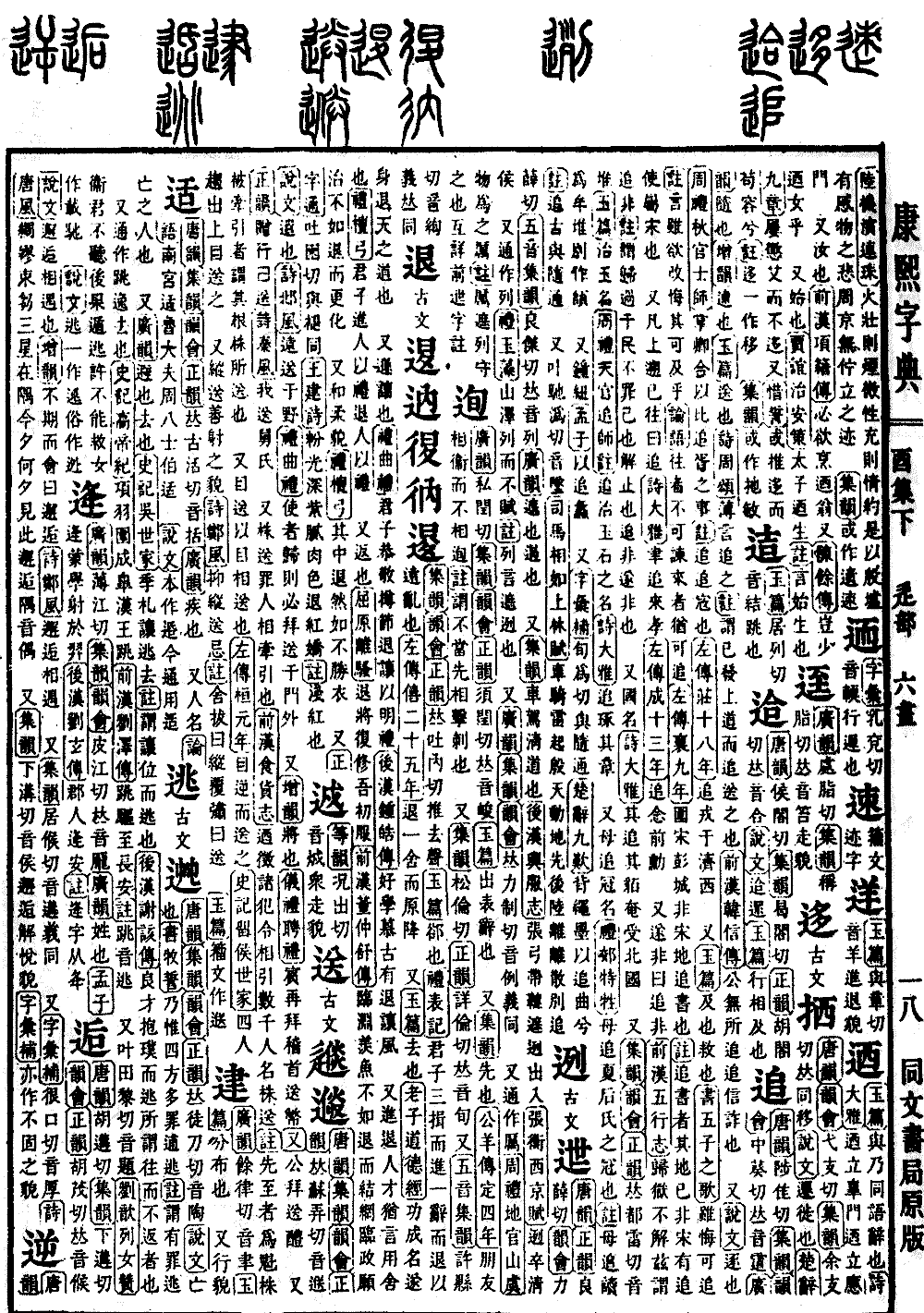
Page 1256, Entry 25
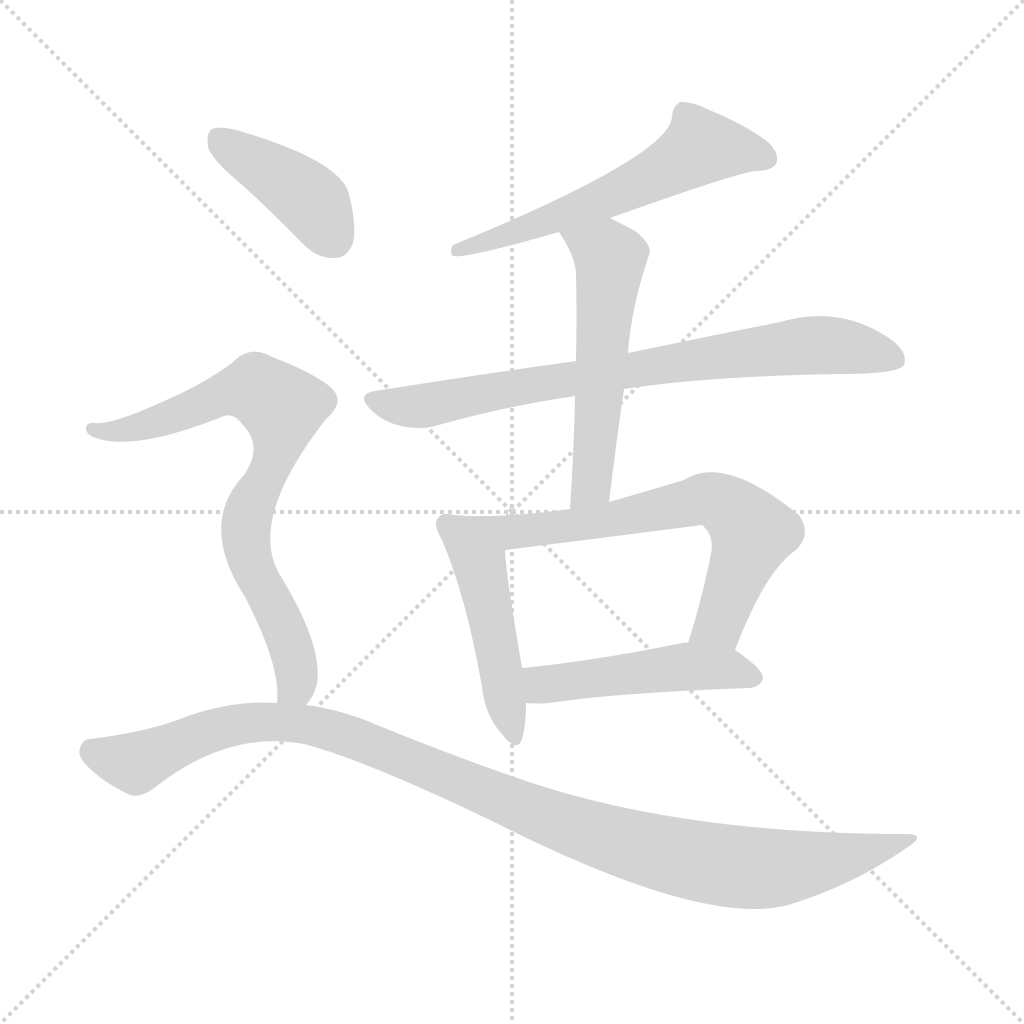
Pronounced shi.
From Shuo Wen Jie Zi (Explaining Graphs and Analyzing Characters): To go to a place.
From Guang Yun (Broad Rhymes): To proceed.
From Zheng Yun (Correct Rhymes): To go, to reach.
Book of Odes (Shijing): "Going to your residence."
Book of Rites (Liji): "When about to go to a residence, one should ask to enter, and not be persistent."
Also, from Guang Yun: Happy.
From Zheng Yun: Comfortable and at ease, self-satisfied.
Book of Odes (Shijing): "Matches my desire."
Zhuangzi: "To cater to another’s comfort, rather than being comfortable in one’s own state."
Also, to follow or obey.
Book of Documents (Shangshu): "Only our task of punishing the Yin had no private motives, we were single-mindedly obedient to the Heavenly Emperor without two hearts."
Zuo Zhuan: "The common people knew what to obey."
Also, from Zheng Yun: Shi-ran, meaning by chance.
Book of Documents (Shangshu): "This was merely a case of accidental calamity."
Commentary: Shi means accidental.
Also, the normal state of affairs. Also called shi-ran.
History of the Former Han (Qian Hanshu): Considered this to be merely accidental.
Also, from Yun Hui (Collection of Rhymes): Shi-lai, meaning recently.
Also, a function word indicating just now or a moment ago.
Old Book of Tang (Tangshu): "Just came from where?"
Also, from Guang Yun: Good.
From Yun Hui: Recommending talent appropriately is called shi.
History of the Former Han (Qian Hanshu): Recommending scholars once appropriately, twice appropriately, three times appropriately.
Also, from Zheng Zitong (Correct Meaning Thoroughness): In the Guanzhong region, filling a quota is called shi.
History of the Former Han (Qian Hanshu): The horses and the soldiers’ quota did not complement each other to reach the full amount.
Commentary: There were few horses and many soldiers, unable to supplement each other to reach the full quota.
Also, from Yu Pian (Jade Chapters): A woman being married.
Also, pronounced di. Equivalent to the character meaning legitimate heir (di).
Book of Odes (Shijing): "The position of the Son of Heaven is the legitimate succession of the Yin-Shang."
Commentary: Yin shi, the legitimate heir of the Yin-Shang.
Book of Rites (Liji): "Supporting the legitimate heir, standing facing south."
Also, shi-shi, referring to a senior scholar.
Book of Rites (Liji): "A senior scholar (shi-shi) may establish two ancestral temples."
Also, shi-shi, referring to the main living quarters.
Book of Rites (Liji): "Crying for him in the main living quarters."
Also, from Yun Hui: To preside over, to be solely in charge.
Analects (Lunyu): "There is no one solely in charge."
Book of Odes (Shijing): "For whom am I adorning my appearance?"
Book of Odes (Shijing): "With whom should I deliberate?"
Also, pronounced di. Equivalent to the character meaning enemy (di).
Book of Rites (Liji): "The ruler ascends the hall alone to stand on the mat, standing alone facing west; this embodies the idea that no one dares to be his equal (di)."
Records of the Grand Historian (Shiji): "At first, like a maiden, (causing) the enemy to keep their gates closed. Later, like a fleeing hare, (causing) the enemy to dare not resist."
Also, pronounced zhai. Equivalent to the character meaning to blame or demote (zhe).
Book of Odes (Shijing): "Do not bring down calamity or blame."
Also, Mencius: Regarding human affairs, it is not worth blaming too much.
Also, pronounced ti. Shi-shi-ran, the appearance of being fearful.
Zhuangzi: "Shi-shi-ran, fearful."
Also, pronounced zhi. To go.
Also, rhyming with shi (level tone), pronounced shi.
Yangzi Tai Xuan Jing: "Sharpening the head at the critical moment is obtaining the appropriate opportunity. Being sharp in the east but failing in the west is something one cannot avoid."
Also, rhyming with lie, pronounced she.
Han Yu's Jin Xue Jie (Exhortation to Learning): "Being tactful and thorough is considered beautiful; being exceptional and outstanding is considered excellent. Comparing the length, short-comings, and superiorities lies only in whether the implement is suitable (shi)."
Also, rhyming with zhuo, pronounced shuo.
Lu Ji's Yan Lian Zhu: "Smoke is produced from fire, it is not the harmonious product of fire. Emotions arise from human nature, it is not the appropriate (shi) state of nature. Therefore, when the fire is vigorous, the smoke is faint; when nature is fulfilled, emotions are simple."