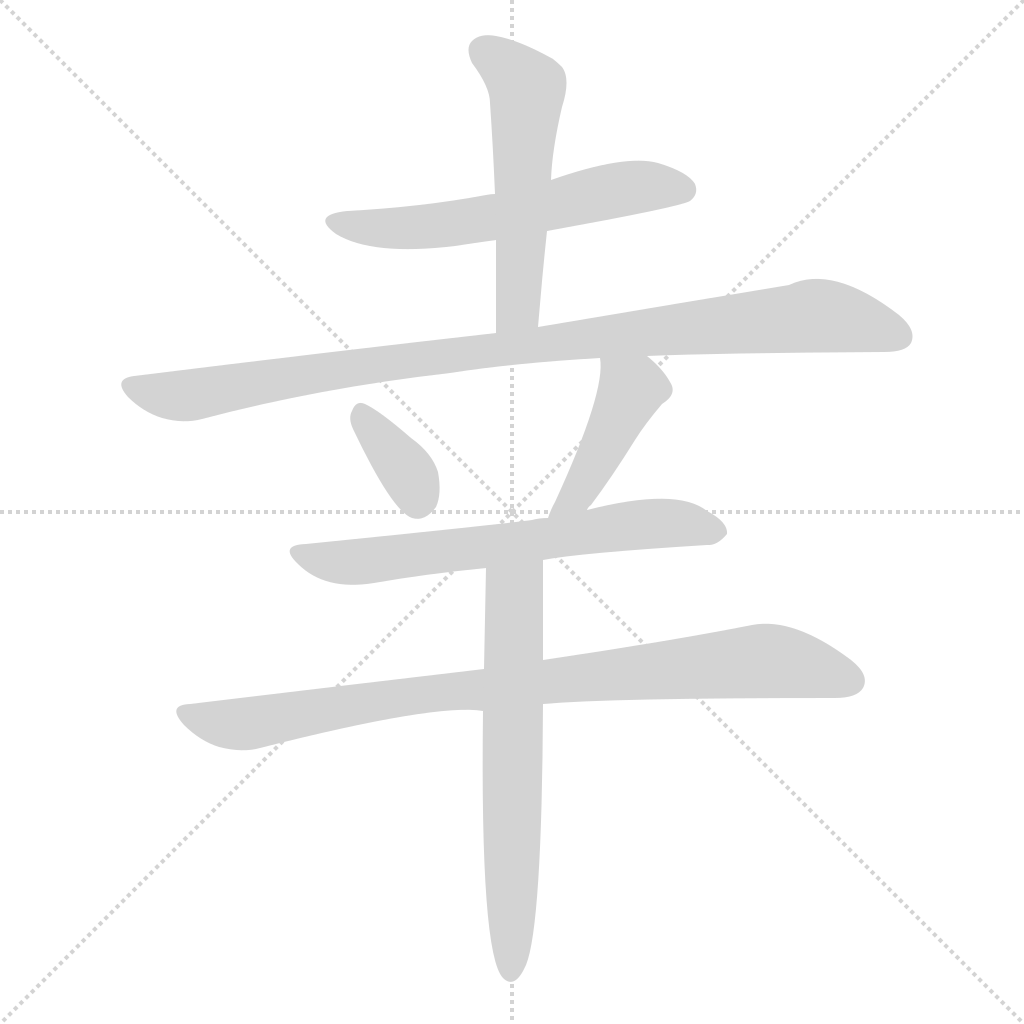
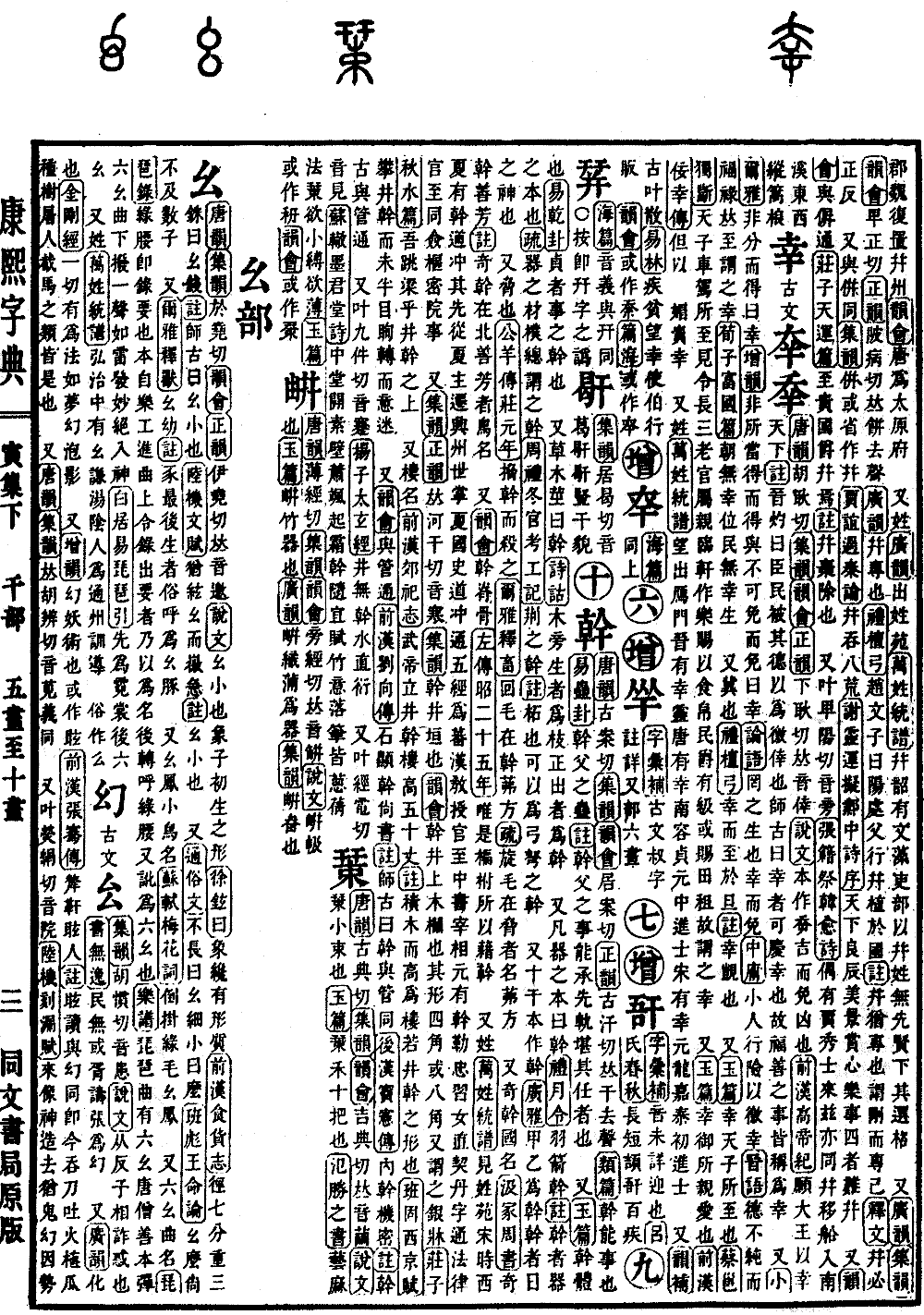
Yin Collection, Lower Volume
Radical: Stem (gàn)
Page 341, Entry 01
Ancient form. Pronounced xing (falling tone).
Shuowen Jiezi (Explanation of Writing and Analysis of Characters): Originally written with an archaic variant form. It means to be fortunate and thus avoid disaster.
Book of Han (Hanshu), Annals of Emperor Gao: Wishing the Great King to bestow good fortune upon the world. Annotation: Jin Zhuo says: When subjects receive his virtue, they consider it an unexpected blessing. Yan Shigu says: Those who are fortunate are those who have cause for celebration. Therefore, matters of good fortune are all referred to as xing.
Also, Xiao Erya (Small Literary Expositor): To obtain something not earned is called xing.
Zengyun (Additional Rhymes): To obtain that which one does not deserve, or to avoid that which cannot be avoided, is called xing.
Analects (Lunyu): To survive despite improper conduct is merely a matter of good fortune avoiding punishment.
Doctrine of the Mean (Zhongyong): The inferior person acts recklessly to seek undeserved fortune.
Discourses of the States (Guoyu): When virtue is not pure yet prosperity and rank arrive, it is called xing.
Xunzi, Chapter on Enriching the State: In the court, there are no positions gained by luck; among the people, there is no survival gained by luck.
Also, to hope or yearn for.
Book of Rites (Liji), Tan Gong: Hoping to last until dawn. Annotation: Xing means to hope or covet.
Also, Yupian (Jade Compendium): The place where the Son of Heaven arrives.
Cai Yong, Duduán (Sole Determinations): When the imperial carriage arrives, the emperor meets with local officials and elders, personally inspects the court, hosts music, and bestows food and silk. The people receive promotions in rank, or are granted tax relief on their fields; therefore, such a visit is called xing.
Also, Yupian: Xing refers to those whom a ruler favors and loves personally.
Book of Han (Hanshu), Biographies of the Flatterers: Merely by flattery, they gained imperial favor.
Also, a surname.
Wanxing Tongpu (Comprehensive Genealogy of Ten Thousand Surnames): The clan originated in Yanmen. During the Jin dynasty, there was Xing Ling. During the Tang dynasty, there was Xing Nanrong, who became a presented scholar (jinshi) during the Zhenyuan period. During the Song dynasty, there was Xing Yuanlong, who became a presented scholar during the early Jiatai period.
Also, Rhyme Supplement (Yunbu): In ancient times, it rhymes with san.
Yilin (Forest of Changes): Suffering in poverty and hoping for good fortune, he sent Bo to engage in trade.
Yunhui (Collection of Rhymes): Sometimes written in a variant form.
Pianhai (Sea of Characters): Sometimes written in a variant form. The original character was written with the component for heaven above the component for silk.