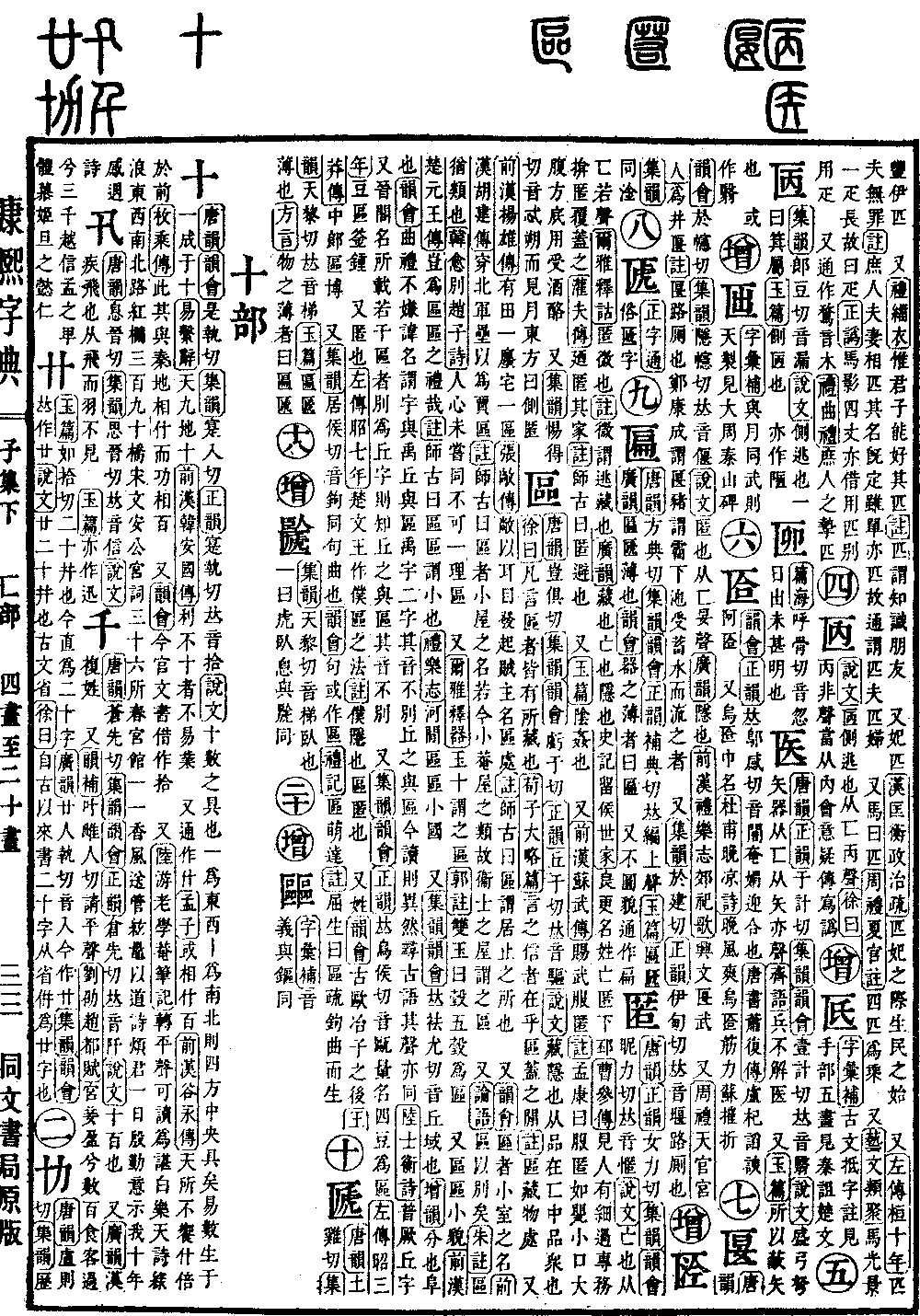
Zi Collection, Page Position: Lower
Radical: Ten (shí)
Kangxi Strokes: 2
Page 155, Entry 17
Pronounced shí.
According to the Explaining Graphs and Analyzing Characters (Shuowen Jiezi), ten is the complete form of numbers. The horizontal line represents the east-west direction, and the vertical line represents the north-south direction, thus signifying the completeness of the four directions and the center. In the Book of Changes (Yijing), numbers originate at one and reach completion at ten.
Book of Changes, Appended Statements (Yijing Xici): The number of heaven is nine, and the number of earth is ten.
History of the Former Han Dynasty (Qianhan Shu), Biography of Han Anguo: If the profit does not reach ten times the cost, the trade is not changed.
It is also used as a variant for the word meaning ten (shí, as in a collection of ten).
Mencius (Mengzi): Some are different by ten times or a hundred times.
History of the Former Han Dynasty, Biography of Gu Yong: Sacrifices not enjoyed by heaven exceed those of the past by tenfold.
Biography of Mei Cheng: Here, compared to the land of Qin, the territory is ten times greater, and the efficacy is a hundred times greater.
According to the Collection of Rhymes (Yunhui), in current official documents, it is borrowed for the character meaning to pick up or ten (shí).
According to Lu You's Notes from the Hall of Old Learning (Laoxuean Biji), when the tone shifts to level, it can be read as chén.
Poem by Bai Juyi: Green waves, roads east, west, south, and north; red railings, three hundred and ninety bridges.
Palace Verses by Song Wen'an Gong: Thirty-six spring palace halls, one by one the fragrant winds carry the sounds of pipes and strings.
Poem by Chao Yidao: Troubling your heart with such diligence for one day, you show me poems of ten years of shared encounters.