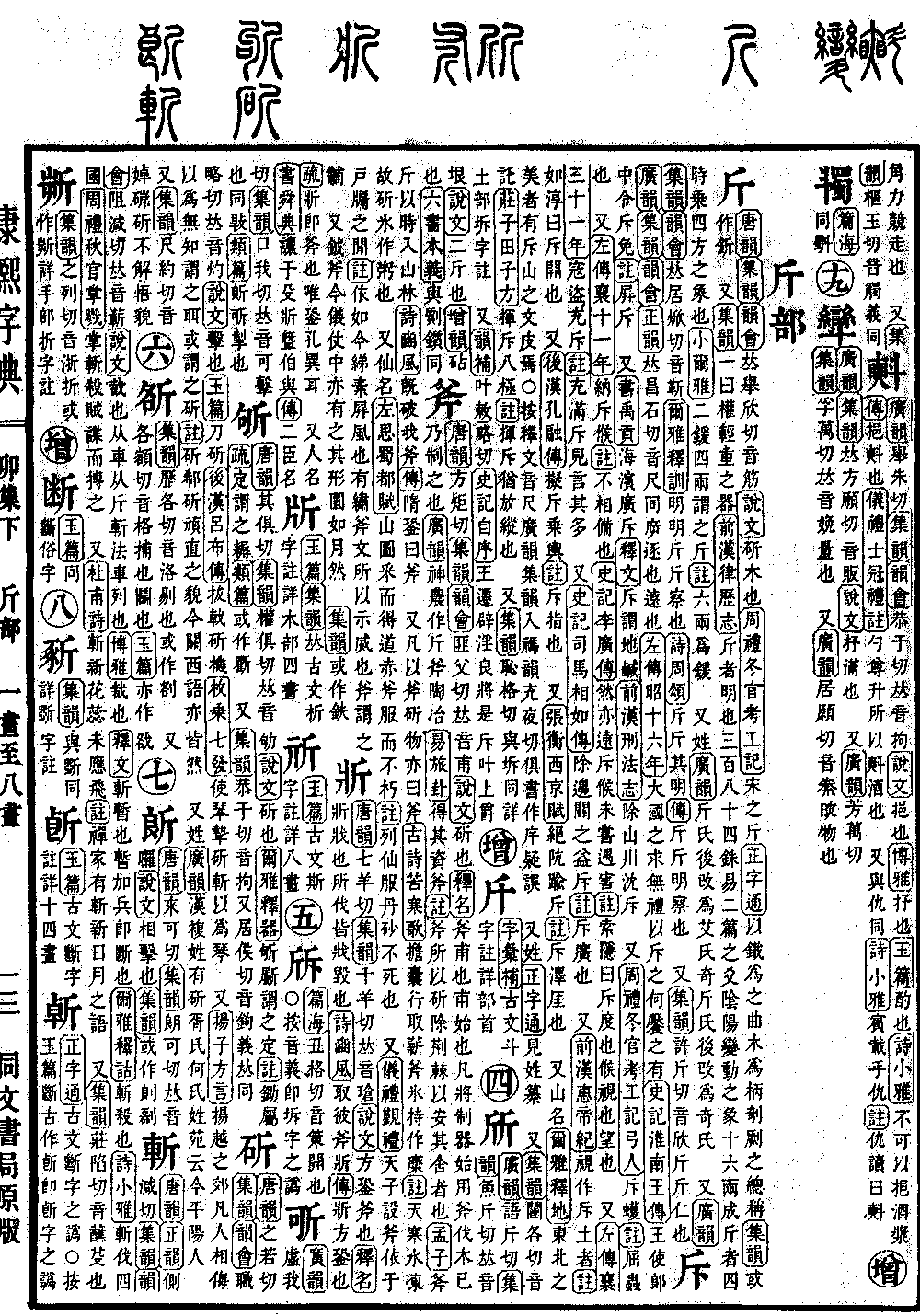
Mao Collection, Lower Volume
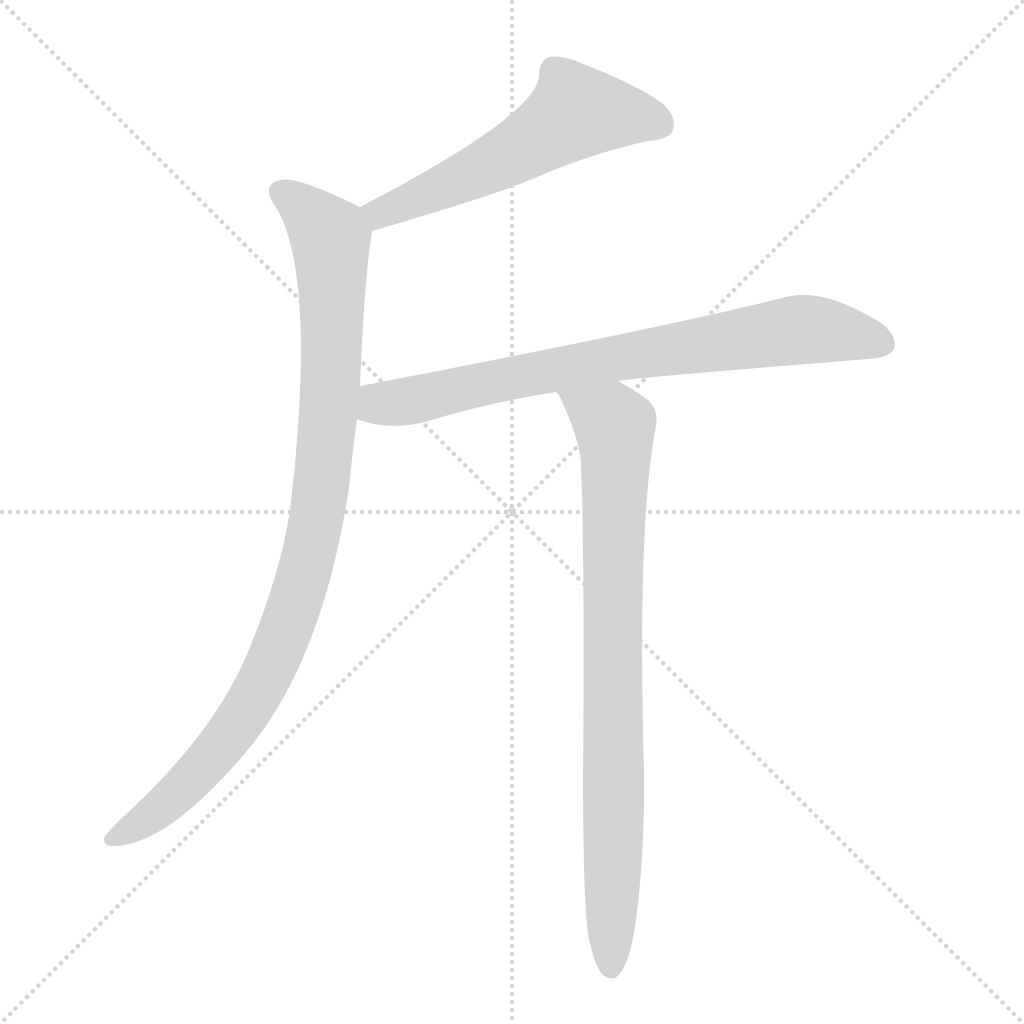
Radical: Axe (jīn)
Page 479, Entry 04
Tang Rhymes (Tangyun), Collection Rhymes (Jiyun), and Rhyme Meeting (Yunhui) state it is pronounced jin.
Shuowen Jiezi explains it as a tool for chopping wood.
Book of Rites, Winter Officer, Artificer's Record (Zhouli, Dongguan Kaogongji) mentions axes made in the State of Song.
Correct Meaning Guide (Zhengzitong) explains it is made of iron with a curved wooden handle, serving as a general term for various carving tools.
Collection Rhymes (Jiyun) records that it is sometimes written in a variant form (jin).
Collection Rhymes (Jiyun) notes another meaning: a device for measuring weight.
History of the Former Han, Treatise on Harmonics and Calendars (Qianhan, Lvli Zhi) states: The jin is a unit of measurement for weight. It is equivalent to three hundred eighty-four zhu. It symbolizes the number of lines in the upper and lower sections of the Book of Changes (Yijing), reflecting the imagery of yin and yang changes; sixteen liang constitute one jin, symbolizing the four seasons multiplied by the four directions.
Little Erya (Xiao Erya) records: Two lüe and four liang are called one jin. The commentary explains that six liang make one lüe.
It is also a surname. Broad Rhymes (Guangyun) records: There is the Jin clan, later changed to the Ai clan. The Qijin clan was later changed to the Qi clan.
Broad Rhymes (Guangyun), Collection Rhymes (Jiyun), and Rhyme Meeting (Yunhui) state it is pronounced jin.
Erya, Explanations of Teachings (Erya, Shixun) defines mingming jinjin as meaning to be discerning.
Book of Odes (Shijing), Odes of Zhou (Zhousong) contains the phrase: Discerning is his clarity. The commentary explains jinjin as the appearance of being discerning.
Collection Rhymes (Jiyun) also states it is pronounced xin, where jinjin means benevolent.