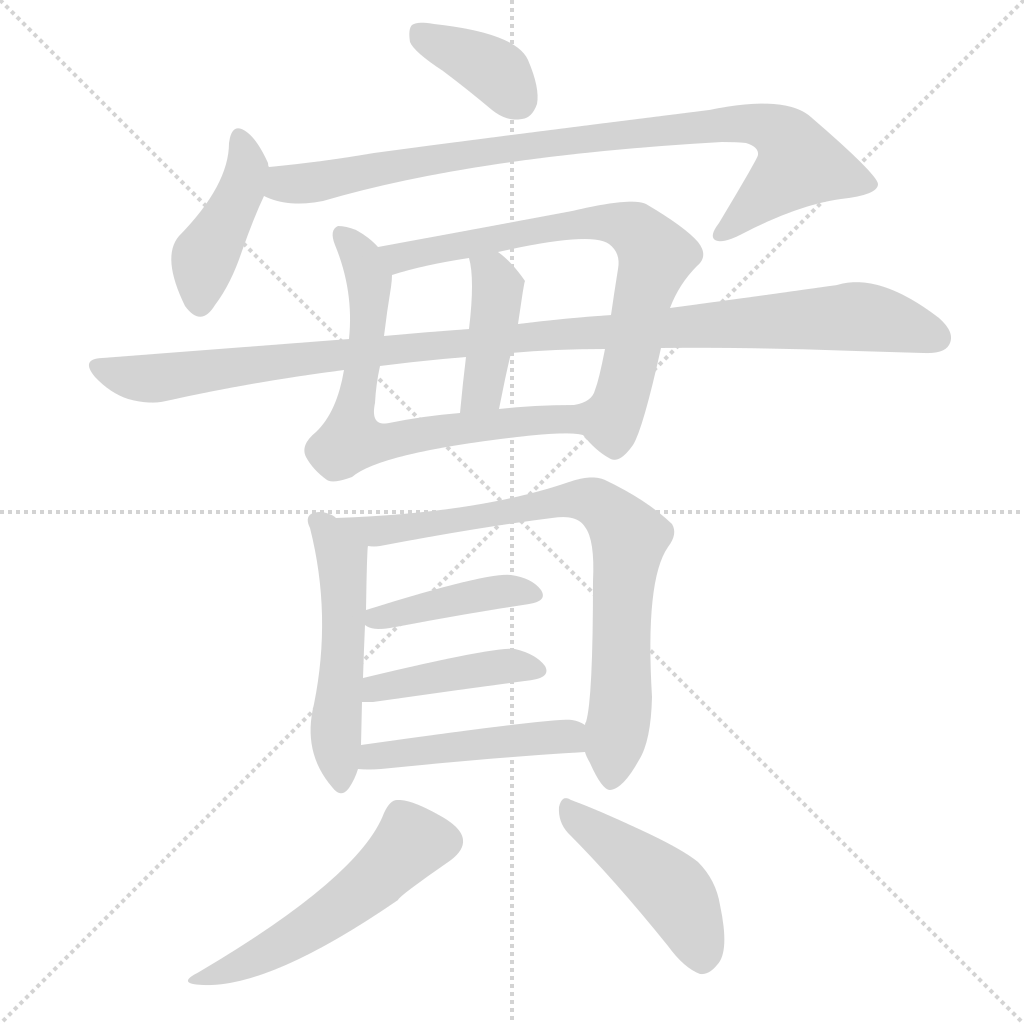
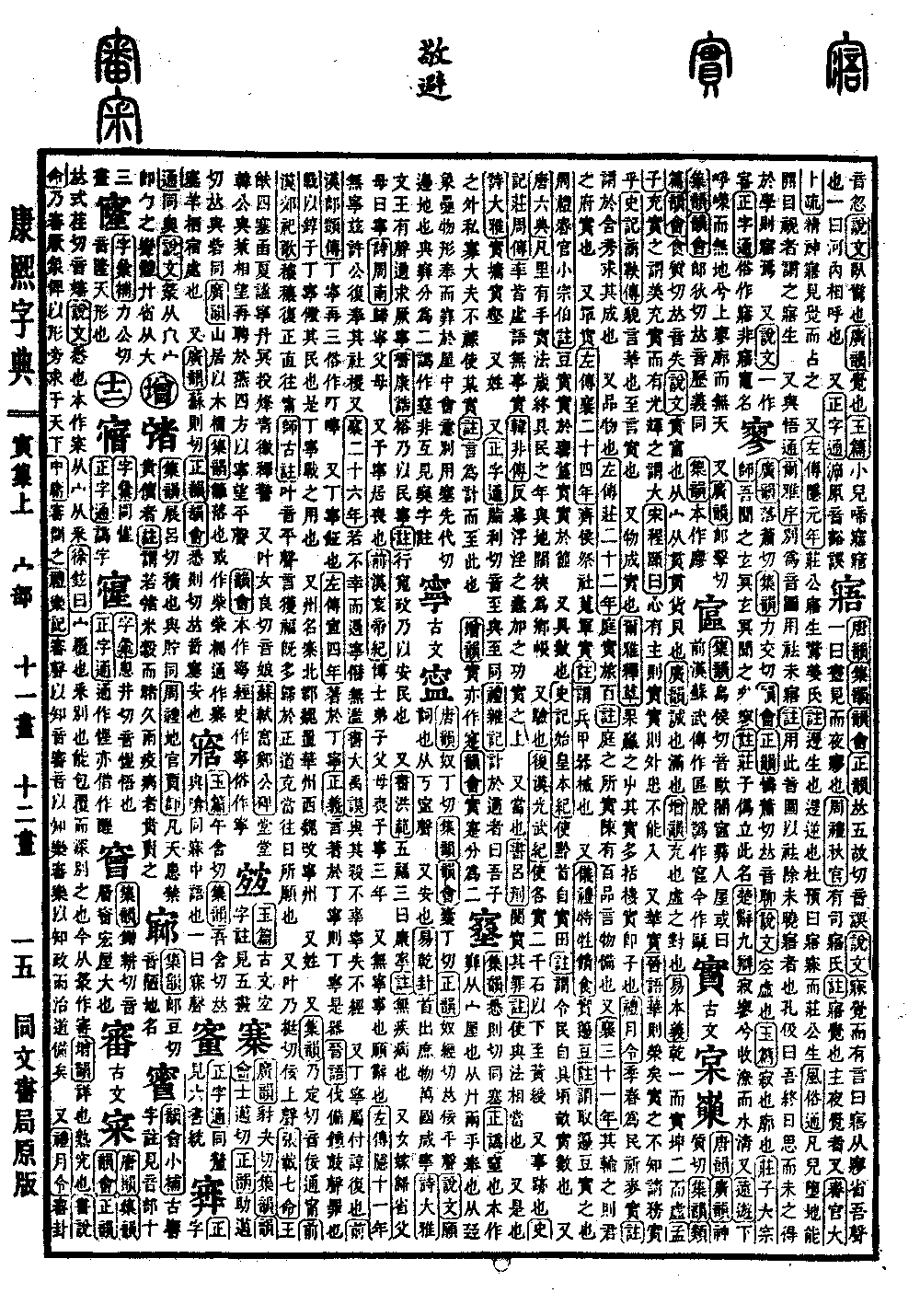
Yin Collection, Upper Volume
Radical: Roof (bù)
14 strokes
Page 291, Entry 04
Ancient character variant for the entry word.
Pronounced shi.
Shuowen Jiezi (Explanation of Graphs and Analysis of Characters) states: The entry word denotes richness. It is composed of the roof radical and the character meaning to pass through. To pass through refers to currency or shells.
Guangyun (Broad Rhymes) states: It means sincerity and fullness.
Zengyun (Augmented Rhymes) states: It means to fill; the opposite of empty.
I Ching: Benyi (Original Meaning of the Book of Changes) states: The Qian hexagram is singular and full, while the Kun hexagram is dual and empty.
Mencius states: To be filled with goodness is called beauty; to be filled with goodness and possess brilliance is called greatness.
Cheng Yi of the Song dynasty stated: When the heart has a guiding principle, it is substantial; if it is substantial, external troubles cannot enter.
Also refers to flowers and fruits.
Jin Yu (Discourses of the States of Jin) states: Flowers are glorious, but if one does not know the fruit, one should seek the truth of the substance.
Records of the Grand Historian (Shiji): Biography of Shang Yang states: Superficial words are like flowers; ultimate truth is like the fruit.
Also refers to the completion and solidification of things.
Erya (Approaching Elegance), section on grasses, mentions the fruit of the snake gourd. The fruit is the seed.
Book of Rites (Liji): Monthly Commands states: In the late spring, one prays for the wheat to bear fruit. The commentary explains this as seeking the perfection of the grain during its flowering stage.
Also refers to items or goods.
Zuo Zhuan (Chronicle of Zuo): 22nd year of Duke Zhuang states: The items in the courtyard were counted by the hundreds. The commentary explains this as a hundred different varieties of goods being fully prepared.
Also in the 31st year of Duke Xiang: Regarding the transport of goods, they belong to the sovereign’s treasury.
Also refers to military supplies.
Zuo Zhuan (Chronicle of Zuo): 24th year of Duke Xiang states: At the Qi altar, military supplies were reviewed. Du Yu’s commentary notes that sacrifices were made at the altar, followed by an inspection of military weapons.
Also, Book of Etiquette and Ceremonial (Yili): Offering Food for a Single Victim states: Fill the bamboo and wooden vessels. The commentary notes this means taking items to fill these vessels.
Zhou Li (Rites of Zhou): Office of Spring, commentary by the Minor Herald, states: Beans are filled with contents, and gui vessels are filled with items kept in baskets.
Also refers to reporting accurate numbers.
Records of the Grand Historian (Shiji): Annals of the First Emperor states: Caused the common people to report their own landholdings. The commentary explains this as ordering the people to provide the actual numbers of their acreage.
Also, Tang Liudian (Six Statutes of the Tang Dynasty) states: Every neighborhood had a household registration law; at the end of the year, citizens reported their age and the dimensions of their land to create village records.
Also refers to verifying or testing.
Book of the Later Han (Hou Hanshu): Annals of Emperor Guangwu states: Caused each official to verify their two thousand shi salary, down to the level of the yellow-ribbon officials.
Also refers to historical facts or traces.
Records of the Grand Historian (Shiji): Biography of Zhuang Zhou states: These are all empty words, without factual evidence.
Biography of Han Fei states: Instead, he promoted the harmful, superficial, and excessive, adding them to actual meritorious achievements.
Also refers to being appropriate.
Book of Documents (Shangshu): Lu Xing states: Carefully verify the appropriateness of their crimes. The commentary explains this as making the punishment match the law.
Also functions as the verb to be.
Book of Odes (Shijing): Great Odes states: It is the wall, it is the moat.
Also functions as a surname.
Zhengzitong (Correction of Characters) states: Pronounced zhi. It is the same as the character for reach.
Book of Rites (Liji): Miscellaneous Records states: When accounting to those of equal status, one says: My external private servants and junior officials have passed away; I was sent by someone to this place. The commentary explains this as speaking of being sent to this place to provide an account.
Zengyun (Augmented Rhymes) states: This character is also written in a variant form.
Yunhui (Collection of Rhymes) states: The two forms are distinct.