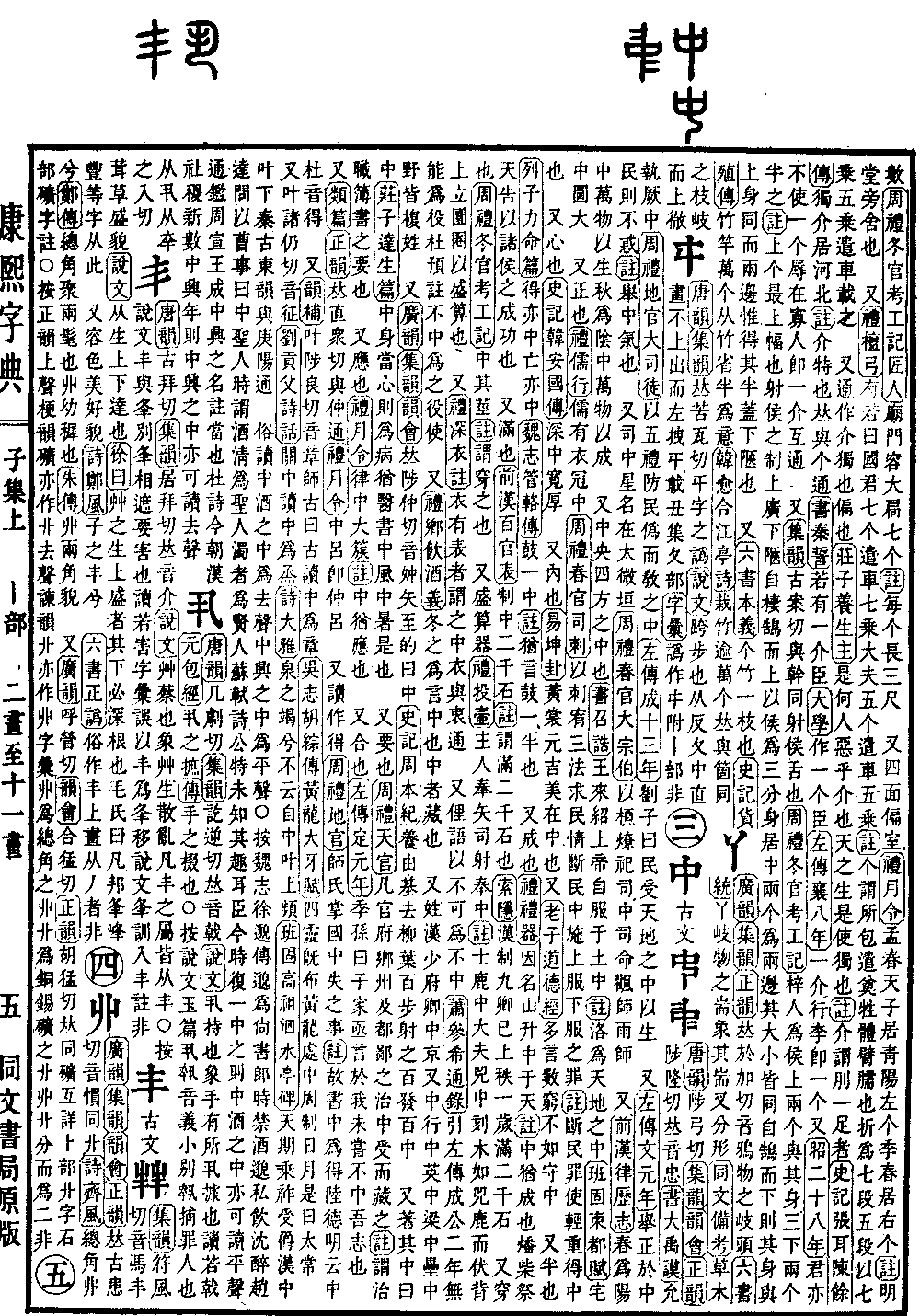
Zi Collection, Page Position: Upper
Radical: Line (gǔn)
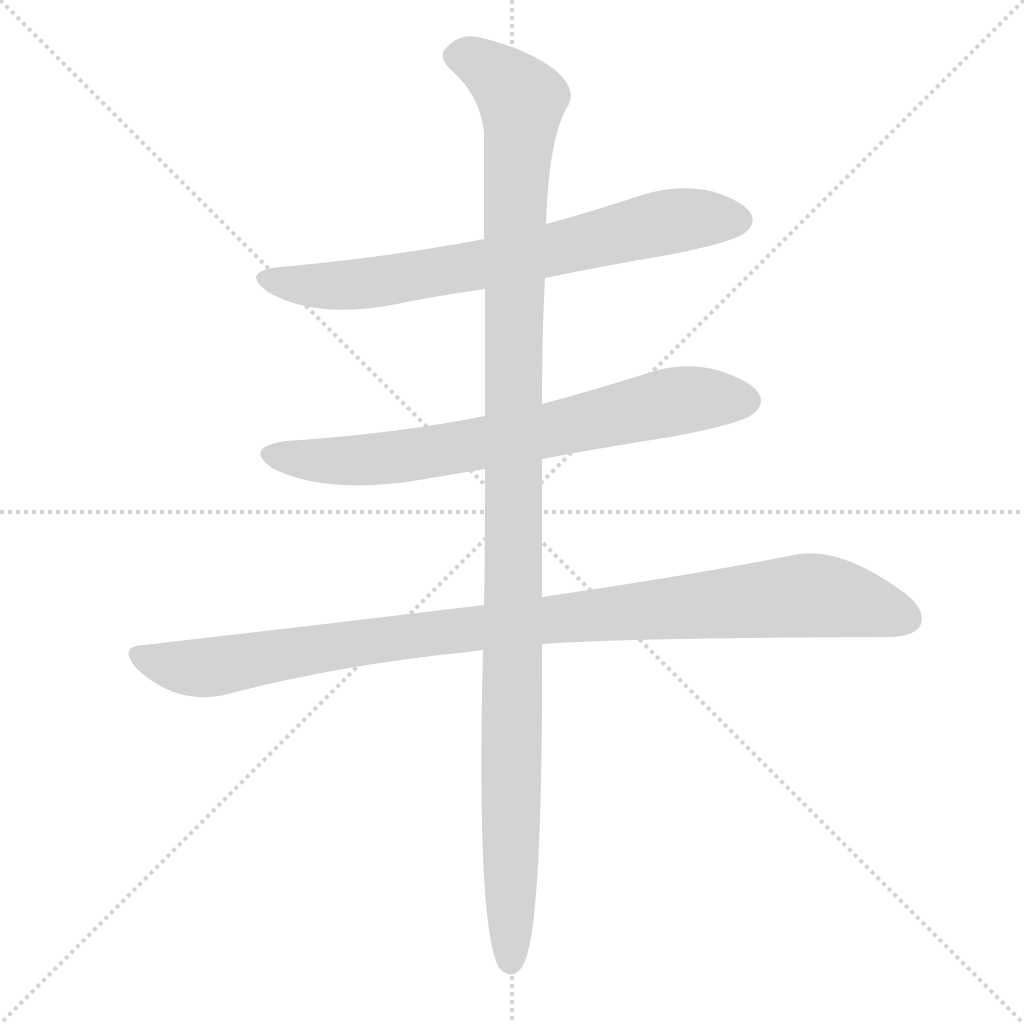
Character: Feng
Kangxi Dictionary Stroke Count: 18
Page 79, Line 8
Ancient form. According to the Collected Rhymes (Jiyun), it is pronounced with the initial of fú and the final of fēng, sounding like féng. The term fēngróng describes the appearance of lush and luxuriant grass.
Explaining Graphs and Analyzing Characters (Shuowen Jiezi) states it is derived from the radical for growth (shēng), indicating penetration from top to bottom.
Xu said: When grass grows, if the top is lush, the bottom must have deep roots.
Mao said: Characters such as bāng, féng, fēng, and fēng all derive from this radical.
It also refers to a beautiful appearance. How handsome you are — Book of Odes (Shijing).
Correcting the Errors of the Six Scripts (Liushu Zheng'e) states it is commonly written as fēng, but writing the top stroke as a slanted stroke is incorrect.
Ancient form of the character pronounced fēng. According to the Tang Dynasty Rhymes (Tangyun), it is pronounced with the initial of fū and the final of róng. According to the Collected Rhymes and the Rhyme Collective (Yunhui), it is pronounced with the initial of fū and the final of féng, sounding like fēng.
Explaining Graphs and Analyzing Characters states it refers to the full and plump appearance of beans. Another theory says it is the name of a vessel; in the village drinking ceremony, there is a vessel called the Fenghou, also known as the feijin.
Lu Dian said: Its shape resembles a bean-shaped vessel but is slightly larger.
Miscellaneous Matters from the Sea of Records (Hailu Suishi) states that in the Ritual of Archery (Shelǐ), the vessel is placed on the western steps. The ancient ruler of the state of Feng lost his kingdom due to wine, so it was used as a cup for penalty drinks, with a human figure drawn on the bottom as a warning.
The master of archery went to the west of the hall and ordered the disciples to set up the vessel — Book of Etiquette and Ceremonial (Yili). The note states: When about to give penalty wine to the loser, the vessel is set up to hold the wine cup.
The sub-commentary states: According to the Ritual of the Banquet (Yànlǐ), the ruler's wine cup has a stand; the stand mentioned here for holding the cup indicates it is used for both purposes.
Also, it means large — Jade Chapters (Yupian). It means many or abundant — Broad Rhymes (Guangyun).
The sub-commentary on the Hexagram Feng in the Book of Changes (Yijing) states: Feng is a name describing abundance and greatness, carrying the meaning of sufficiency. When wealth is plentiful and virtue is great, it is called feng.
In sacrificial ceremonies, do not be excessively lavish toward close relatives — Book of Documents (Shujing). The sub-commentary states: This means the sacrificial offerings are too numerous.
If they plot against the state of Chu, they will likely suffer a great defeat — Discourses of Chu (Chuyu). The note states: It means great.
Yangzi's Dialects (Fangyan) states: Any object that appears large is called feng. Furthermore, in the outskirts of Zhao and Wei and the northern borders of Yan, tall people are called fengren. The Records of Yan states that fengren have narrow and long heads. A shuttle-shaped head means a long head.
Also, it means lush and luxuriant — Broad Rhymes. In those lush grasses — Book of Odes. The commentary states: Feng means luxuriant.
Those who serve a ruler do not change their conduct based on prosperity or decline — Discourses of Chu. The note states: Feng means prosperous, while yue means declining.
Also equivalent to the meaning of thick or fleshy. In the plains and low-lying marshy lands, the people are fleshy and short in stature — Rites of Zhou (Zhouli).
Also, a bountiful harvest is called feng. In this year of abundance, there is much millet and much rice — Book of Odes. What is meant by a year of great abundance? It means a year of a great harvest — Gongyang Commentary (Gongyangzhuan). The note states: This means the five grains have all ripened well.
Also, the Master of Clouds is called Fenglong — Broad Elegance (Boya). Another theory says it is the Master of Thunder. I commanded Fenglong to ride upon the clouds — On Encountering Sorrow (Li Sao) by Qu Yuan.
In the third month of late spring, Fenglong appears — Master of Huainan (Huainanzi). The note states: Refers to thunder.
Also refers to a feng mat. Kong Anguo's Commentary on the Book of Documents states: Feng refers to the wǎn grass. Guo Pu said: People in the west now call cattails wǎn and use them to make mats. Zheng Kangcheng said: It is a polished bamboo mat.
Also, fengben is another name for chives. In all rituals for the ancestral temple, chives are called fengben — Book of Rites (Liji). The note states: Because its roots and stems are lush.
Also a place name. The King returned from the land of Shang and arrived at Feng — Book of Documents. The commentary states: The old capital of King Wen was in Hu County of Jingzhao, which is northwest of present-day Chang'an County. Commonly written as the variant form Fēng.
Also a river name. The Feng River flows eastward — Book of Odes. The note in the Book of Commandries and States (Junguo Zhi) of the History of the Later Han (Houhanshu) states: The Feng River originates in the Feng Valley of the Southern Mountains in Hu County and flows north into the Wei River. Commonly written as the variant form Fēng.
Also a county name. Feng County belongs to Pei Commandery — Book of Han (Han Shu). Also a prefecture name. Formerly Taiyuan Commandery, Feng Prefecture was established during the Song Dynasty. Also in Shaanxi, Feng Prefecture was established during the Sui Dynasty.
Also a mountain name. Mount Feng is located about two li south of the city of Chuzhou, and upon it sits the Fengle Pavilion. See the record by Ouyang Xiu.
Also a person's name. Feng was a consort of Emperor Ku and gave birth to Yao — Table of Ancient and Modern People (Gujin Renbiao) in the Book of Han. Yan Shigu said: This is the same as the name Fēng.
Also a surname. Descendants of Feng, the son of Duke Mu of Zheng — Broad Rhymes. Also a compound surname, Fengjiang. See the Comments of a Recluse (Qianfu Lun).
Also a rhyming pronunciation, pronounced with the initial of fū and the final of wén, sounding like fēn. The people are settled and products are abundant — Cai Yong. It rhymes with "soothing our Jing and Heng" above and "to record great merits" below.
Also a rhyming pronunciation, pronounced with the initial of fū and the final of kāng, sounding like fāng. Friends have already been found, but the official salary is truly not generous. Using one's aspirations as nourishment, why is there a need for oxen or sheep? — Elegy for Ouyang Sheng (Ouyang Sheng Aici) by Han Yu.
Textual Research on Feng: Explaining Graphs states it refers to the fullness of beans. Another theory says it is the name of a vessel; in village drinking ceremonies, there is a vessel called feng, also called feijin. Corrected according to the original text from feng to Fenghou.