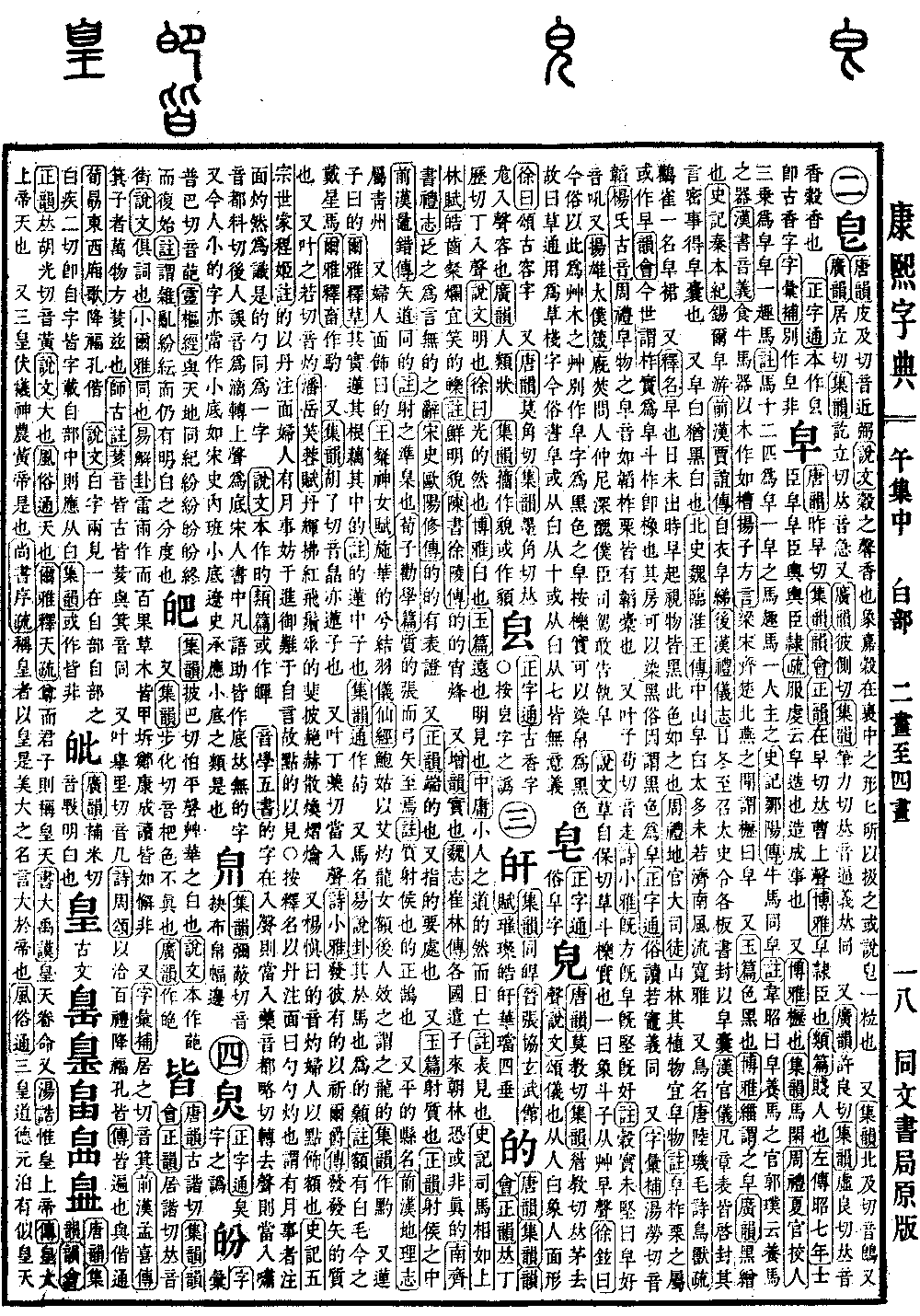
Wu Collection, Middle Volume
Radical: White (bái)
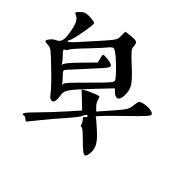
Zao
Kangxi strokes: 7
Page 786, Entry 02
Pronounced zao (rising tone).
Pronounced zao (rising tone).
Pronounced zao (rising tone).
Pronounced zao (rising tone).
Pronounced cao (rising tone).
Broadening of Refined Cultural Terms (Boyo): Low-ranking attendants, referring to subjects.
Categorized Dictionary (Leipian): Refers to base or lowly people.
Zuo Zhuan (Zuozhuan), Seventh Year of Duke Zhao: Scholars manage the attendants, the attendants manage the carriages, and the carriages manage the laborers.
Commentary (Shu): Fu Qian explains: Zao means to create. To create means to complete affairs.
Broadening of Refined Cultural Terms (Boyo): Refers to a horse manger.
Collected Rhymes (Jiyun): Refers to a horse stable.
Rites of Zhou (Zhouli), Summer Officials, Equerry: Three carriages are called a zao, and each zao is assigned one groom.
Commentary (Zhu): Twelve horses constitute one zao; the horses of one zao are managed by one groom.
Records of the Grand Historian (Shiji), Biography of Zou Yang: Cattle and horses share the same manger.
Commentary (Zhu): Wei Zhao says: Zao is the official post for raising horses. Guo Pu says: It is the implement for raising horses.
Book of Han (Hanshu), Pronunciations and Meanings: An implement for feeding cattle and horses, made of wood and shaped like a trough.
Dialect (Fangyan) by Yang Xiong: In the regions of Liang, Song, Qi, Chu, and Northern Yan, a horse manger is called a zao.
Jade Chapter (Yupian): Refers to the color black.
Broadening of Refined Cultural Terms (Boyo): The color black is called zao.
Wide Rhymes (Guangyun): Refers to black silk textiles.
Records of the Grand Historian (Shiji), Annals of Qin: Bestowed upon you black banners and ribbons.
Biography of Jia Yi, Former Book of Han: He wore black thick silk robes.
Treatise on Rituals and Ceremonies, Book of the Later Han: On the winter solstice, the Grand Historian was summoned and ordered to write on wooden tablets, which were then sealed in black bags.
Ceremonies of the Han Officials (Hanguanyi): All memorials were opened upon arrival; those involving confidential matters were sealed in black bags.
Zao-bai, similar to saying black and white.
History of the Northern Dynasties (Beishi), Biography of Prince Linhuai of Wei: The distinction between right and wrong (black and white) by the Prince of Zhongshan was too severe; it was not as fluid, generous, and elegant as that of the Prince of Jinan.
A bird name.
Record of Birds and Beasts in the Book of Odes by Lu Ji of the Tang dynasty: The stork, also known as the zao-qun.
Explanations of Names (Shiming): Related to early. When one rises early before the sun has risen, everything looks black, and this color is just like that.
Rites of Zhou (Zhouli), Earth Officials, Great Superintendent: In the mountains and forests, it is suitable to grow zao-type plants.
Commentary (Zhu): Zao refers to plants like the sawtooth oak and chestnut. Sometimes written as zao (early).
Collected Rhymes (Jiyun): Present-day people call the fruit of the sawtooth oak the zao-dou. The sawtooth oak is a type of oak; its acorn cups can be used to dye things black, and thus common parlance refers to the color black as zao.
Explanation of Characters (Zhengzitong): The common pronunciation is like zao (stove). The meaning is the same.
Supplement to the Collection of Characters (Zihuibu): Pronounced tao, same sound as tao (sheath).
Ancient Pronunciation of the Yang Family (Yangshi Guyin): In the Rites of Zhou, the zao in zao-type plants is pronounced like tao. Both sawtooth oak and chestnut have outer shells that wrap around them.
Rhyme variant, pronounced zou (rising tone).
Book of Odes (Shijing), Lesser Odes: Already seeded and already formed into zao, already firm and already perfect.
Commentary (Zhu): When grain seeds are not yet hard, they are called zao. Hao is pronounced like hou.
Memorial on the Grand Master of Horse by Yang Xiong: Confucius deeply detested that when the stable caught fire, [the official] asked about the people [and not the horses]. The attendant official in charge of driving the carriage ventured to report to the official in charge of the stables.
Analytical Dictionary of Characters (Shuowen): Cao, pronounced zi plus bao. Cao-dou refers to the fruit of the sawtooth oak. Alternatively, it is said to look like a measuring scoop. The character structure is derived from grass with the sound of zao (early).
Xu Xuan: Today, the common character uses this for the grass in vegetation. A separate character, zao, was created to represent the color black. Note: The fruit of the sawtooth oak can dye silk black, hence it is called cao (grass). It is generally used for the cao in grass-thatched shed. The modern common character for zao is sometimes written with the components for white and ten, or white and seven, both of which are meaningless. The original form of the character zi (black) was derived from a different radical, not from the radical for river.