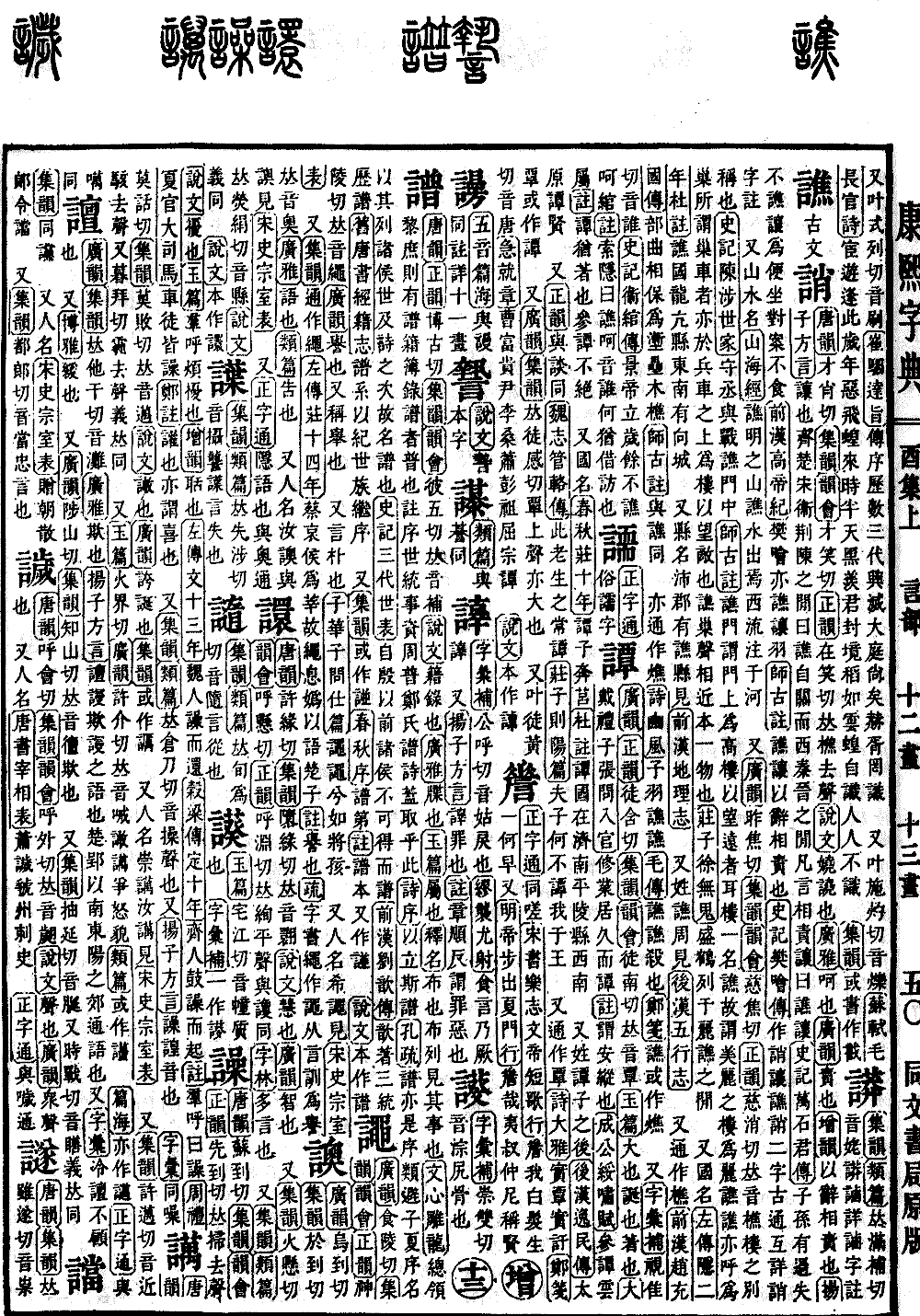
You Collection, Upper Volume
Radical: Speech (yán)
Kangxi stroke count: 19
Page 1182, Entry 02
Pronounced tan.
Great, exaggerated, evident.
Book of Rites by Dai the Elder (Da Dai Liji): One who cultivates his profession and resides long therein becomes great. Annotation: Refers to being at ease and indulgent.
Rhapsody on Whistling (Xiao Fu) by Cheng Gong Sui: Mixed and extensive, like clustering clouds. Annotation: Tan signifies to be evident. Mixed and extensive means continuous.
Also a name of a state.
Spring and Autumn Annals (Chunqiu), tenth year of Duke Zhuang: The Viscount of Tan fled to Ju. Du Yu's annotation: The state of Tan was located southwest of Pingling County in Jinan.
Also a surname. Descendant of the Viscount of Tan.
Biography of Hermits (Yimin Zhuan) in the History of the Later Han (Hou Hanshu): Tan Xian of Taiyuan.
Also, according to the Correct Rhymes (Zhengyun), identical to talk.
Records of the Three Kingdoms (Weizhi): This is the common talk of a pedant.
Book of Zhuangzi (Zhuangzi): Master, why do you not speak about me to the King?
Also used interchangeably with tan.
Book of Odes (Shijing), Greater Odes (Daya): Truly great and truly grand. Zheng Xuan's commentary: Tan is sometimes written as tan.
Pronounced tan (rising tone). Also means great.
Also rhymes with tang.
Emergency Handbook (Jijiuzhang): Cao Fugui, Yin Li Sang. Xiao Pengzu, Qu Zong Tan.
In the Origin of Chinese Characters (Shuowen), originally written as speech.