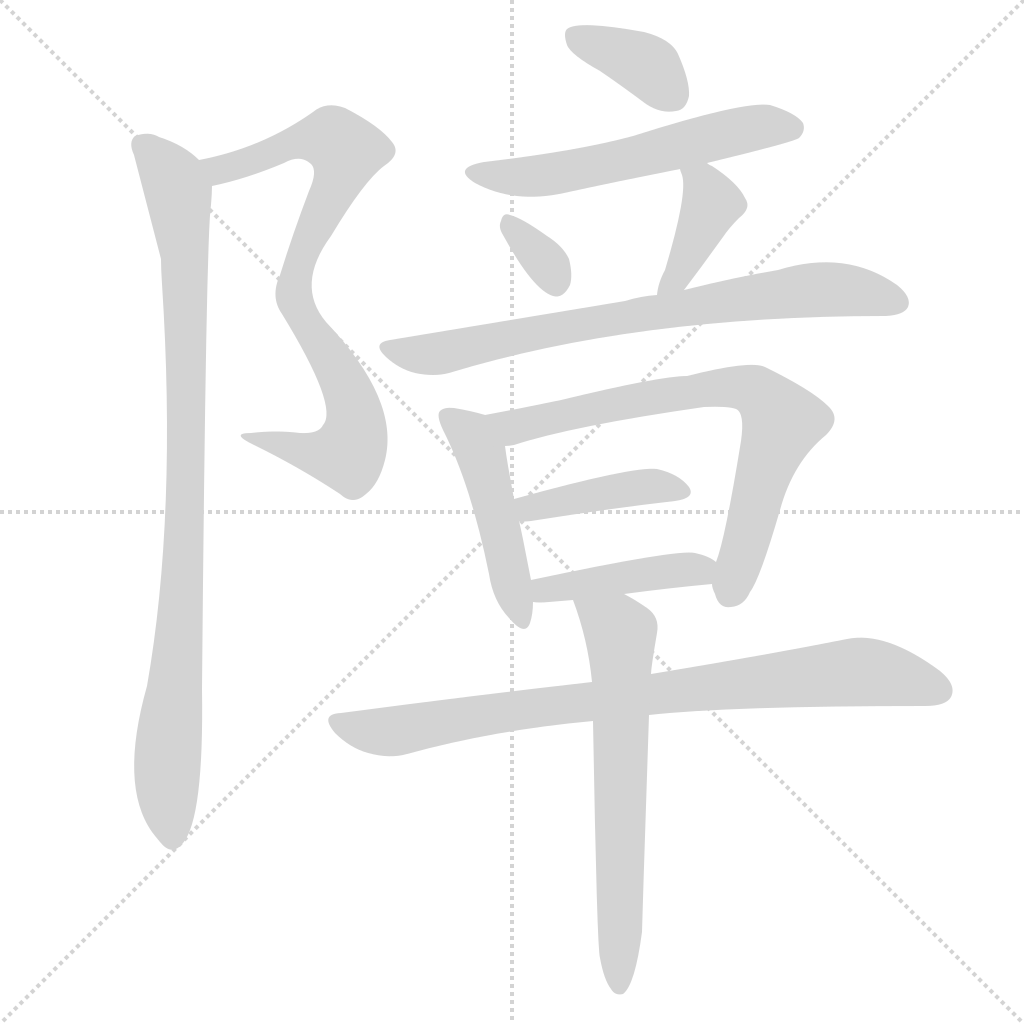
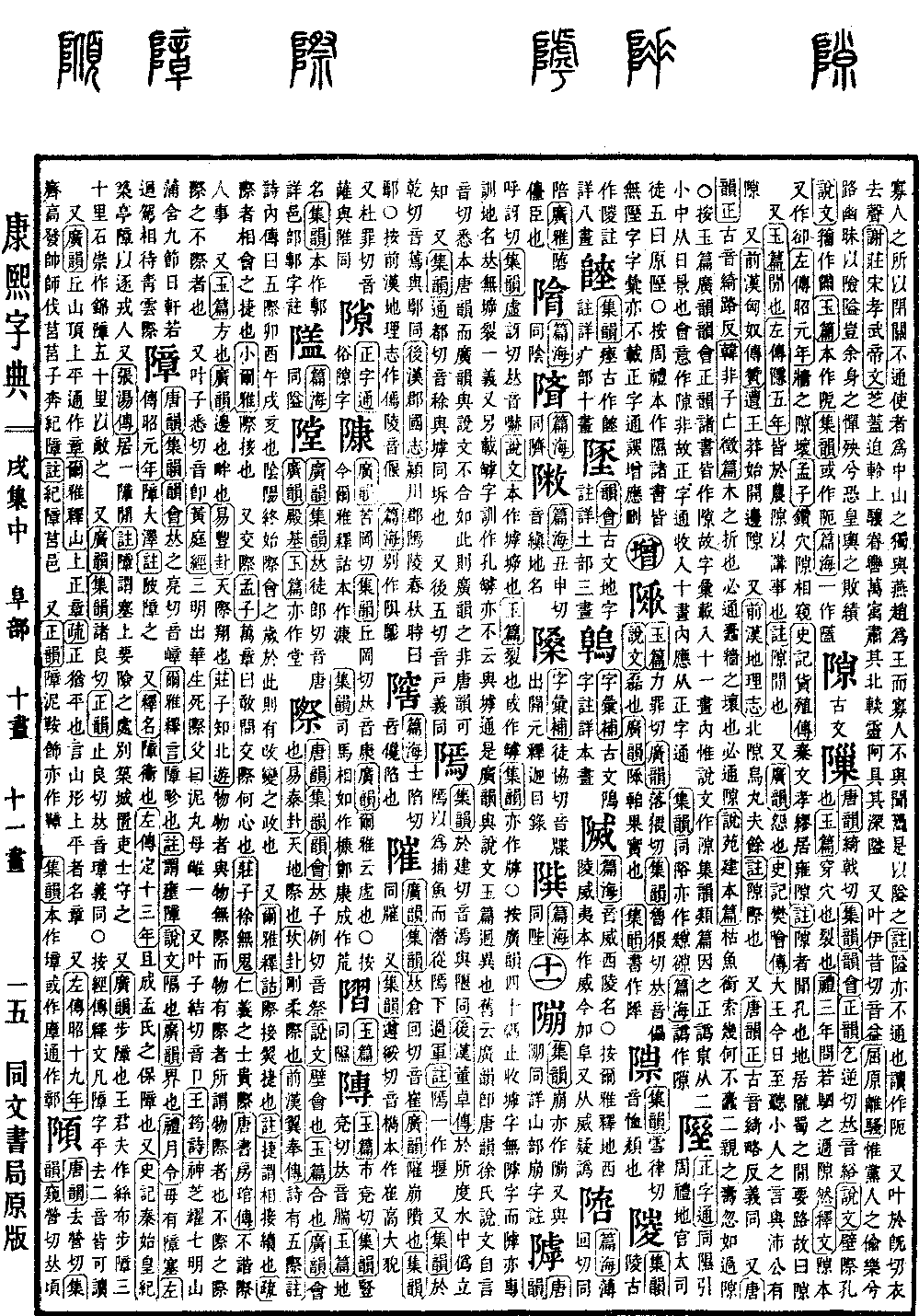
Xu Collection, Middle Volume; Radical: Mound (fù); Character: 障; Kangxi Strokes: 19; Page: 1359, Entry 29
According to Tang Rhymes (Tangyun), Collected Rhymes (Jiyun), and Rhyme Conventions (Yunhui), the character is read with the initial sound zhī and final sound liàng, pronounced like zhàng. The Erya (Erya), Explanations of Words, defines "障" as zhěn. The commentary explains it means to block or obstruct. Explanations of Graphs (Shuowen Jiezi) defines it as "to separate". Extensive Rhymes (Guangyun) defines it as "boundary". The Book of Rites (Liji), Monthly Ordinances, states, "There should be no obstructions or blockages." The Zuo Commentary (Zuozhuan), Duke Zhao, Year 1, mentions, "to block the great marsh." The commentary explains this means to build dikes to obstruct it.
Further, Explanations of Names (Shimíng) defines "障" as "to guard". The Zuo Commentary, Duke Ding, Year 13, says, "and become a safeguard for the Meng clan." Further, The Records of the Grand Historian (Shiji), Basic Annals of Qin Shi Huang, records, "constructing tingzhàng (outposts and barriers) to drive away the Rong people." Further, The Records of the Grand Historian, Biography of Zhang Tang, mentions, "residing between a zhàngsài (fortified border post)." The commentary explains "障" refers to strategic points on the border. Additionally, it involved building cities and stationing officials and soldiers to guard them. Further, Extensive Rhymes refers to bùzhàng (mobile screens). Wang Junfu made silk cloth bùzhàng thirty li long, and Shi Chong made brocade bùzhàng fifty li long, rivalling him.
Further, according to Extensive Rhymes and Collected Rhymes, the character is read with the initial sound zhū and final sound liáng. According to Correct Rhymes (Zhengyun), it is read with the initial sound zhǐ and final sound liáng, pronounced like zhāng. The meaning is the same. Note: In the commentaries of the classics, whenever the character "障" appears, both the level tone (píngshēng) and the departing tone (qùshēng) pronunciations can be used. Further, Extensive Rhymes refers to a flat mountaintop. It is interchangeable with zhāng. The Erya, Explanations of Mountains, states, "The upper part is zhèng zhāng." The commentary explains that zhèng is like píng (flat). It means a mountain whose top is flat is called zhāng. Further, The Zuo Commentary, Duke Zhao, Year 19, records, "Gao Fa of Qi led his army to attack Ju, and the ruler of Ju fled to Jizhàng." The commentary explains that Jizhàng was a city in Ju. Further, Correct Rhymes states that zhàngní (a type of saddle decoration) is an ornament for a horse saddle. It is also written as . Collected Rhymes states that the original form of the character is "墇". It can also be written as . It is interchangeable with "鄣".