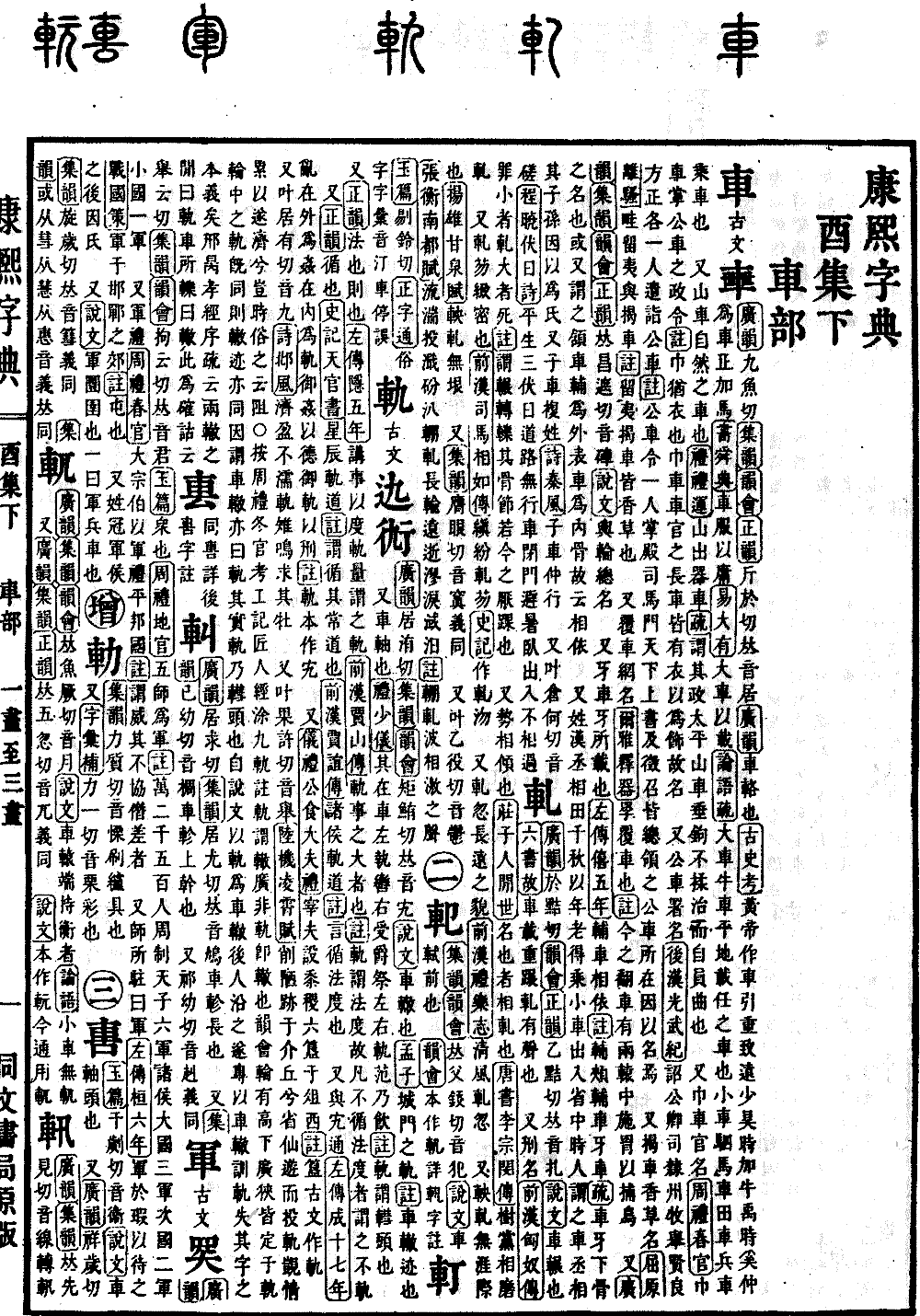
You Collection, Lower Volume
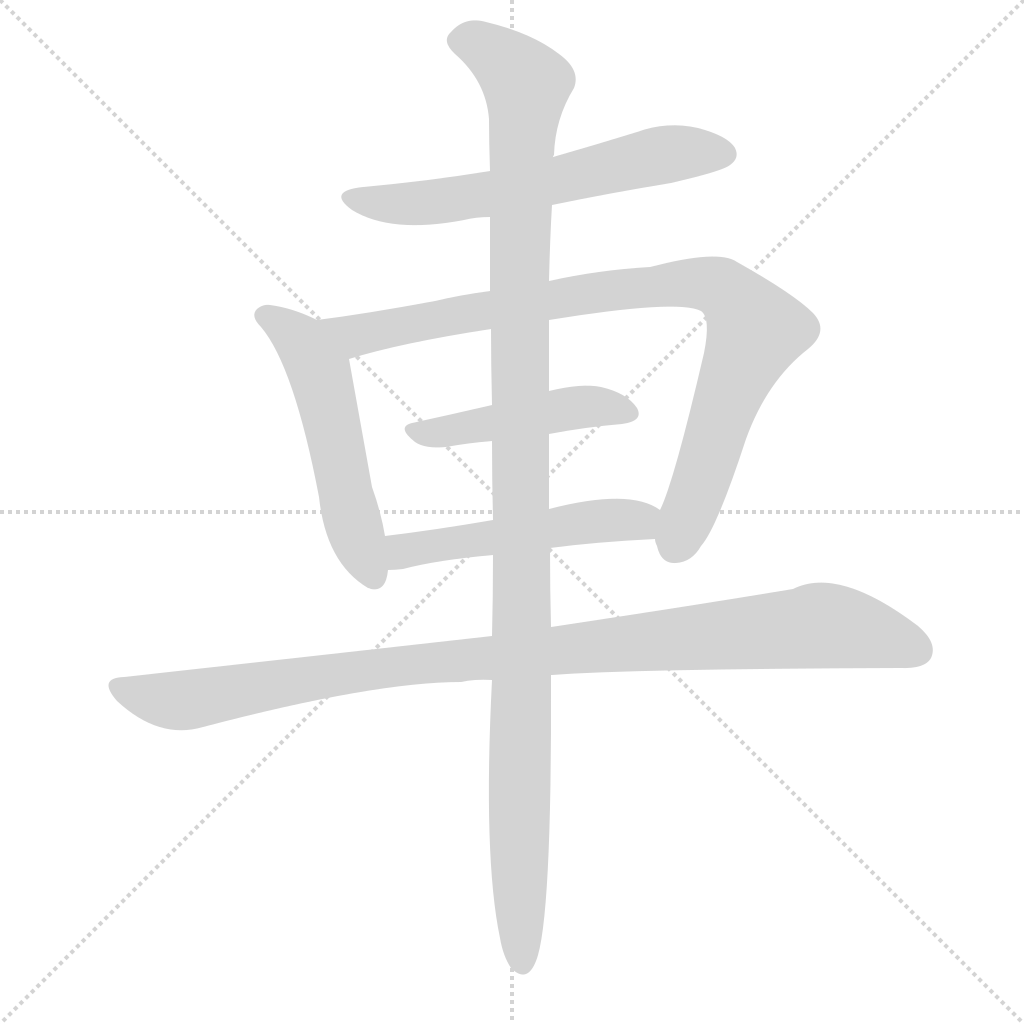
Radical: Carriage (chē)
Kangxi stroke count: 7
Page 1239, Entry 01
In the Expanded Dictionary of Sounds (Guangyun), the Book of Rhymes (Jiyun), the Collection of Rhymes (Yunhui), and the Correct Rhymes (Zhengyun), it is pronounced ju.
In the Expanded Dictionary of Sounds (Guangyun), it is described as a carriage (luche), which is a type of large vehicle.
According to the Examination of Ancient History (Gushi Kao), the Yellow Emperor created the carriage to transport heavy loads to distant places. During the reign of Shaohao, oxen were added to carriages to pull them, and during the time of Yu, Xizhong served as the Minister of Carriages (Chezheng), who added horses to the vehicles.
Book of Documents (Shujing), Canon of Shun: Carriages, horses, and clothing are used to reward meritorious service.
Book of Changes (Yijing), Great Possession hexagram: Using a large carriage to carry loads.
In the Annotations to the Analects (Lunyu Shu), a large carriage is described as an ox-cart, used to transport goods on flat land. A small carriage is drawn by four horses and includes carriages used for hunting, combat vehicles, and daily transportation.
There is also the mountain carriage, which is a naturally formed vehicle.
Book of Rites (Liji), Evolution of Rites (Liyun): Artifacts and carriages appear in the mountains.
The commentary notes that this refers to a time of great peace, where the hooks of the mountain carriages are naturally curved without the need for manual processing or refinement.
There is also the Jinche, which is an official title.
Rites of Zhou (Zhouli), Spring Offices: The Jinche oversees the administrative orders regarding public carriages.
The commentary notes that Jin refers to a covering like clothing. Jinche is the head of the carriage office, and because vehicles were adorned with decorative covers, it received this name.
There is also the Gongche, which is the name of a government office.
Book of the Later Han (Houhan Shu), Annals of Emperor Guangwu: A decree was issued to high ministers, the Chief of Metropolitan Police (Sili), and provincial governors to each recommend one person of integrity and rectitude to be sent to the Gongche office.
The commentary notes that there was one Director of the Gongche office who managed the Sima Gate of the palace. All petitions from the realm and imperial summons were managed by this office, and thus the office took its name from it.
There is also the Jieche, which is the name of an aromatic herb.
Qu Yuan, Encountering Sorrow (Lisao): Planting plots of Liuyi and Jieche herbs.
The commentary notes that both Liuyi and Jieche are aromatic herbs.
There is also the Fuche, which is the name of a net.
Erya, Explanation of Vessels (Shiqi): A Fu is a Fuche.
The commentary notes that this is the modern-day Fanche, which has two shafts with a net stretched between them to catch birds.
In the Expanded Dictionary of Sounds (Guangyun), the Book of Rhymes (Jiyun), the Collection of Rhymes (Yunhui), and the Correct Rhymes (Zhengyun), it is pronounced che.
According to the Explaining Graphs and Analyzing Characters (Shuowen), it is the collective term for the carriage box and the wheels.
There is also the Yache, which refers to the jawbone.
Zuo Tradition (Zuozhuan), Fifth Year of Duke Xi: The cheeks and the jawbone depend upon one another.
The commentary notes that Fu refers to the cheeks, and Che refers to the jawbone.
The sub-commentary notes that Che is the name for the mandible, sometimes also called the Hanche. The cheeks are the external part, and the jawbone is the internal bone, hence they depend upon one another.
There is also a surname. During the Han dynasty, the Chancellor Tian Qianqiu was allowed to enter the palace grounds in a small carriage due to his advanced age, and people of the time called him Chancellor Che. His descendants adopted Che as a surname.
There is also Ziche, a compound surname.
Book of Odes (Shijing), Odes of Qin: Ziche Zhongxing.
It also rhymes with cuo.
Cheng Xiao, Poem on the Dog Days of Summer: During the three dog days of summer in a lifetime, there are no carriages traveling on the road. Closing the doors and lying down to avoid the heat, people neither go out nor visit one another.
Also pronounced hong, the sound of many carriages.